What Should I Look for When Choosing a Chiropractor?
You are already in pain. You have already searched Google, scrolled through reviews, maybe asked a friend. You have a list of names in front of you and very little idea how to sort them. Every website says the same things. Every office looks professional enough. And none of it tells you what you actually need to know before you trust someone with your spine.
I have been in clinical practice since November of 1996. In that time I have seen patients hurt by the wrong choice, not because a chiropractor was careless exactly, but because the fit was wrong for the condition, the exam was incomplete, or the financial pressure outpaced the clinical judgment. I have also watched people heal in ways they had stopped believing were possible, once they found the right care.
This is what I would tell a friend who was standing at that crossroads right now.
The Three Things That Matter Most Before You Agree to Anything
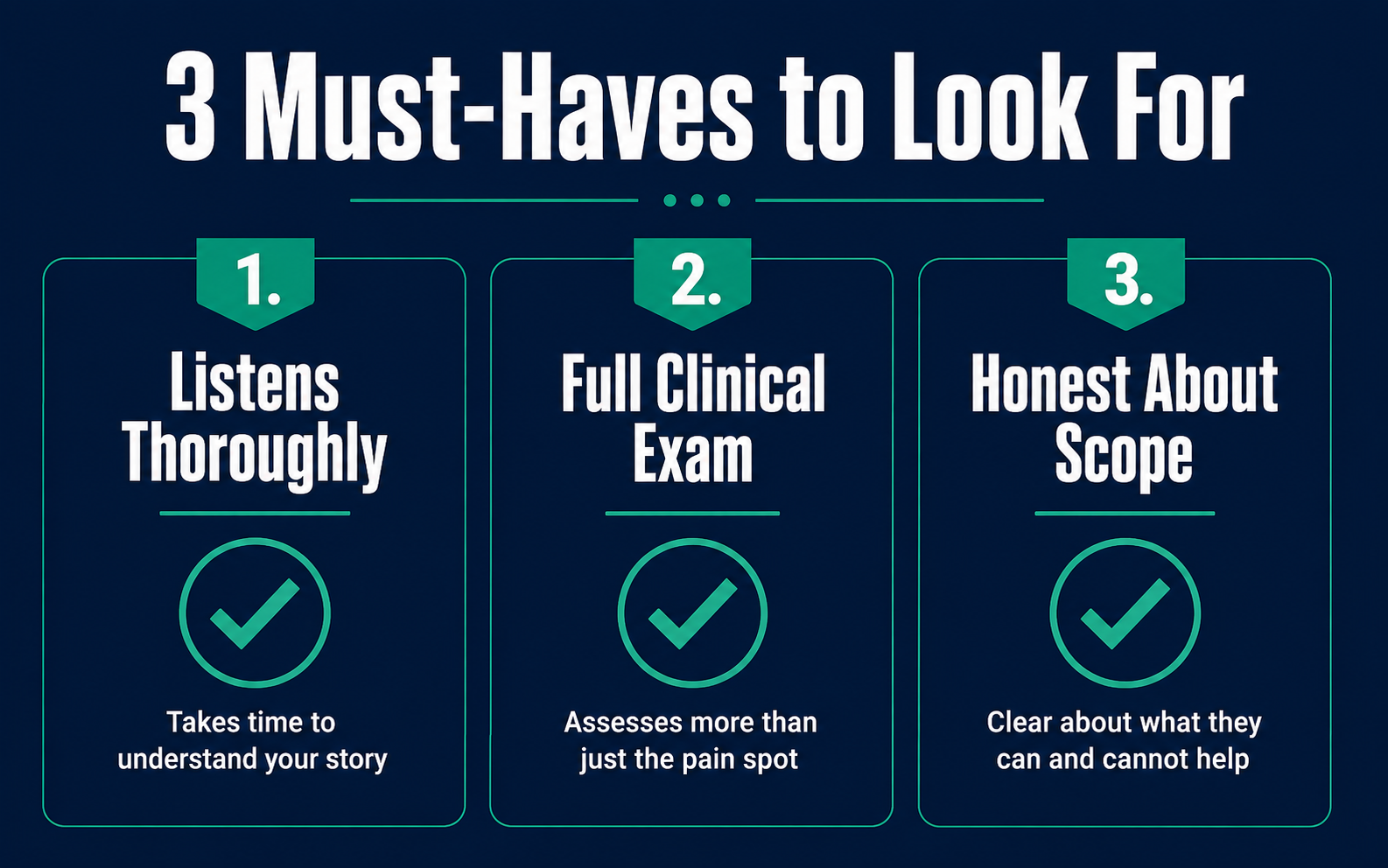
The first is whether the doctor actually listens. Not nods while waiting to talk. Actually listens. Your history, your symptoms, your daily life — that context is what separates good care from informed guesswork. If a chiropractor is rushing through your intake or moving toward adjustments before they know your story, that is a problem from the first visit forward.
The second is whether they do a real examination. Not a two-minute posture check. I mean orthopedic testing, neurological assessment, range of motion measurement, and imaging when it is warranted. You would not want a cardiologist treating your heart without an EKG. Your spine deserves the same standard. Research consistently supports structured clinical examination as the foundation of effective musculoskeletal care — and a thorough intake process is directly associated with better patient outcomes.
The third is whether they are honest about what chiropractic can and cannot do. The doctors I respect most in this profession are the ones who tell patients the truth, even when the truth is "you need something I can't fully provide." That kind of clinical honesty is rare, and it is worth everything when you find it.
The Red Flags That Should Stop You Before You Sign Anything
A treatment plan handed to you before the exam is finished is the first one I want you to know about. I have heard from patients who walked in with back pain and walked out with a signed 40-visit commitment before a single X-ray was reviewed. That is not clinical care. That is a sales process in a white coat.
High-pressure closing is the second. If you feel like you are sitting in a timeshare presentation instead of a doctor's office, trust that feeling. No one should be guilted or pressured into committing to care on visit one.
Third: no documentation, no objective findings, no explained reasoning. If a doctor cannot tell you what they found, why they are recommending what they are recommending, and what success looks like, you are flying blind. Patients have a right to informed consent. Not just a signature on a form — an actual conversation. The American Chiropractic Association's clinical practice guidelines reinforce that transparent communication and documented findings are professional standards, not optional extras.
And one more: be cautious of any chiropractor who never refers out. Nobody can fix everything. A doctor who acts like every condition fits their toolkit is either overconfident or not paying close enough attention.
The Mistakes Patients Make When They Are in Pain
The biggest one is choosing based on proximity and price. I understand it — life is busy and budgets are real. But closest and cheapest is not a clinical decision. You would not pick a surgeon that way.
The second is waiting too long and then picking whoever can see them fastest. Pain creates urgency, and urgency kills discernment. I have had patients come to me after a year or more of care somewhere else that made them worse — not because the other provider was careless, but because they were not the right fit for that patient's actual condition.
Third, people do not ask questions. They hear a plan and say okay because pushing back on a doctor feels awkward. That dynamic has to change. The right chiropractor welcomes your questions. If you feel like you cannot ask, that is information about the practice.
The Questions You Should Ask Before You Agree to a Treatment Plan
Start with this one: "What did you find in my exam, and what does it mean?" Ask them to explain it in plain language. If they cannot, or will not, that tells you something important.
Ask: "Why are you recommending this specific approach for my specific case?" Not the generic answer about restoring function. Your answer, based on your findings.
Ask: "What does success look like, and how will we measure it?" You need a target, not a hope.
Ask: "What happens if I do not respond to this approach?" A good doctor has already mapped that conversation out. They are not offended by the question. They are glad you asked.
And before you sign anything: "What is the full cost of care, what do I actually owe, and what is your cancellation or refund policy?" That question alone separates the transparent practices from the ones that make it hard to leave.
What Technology Should and Should Not Tell You About a Practice
Technology matters, but not in the way most people assume. A tool is only as good as the clinician using it — and the more important question is whether it is being used because it genuinely serves your care or because it looks impressive on a website.
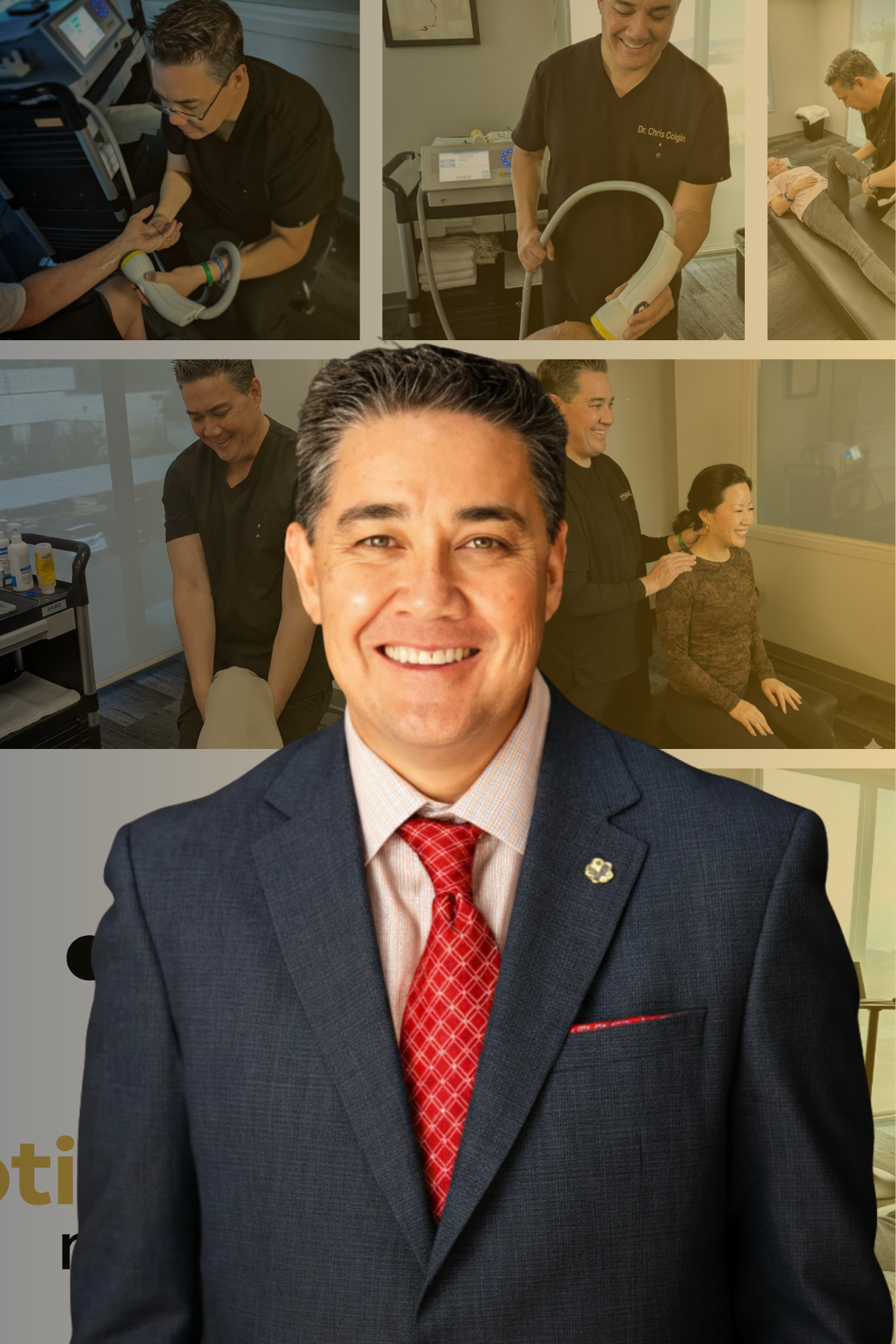
At Optimal Health Members, I invested in SoftWave Tissue Regeneration Therapy and robotic laser spinal decompression because I kept seeing patients who were not getting full results with traditional care alone. SoftWave therapy, a form of electrohydraulic shockwave technology, has demonstrated meaningful results in chronic musculoskeletal conditions — and I use it because it changes outcomes I could not fully change before.
Body composition testing also matters, especially in a practice like mine where weight and metabolic health are often part of the clinical picture. A scale number tells you almost nothing clinically. Knowing what a patient is actually made of, and tracking how that changes, is a different conversation entirely.
The honest answer is this: advanced technology in the hands of a thorough, experienced clinician is powerful. The same technology used as a marketing prop without clinical rationale is expensive furniture.
How I Ranked the Factors That Actually Predict a Good Outcome
When people ask me how to weigh everything — reviews versus credentials versus technique versus personality — here is how I would actually rank it:
Results. Did this doctor help people with conditions like yours? That is the question.
Experience. Pattern recognition, knowing when something does not fit, knowing when to refer — that comes from years in the room with patients. There is no shortcut for clinical time.
Thoroughness. How carefully do they examine, document, and explain? This single factor predicts outcomes more reliably than any specific technique.
Communication. You have to be able to say "this is not working" without feeling like you are causing a problem. If you cannot have that conversation, the relationship will not serve you.
Credentials and continuing education. It matters that they keep learning. Chiropractic and functional health have evolved significantly. Continuing education requirements exist precisely because the evidence base keeps developing, and you want a doctor who has evolved with it.
Technique. Relevant, but secondary. A skilled clinician adapts their approach to the patient. Dogmatic attachment to one technique is a limiting factor, not a credential.
Reviews. Useful context, but read them critically. Five-star reviews for a quick-adjustment mill do not tell you much about clinical depth.
Equipment. Valuable when clinically indicated. Not a substitute for skill or judgment.
What Actually Happens When the Right Doctor Finally Takes a Real Look
I want to tell you about a woman who came to me after being treated at another office for nearly a year. She had chronic low back pain. She was getting adjusted two to three times a week with minimal lasting relief. When I did a full workup, I found significant lumbar disc involvement that had never been properly identified or addressed. The previous care was not wrong exactly — but it was incomplete for her actual condition.
We got her into robotic spinal decompression and addressed significant inflammation through nutritional support. Within eight weeks, her pain levels dropped dramatically. She told me that no one had ever explained to her what was actually happening in her spine. Not once in a year of regular visits.
Lumbar disc conditions respond measurably better when treatment is matched to confirmed diagnosis — and that is the clinical difference between applying a treatment and actually understanding what you are treating. Her outcome changed because the approach changed. The approach changed because someone finally took the time to look.

My Honest Opinion on Cheap Adjustment Clinics Versus Complete Chiropractic Care
High-volume, low-cost adjustment clinics serve a population. If someone already has a confirmed diagnosis, knows their body well, and needs maintenance care — a quick adjustment a few times a month is reasonable. I am not here to dismiss that.
But for someone with a new complaint, an unresolved chronic issue, or anything involving neurological symptoms, that setting is not equipped to serve them well. The math does not work. At high volume and low margin, you do not have time for proper assessment. You cannot slow down. And when you cannot slow down, you miss things.
I have also seen low-cost clinics cause harm — not through careless intent, but through treating conditions that needed imaging first, or applying adjustments to patients with contraindications that a proper intake would have identified. The North American Spine Society's clinical guidelines are clear that imaging and diagnostic workup should precede certain interventions, and high-volume settings rarely have the structure to enforce that standard.
Pay for the exam. Pay for the time. Pay for the doctor who actually knows what they are looking at. That is not a luxury. That is basic due diligence when it comes to your spine.
What I Would Say to Someone Who Is Overwhelmed and Does Not Know Who to Trust
I would tell you what I would want someone to tell me.
Slow down just enough to ask one question before you commit: does this doctor actually see me, or are they running a process? The answer usually comes through in the first fifteen minutes if you are paying attention.
Do not let pain make the decision for you. Desperation leads to the wrong choices. You deserve a doctor who takes your history seriously, examines you properly, explains what they find, and gives you an honest picture of what is realistic.
Find someone who cares about your long-term health, not just your short-term symptoms. That distinction is what I have built my entire practice around. I want to know where you are in ten years — not just whether your back hurts less next week.
You are not just a spine case walking through a door. You are a person with a history, a life, and a future. Find the doctor who treats you like it.
If you are in Henderson or the Las Vegas area and you are ready for care that actually starts with a real examination, I invite you to reach out to Optimal Health Members at 702-541-9060. And if metabolic health, weight, or inflammation are part of what you are dealing with, learn more about our national online program at glpthreevegas.com