What Is Class 4 Laser Therapy, and How Does It Actually Help You Heal?
For a lot of people I meet, the day starts with a negotiation. You take something for the pain, you wait for it to kick in, and you get moving before it wears off. Then you do it again. If that sounds familiar, you already know the frustrating part. Nothing is actually getting better. You are just turning the volume down on a signal your body keeps sending. I want to talk about a tool I use every day in my office that works from the other direction, by helping the tissue itself heal. It is called Class 4 laser therapy, and after almost thirty years in practice I have a clear, honest picture of what it does, who it helps, and where the hype gets out of hand.
What Class 4 Laser Therapy Actually Does Inside Your Body
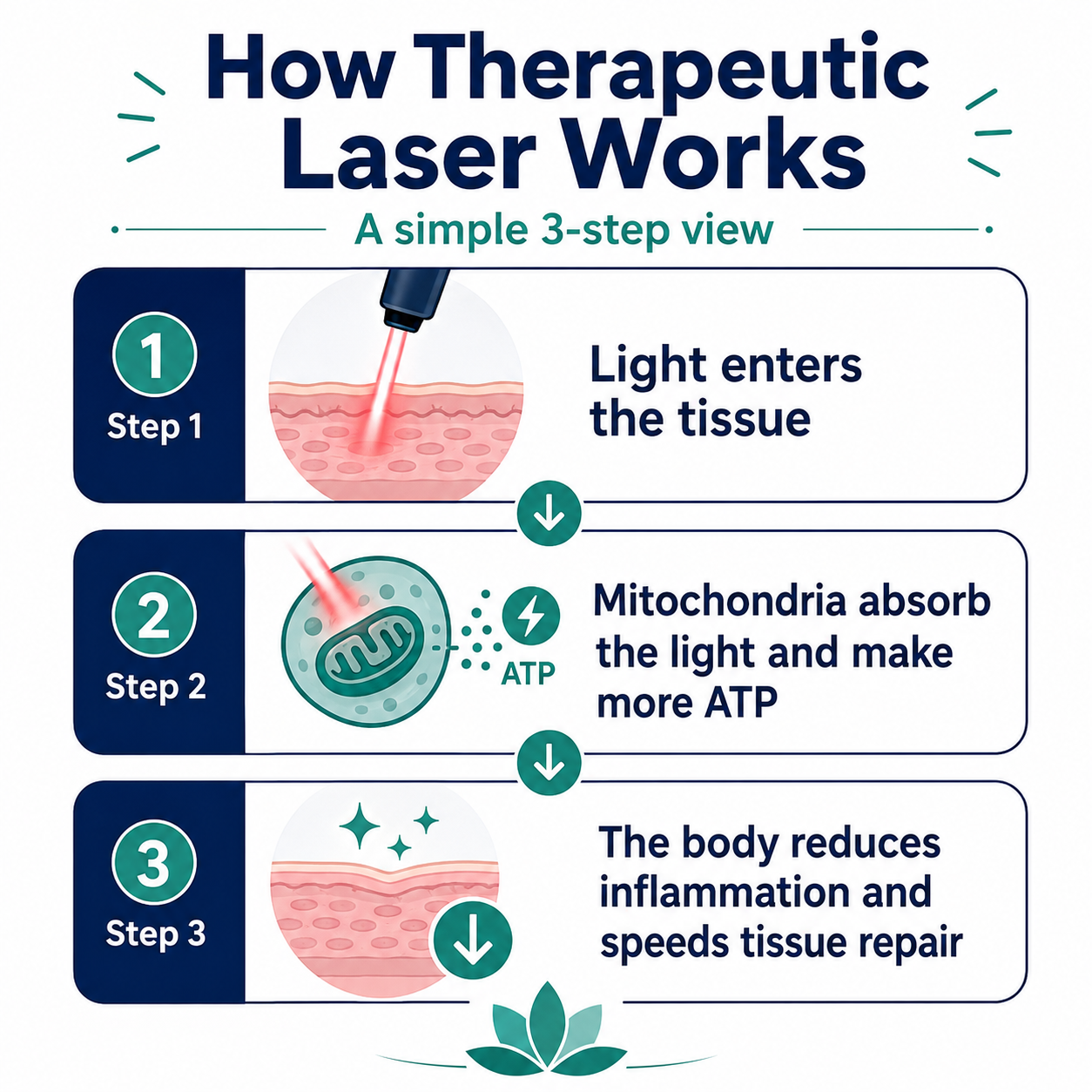
When a patient asks me what this thing is really doing, I keep it simple. The laser is putting concentrated light energy deep into the tissue, and your cells absorb that light much like a plant absorbs sunlight. Inside every cell you have tiny engines called mitochondria, and the light is absorbed there and prompts them to make more energy. When your cells have more energy to work with, they heal faster, inflammation calms down, and the pain signals quiet on their own. This process has a name, photobiomodulation, and the research shows it is used to reduce pain, ease inflammation, and help regenerate damaged tissue like tendons and wounds.
So this is not masking your pain the way a pill does. It is giving your body the fuel to fix what is actually wrong. That distinction matters to me, and it usually lands with people the moment they hear it. Most folks walk in picturing a laser that cuts or burns. Once they understand it is feeding the healing process, the whole thing makes sense.
The Conditions I Treat Most Often With Class 4 Laser
Most of what I treat with the laser is musculoskeletal, and that is also where the science is strongest. Low back pain and neck pain are the big ones, because that is what walks through my door every single day, and the research on laser therapy for chronic low back pain continues to grow. Beyond that, I use it for shoulders, knees, plantar fasciitis, and tendon problems like tennis elbow and Achilles issues, because the laser reaches deep tissue that surface treatments simply cannot touch. Plantar fasciitis in particular responds well, and controlled trials have shown laser therapy improving pain and function for that stubborn heel pain.
I also use it a lot for arthritic joints, muscle strains, and sports injuries where the goal is to speed recovery. With disc-related pain and some neuropathy cases, I will use it as part of a larger plan, and I am honest with people that those tend to be a longer road. After almost thirty years and a lot of extremity work, I have a good feel for which tissues answer the fastest, and I set expectations around that from the start.
Who Responds Best, and Who I Am Honest With
The people who respond best are the ones with real inflammatory or soft-tissue pain, whether it is a fresh injury or something chronic that just will not settle down. Acute problems often respond fastest, because you are catching the healing process early and helping it along. Someone with a cranky tendon or an irritated joint that has been nagging for months is usually thrilled with the results.
Where I get more cautious is when the pain is being driven by something the laser was never designed to fix, like a serious structural problem, or when there is a real contraindication. I do not run the laser over active cancer, I do not treat the abdomen or low back of a pregnant patient, and I stay off glandular tissue like the thyroid. And I will be straight with someone if their pain is coming from a lifestyle or metabolic driver. The laser helps, but it is not going to outrun what a person is doing to themselves at the dinner table. That is a bigger conversation, and I would rather have it honestly than pretend a light beam fixes everything.
A Patient Who Got Her Mornings Back
I had a woman in her late fifties with plantar fasciitis that had been dragging on for the better part of a year. She had done the boot, the orthotics, the stretching, and a cortisone shot that gave her a few weeks of relief before it wore off. She was at the point of just accepting she would hurt every morning for the rest of her life, and you could hear that resignation in her voice.
We started running the Class 4 laser on it a few times a week alongside some hands-on work on the foot and ankle. By the third or fourth visit she told me those first painful steps out of bed were not stopping her cold anymore. Within a few weeks she was walking her dog again without dreading it. Nothing flashy happened. We just gave the tissue what it needed to finally heal instead of staying stuck in that inflammation loop. Watching somebody get their normal life back is the whole reason I do this work.

What Treatment Actually Feels Like
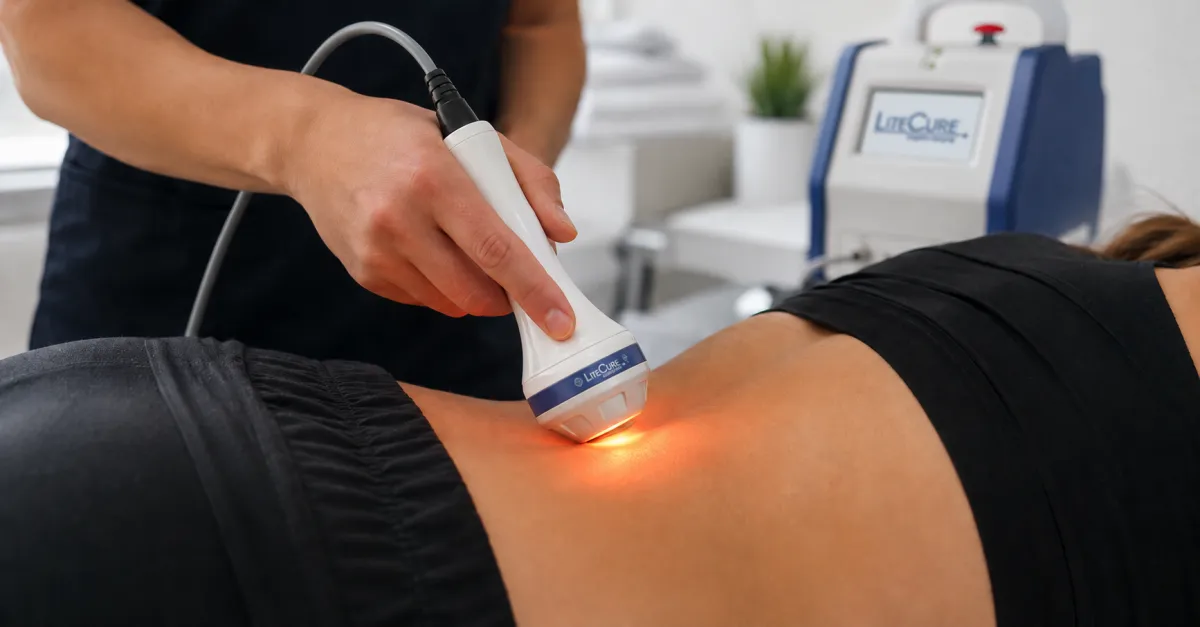
This is one of the questions people ask most, usually with a little worry in their voice. The honest answer is that most people feel a gentle, soothing warmth and that is about it. It is actually pleasant. A lot of patients relax right into it, and I have had more than a few nearly fall asleep on the table. On the deeper settings for a thick area like the low back or hip, the warmth is more noticeable, which is completely normal, and my job is to keep the handpiece moving so it stays comfortable the whole time.
There is no shock, no needle, and no downtime. Nobody is gritting their teeth through it. I tell folks up front that this is one of the easier things they will do all week, and they usually agree.
How Soon You Can Expect Results
It varies, and I am careful not to overpromise. Some people, especially with an acute injury, feel a real difference after one or two sessions. That happens, and it is great when it does. But I always give everybody the honest version, which is that this is cumulative. The laser builds on itself visit over visit, so most people need a series to get a lasting result, usually somewhere in the range of six to ten sessions depending on how deep and how old the problem is.
What I do not want is someone coming in once, feeling a little better, and assuming they are done. Healing takes reps. I would rather set that expectation clearly on day one than have someone quit halfway and decide it did not work, when the truth is they stopped short of the finish line.
Where Laser Fits in the Bigger Plan
The laser rarely rides alone. The way I practice, it is one tool inside a bigger plan, and it plays well with everything else we do at Optimal Health Members. I will pair it with a chiropractic adjustment to get the joint moving right, then use the laser to calm the inflamed tissue around it. It works beautifully alongside SoftWave therapy, since both are aimed at stimulating your body's own repair process from different angles. With my extremity work on shoulders, knees, and feet, the laser is a natural add-on to move the tissue along faster.
Here is something I have learned over the years about that repair process. The therapies we do in the office start the healing response, but your body has to carry that work forward between visits, and it needs the right cellular building blocks to do it. That is where a targeted support like RECOVER by AgeRecode earns its place. It is a regenerative peptide and antioxidant complex that gives the body raw material for collagen production, tissue repair, and managing inflammation during recovery. It is not a replacement for hands-on care. It is what helps the body finish the repair work between appointments, which is exactly why patients getting SoftWave, spinal decompression, or chiropractic treatment tend to benefit most from it.
And I am always going to tie all of this back to how you move, eat, and recover at home, because a treatment on my table only goes so far if the rest of your day is working against it. My whole philosophy is that no single therapy is the hero. The results come from stacking the right things together and staying consistent.
Why I Care More About Healing Than Silencing Pain
If there is one thing I wish more people understood, it is that pain is a messenger, not the problem. We have been trained by pill culture to shoot the messenger and call it a day. You take something, the pain goes quiet, you assume you are better, and really you have just turned down the alarm while the fire keeps burning underneath. Inflammation is your body's repair crew showing up. The goal is not to shut it off. The goal is to help it do its job and then move on, instead of letting it get stuck and turn chronic.
This one is personal for me. I lost my mom to heart disease, and I lost my younger brother to the same kind of thing two days before his forty-eighth birthday. So much of that traces back to chronic inflammation that nobody addressed until it was too late, and the link between long-term inflammation and cardiovascular disease is well established in the research. When I talk about healing instead of masking, I am not reciting a philosophy. I am telling you what I wish my own family had understood sooner. Chase the cause, support the healing, and stop settling for the volume knob.
Clearing Up the Biggest Myths About Laser Therapy
The number one thing people get wrong is picturing a laser that cuts or burns, like something out of a surgery or a movie. This is the opposite of that. It is therapeutic light, it is non-invasive, and the mechanism is photochemical, not thermal. Nothing gets cut and nothing gets burned.
The second misconception is that it is only for pro athletes. Athletes use it because it works and it gets them back on the field fast, but the same benefit applies to a grandmother with a sore knee or a warehouse worker with a bad back. The third one comes up in my office specifically, because we also offer red light therapy. People assume a Class 4 laser is the same as a red light panel. They are cousins, not twins. Red light is wonderful for the skin and surface-level recovery, but it does not have the power to drive deep into a joint or the spine. The Class 4 laser does.
The last one is the folks who write it off as a gimmick. I understand the skepticism, I really do, but there are thousands of studies on photobiomodulation and it is FDA cleared for pain. This is not hype. It has earned its place.
My Honest Take After Using It Clinically
Honestly? I am a fan, and I do not say that lightly, because I only put my name on things I actually use and believe in. Where the Class 4 laser shines is soft-tissue and joint pain, inflammation, and speeding up recovery, and it does that without drugs or downtime, which fits everything I stand for as a chiropractor who has spent three decades pushing natural, non-invasive care.
Where people should be careful is the marketing. There are companies out there throwing around words like cure and permanent and miracle, and that kind of talk makes me cringe, because it sets patients up for disappointment and it is just not honest. The laser is powerful, but it is a tool inside a plan, not magic. When you are choosing a provider, look for someone who treats it as part of comprehensive care instead of a standalone money machine, someone who runs it in a proper laser-safe setup with eye protection, and someone who is willing to tell you the truth about whether you are even a good candidate. If a provider promises you the moon after one visit, walk out. Real healing has never worked that way.
If you are in Henderson or the greater Las Vegas area and you are tired of managing pain instead of resolving it, I would be glad to take a look and tell you honestly whether Class 4 laser therapy is a good fit for what you are dealing with. You can learn more about how we work at Optimal Health Members, and if it makes sense, we will build a plan around getting you back to your life.