How Phone Use Is Wrecking Your Spine
You wake up with a stiff neck. By midafternoon there’s a knot between your shoulder blades that won’t let go, and by evening a headache has crept up from the base of your skull. You blame your pillow, your stress, maybe your age. In nearly 30 years of practice, I can tell you the more likely culprit is sitting in your hand right now.
Tech neck is what happens when your head spends hours a day tipped forward over a phone, tablet, or laptop. It doesn’t announce itself all at once. It builds quietly, and by the time it hurts, your body has usually been compensating for years. Here’s what I see in my office every week, what most people get wrong when they try to fix it, and what actually helps.
Quick Answer: What is tech neck?
Tech neck is strain on the neck and upper back caused by looking down at screens for long periods. Tipping your head forward multiplies the load on your cervical spine. In my practice, it rarely shows up as just neck pain. It usually arrives as headaches, a knot between the shoulder blades, or tingling in the hands.
Key Takeaways
At a 60 degree forward bend, the effective load on your neck can approach 60 pounds, according to published biomechanics research.
Forward head posture is linked in research to reduced breathing capacity, not just neck pain.
Stretching the sore spot without strengthening the deep neck muscles usually brings only short-term relief.
Changing position every 20 to 30 minutes matters more than holding “perfect” posture.
Bringing your phone up to eye level is the single most effective daily change I give patients.
What Happens to Your Spine When You Look Down at Your Phone
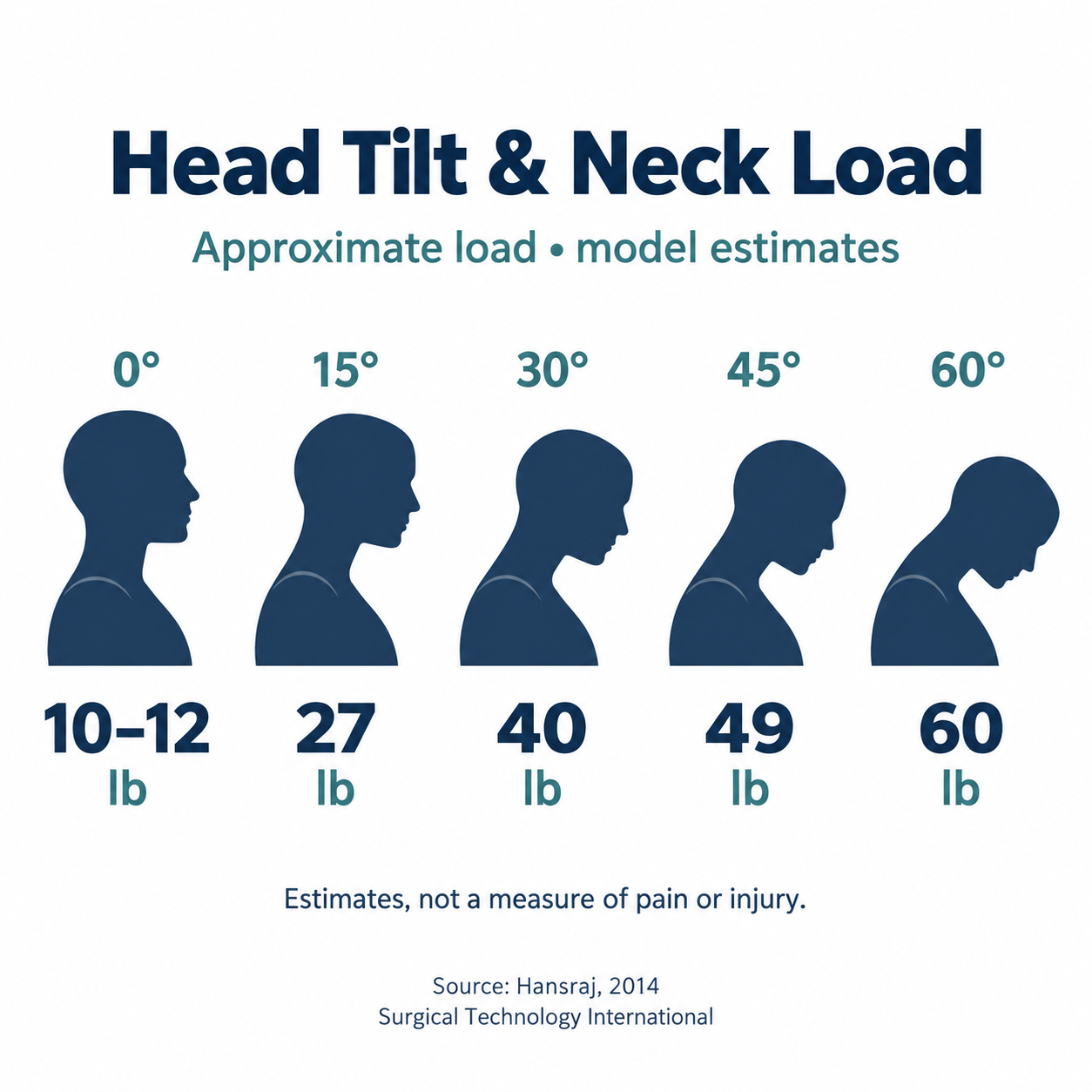
Your head weighs roughly 10 to 12 pounds, about the same as a bowling ball. When it sits balanced over your shoulders, your spine carries it without much effort. Tip it forward and the math changes fast. A biomechanics study by Dr. Kenneth Hansraj estimated that at a 60 degree forward bend, the effective load on the cervical spine approaches 60 pounds. That’s the angle most people hold while scrolling.
Now multiply that by four, five, or six hours a day. The muscles along the back of your neck get overworked and tight because they’re holding that weight up. The small muscles in the front of your neck, the ones meant to stabilize your head, get weak because they’ve been handed nothing to do. Over time, the natural curve of the neck starts to flatten, and in some patients I see it begin to reverse.
I explain it to patients this way: that curve is your shock absorber. When you lose it, the discs and joints in your neck start taking stress they were never designed to carry. When I look at a neck X-ray that has gone straight or reversed, I’m not just looking at a picture. I’m looking at a habit.
Tech Neck Rarely Shows Up as Neck Pain
Most people who walk into Optimal Health Members never say, “I think I have tech neck.” They come in with headaches that start at the base of the skull. They come in with a knot between the shoulder blades they’ve been trying to massage out for months. Some come in convinced they have carpal tunnel because their fingers tingle at night.
They think the problem lives where it hurts. What I’m watching is how they sit down in the chair. Before I ever put a hand on them, I can usually see it: the head drifting out in front of the shoulders, the upper back rounding, and the chin pushing forward so the eyes stay level. Pain is usually the last chapter of a story that started years earlier.
Why Tech Neck Affects Your Headaches, Breathing, and Sleep
This is the part most people don’t expect. The upper neck is home to nerves that connect directly into the head, and irritation there can refer pain upward. Cervicogenic headache, a headache that originates in the neck, is a recognized diagnosis, and it often gets mistaken for a tension headache or migraine. When a patient tells me their headache wraps from the back of the head toward the eye on one side, the first place I look is the top of the neck.
Breathing is affected too. A study in the Journal of Physical Therapy Science found that forward head posture changed the shape of the rib cage and was associated with lower lung function measurements than a neutral head position. In the office, I see patients who have quietly become shallow chest breathers. Many of them describe feeling wired and tired at the same time, and they’ve never connected it to how they hold their head.
And when your neck is tense all day, it doesn’t magically relax at night. A lot of my tech neck patients tell me they can’t find a comfortable sleeping position. I tell them plainly: your posture affects how you breathe, how you sleep, and how you feel at 3 p.m. This is not a cosmetic problem.
The Mistake I See Most: Stretching the Part That Hurts
When people try to fix tech neck at home, they almost always go after the sore spot. They pull on their neck, roll it, crack it themselves, and feel better for about twenty minutes. Then it’s right back.
Here’s why. The tight muscles in the back of your neck are usually tight because they’re losing a tug-of-war. They’re holding up a heavy head that’s hanging forward all day. Stretching them more doesn’t change why they’re working so hard. The real fix is waking up the muscles that are supposed to be helping. Research on deep cervical flexor training in regular computer users showed improvements in forward head posture and neck pain when those deep stabilizing muscles were trained.
The other mistake is the posture brace worn all day. I understand the appeal. But a brace does the work your muscles should be doing, and muscles that aren’t asked to work get weaker. I would much rather you build the strength to hold yourself up than buy something that holds you up for you.
Why I Don’t Chase Perfect Posture
This may surprise you coming from a chiropractor, but I don’t think “perfect posture” is the goal, and I think my profession and the wellness world oversell it. No human sits like a statue all day, and trying to lock yourself into one rigid position creates its own problems.
The real enemy is staying in any one position too long. I tell patients that your best posture is your next posture. I’d rather you change positions every 20 to 30 minutes in a so-so posture than sit “perfectly” for three straight hours.
I’ll say one more thing that not everyone in my field likes to say out loud. An adjustment alone will not fix tech neck if you go home and spend six hours with your chin on your chest. Care starts the correction. Your daily habits decide whether it holds.
Tech Neck Is Showing Up Younger Than Ever
When I started practicing in 1996, a teenager with a flattened neck curve was unusual. Today I see it regularly in kids, college students, and young professionals. They’re on screens for school, for friends, and for entertainment, and nobody ever taught them how to hold their body while they do it.
That concerns me. A young spine is still developing, and the habits set early tend to stick. I’m not anti-technology. I’m pro-awareness. When parents ask me what to do, my first suggestion is simple: watch how your child sits for ten minutes while they’re on a device. Don’t correct them yet. Just watch. You’ll learn more from those ten minutes than from anything you read online.

How We Treat Tech Neck at Optimal Health Members
Care starts with finding out what’s actually going on, not guessing. We look at how you stand and move, check your range of motion, and when it’s warranted, use imaging to see what’s happening with the curve of your neck. I want to know whether we’re dealing with muscle tension, joints that have stopped moving well, nerve irritation, or all three.
From there, care usually combines chiropractic adjustments to restore motion to the joints that have gotten stuck, soft tissue work, and therapies like Class 4 laser and SoftWave to support tissues that have been under strain for years. Then comes the part I consider most important: I teach you what to do at home. Specific strengthening for the deep neck muscles and upper back, plus changes to how you use your devices. My goal is for patients to leave understanding their own body, not depending on me forever.
Tissues that have been overloaded for years need support to finish their repair work, and that work doesn’t stop when you leave the office. For patients going through adjustments, laser, or SoftWave, I often recommend RECOVER™, a peptide and antioxidant complex with BPC-157, GHK-Cu, and carnosine designed to support the body’s natural tissue repair and collagen production between visits. It isn’t a replacement for hands-on care. The therapies in the office start the process, and RECOVER™ helps support it in the days between. If you take a blood thinner or are pregnant, talk with your provider before starting it.
Simple Changes I Give Every Patient
These are the same instructions I give in the treatment room, and they cost nothing.
Bring the phone up to your eyes. Don’t bring your eyes down to the phone. If you only change one thing, change this.
Support your arm. Prop your elbow on your other hand, a table, or the arm of a chair so holding the phone up doesn’t tire you out.
Raise your screen. Set your laptop or monitor so the top of the screen sits roughly at eye level. The Mayo Clinic’s office ergonomics guidance offers a helpful setup checklist.
Move every half hour. Set a reminder. Stand up, roll your shoulders back, look at something across the room.
Practice chin tucks. Gently draw your chin straight back, as if you’re making a double chin, and hold for a few seconds. Repeat several times a day. It feels silly. It works.
And here’s one most people never think about: notice the first moment of your day that you pick up your phone. For many of my patients, it’s before their feet hit the floor, curled up in bed with their neck bent at its worst angle. That’s a habit worth breaking first.
If You’ve Been Ignoring Your Neck for Years
It’s not too late, and you are not broken. I’ve worked with patients in their 60s and 70s who made real changes once they understood what was happening and committed to the work. The body is designed to heal. I’ve believed that my entire career, and I see it confirmed in my office every week.
But neck pain that keeps coming back is your body asking for attention, and ignoring it usually means it gets louder. You don’t need to fear it, and you don’t need to just live with it. You need someone to take the time to find the cause.

Let’s Find Out What Your Neck Is Telling You
If you’re in Henderson or the Las Vegas area and your neck, shoulders, or headaches have been asking for attention, I’d be glad to take a look. We’ll find out what’s driving it, and I’ll show you exactly what you can do about it at home. You can learn more or schedule a visit at Optimal Health Members.