
Sustainable Weight Loss: Why Quick Fixes Don't Work
If you have lost the same twenty or thirty pounds more than once, I want you to hear this first: that is not a willpower problem. That is a strategy problem.
I have been in practice for almost thirty years here in Henderson, and I have sat across from more patients than I can count who came to me after a crash diet, a shake program, or a trendy cleanse worked for a few weeks and then quietly stopped working. The weight came back. Sometimes it came back with a little extra. They walked in blaming themselves. Almost none of them needed to.
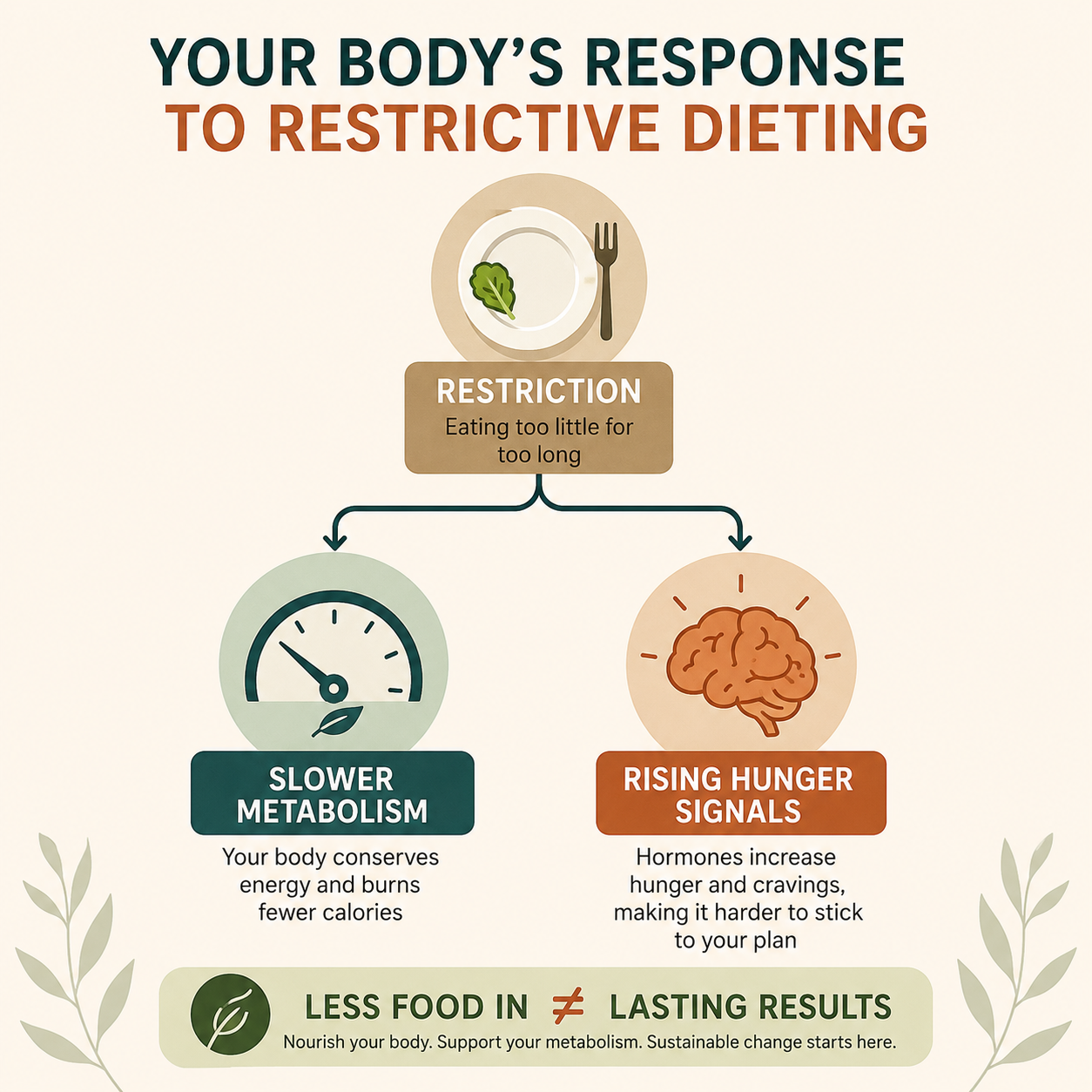
Quick Answer: Quick fix diets fail because they focus only on cutting calories while ignoring the hormones, sleep, stress, and muscle mass that actually control long-term weight regulation. Extreme restriction triggers your body's survival response, slowing metabolism and increasing hunger signals, which is why the weight often returns once the diet ends. Sustainable weight loss works with your biology instead of against it, addressing the root causes so results actually last.
Key Takeaways
Rapid weight loss triggers metabolic and hormonal changes that make regain more likely once the diet ends, according to NIH research on metabolic consequences of weight reduction.
After weight loss, rising hunger signals from hormones like ghrelin tend to drive regain more than a slower metabolism does, per findings reviewed in the National Library of Medicine.
Chronic stress and elevated cortisol are directly linked to increased abdominal fat storage and insulin resistance, according to research published via the National Library of Medicine.
Diet plays a larger role than exercise alone in long-term weight regulation, based on findings from Harvard T.H. Chan School of Public Health.
Sustainable programs that address hormones, sleep, and stress alongside nutrition produce results patients are far more likely to keep.
What I See Most When Patients Walk In After a Quick Fix
Almost every time, the pattern looks the same. Someone lost weight fast, felt hopeful, and then watched it come back, often with a little more waiting for them on the other side. That is not bad luck. It is physiology working exactly the way it is designed to work under threat.
When you cut calories drastically, your body reads that as a genuine emergency, not a lifestyle choice. It responds the way it has responded for as long as humans have existed: it slows down to protect you. Researchers describe this as metabolic adaptation, and the NIH's clinical review on the metabolic consequences of weight reduction lays it out clearly. Weight loss produces real physiological changes in energy expenditure and hormone signaling, and those changes favor regain once the restrictive phase ends.
Here is the part most people never get told. The bigger driver of regain usually is not a slower metabolism. It is hunger. After weight loss, appetite-regulating hormones shift in a direction that makes you want to eat more, and research reviewed through the National Library of Medicine on leptin and ghrelin shows that ghrelin, the hormone that signals hunger, tends to rise after weight loss while leptin, the hormone that signals fullness, tends to fall. Your body is not sabotaging you out of spite. It is doing exactly what it was built to do when it senses scarcity.
I have had patients tell me they lost the same thirty pounds four or five times over the years. Once they understand this is biology and not a character flaw, something shifts in how they approach the next attempt.
Why Do Quick Fixes Fail Even When They Technically Work at First?
Because most of them solve for one variable, calories in versus calories out, while ignoring everything else that actually determines whether your body wants to hold onto weight or let it go.
You can lose weight on almost any sufficiently restrictive plan for a few weeks. I am not disputing that. But if the underlying reason your body is holding onto weight has not been addressed, whether that is insulin resistance, chronic stress, poor sleep, or hormonal imbalance, you are fighting your own biology the entire time you are on the plan. The moment the extreme structure ends, your body returns to the pattern it knows.
Chronic stress deserves particular attention here, because I see it constantly in my Henderson patients balancing work, family, and everything in between. When cortisol stays elevated over time, research published through PubMed shows it promotes fat storage specifically in the abdominal region, since visceral fat tissue has a higher concentration of cortisol receptors than fat elsewhere in the body. Chronically high cortisol also worsens insulin sensitivity, which compounds the problem. You can eat perfectly and still struggle if this piece is ignored.
This is why two people can follow the exact same diet and get completely different results. One of them might have a stress and sleep picture working against her. The other might not. Treating them identically was never going to work.
What Does "Sustainable" Actually Mean?
Sustainable does not mean slow for the sake of slow. It means the plan is something you could keep doing, in some form, for the rest of your life without dreading it.
I tell patients directly, if a plan does not survive a Tuesday night dinner with your family or a genuinely stressful work week, it was never going to hold up long term. Life does not pause while you try to get healthy. A sustainable approach is built around your actual metabolism, your actual schedule, and your actual life, not a rigid 21-day program that assumes none of that exists.
This is also where hormones and metabolism come back into the conversation, because insulin, cortisol, thyroid hormones, leptin, and ghrelin all regulate hunger, fat storage, and energy in ways that go far beyond willpower. When those systems are working against you, no amount of discipline on food alone produces lasting results. When they are supported properly, the results tend to hold.

A Patient Story: Breaking the Cycle for Good
I had a patient, a woman in her late 40s, who came to me after trying nearly everything. Keto, juice cleanses, one of those meal replacement shake programs. She told me she had lost and regained weight so many times that she no longer trusted her own body.
We did not start with another restrictive food list. We started with ChiroThin alongside a real look at her sleep and stress levels, because her cortisol pattern was working directly against her progress. Within a few months she was down significantly. But the part that mattered more came a year later. She had kept it off. The difference was not more discipline. It was treating the whole picture instead of just the number on the scale.
I think about her often, because her story is not unusual. It is the norm for patients who have failed at weight loss multiple times, once someone finally looks past the calorie count.
The Role of GLP THREE in a Non Quick Fix Approach
For patients who need additional metabolic support, especially those whose hormone regulation has been working against them for years, I recommend GLP THREE. It is built around supporting your body's own metabolic and hormonal systems rather than forcing rapid change through extreme restriction alone.
I am always honest about this with patients. GLP THREE works best paired with real lifestyle changes, not as a replacement for them. It is a tool that can make the metabolic piece more achievable, not a shortcut around the work of building sustainable habits. I recommend it selectively, for the right patient at the right point in their process, and I say that directly rather than treating it as a solution for everyone who walks through the door.
What I Tell Patients Who Are Frustrated and Want Faster Results
I never dismiss that frustration. It is real and I understand it. But I ask patients to consider how long it actually took for the weight to accumulate. Usually it is years, not weeks. So why would we expect the body to safely reverse that in a matter of days?
I would rather see someone lose weight steadily over several months and keep it off permanently than watch them lose it in three weeks and land right back where they started by summer. Fast weight loss and lasting weight loss are usually two separate goals, and in most cases you have to choose one.
This connects to something the exercise research consistently shows too. A study cited by Harvard T.H. Chan School of Public Health found that diet, not activity level, was the strongest predictor of obesity rates across dramatically different populations and lifestyles around the world. Exercise is essential for health and for maintaining results, but it was never designed to be the primary lever for significant weight change, and treating it that way sets people up for disappointment.
The Biggest Myths I Wish More People Understood
The biggest one is that weight loss is purely a math equation, calories in versus calories out, and if you are not losing weight you simply are not trying hard enough. That framing ignores hormones, sleep, stress, gut health, and muscle mass entirely, and it leaves people blaming themselves for outcomes that were never fully in their control.
The second myth is that all calories are treated identically by the body. They are not. The third is that exercise alone will create significant weight loss. It will not, at least not reliably. A systematic review published through the National Library of Medicine found that isolated aerobic exercise, without dietary change, produced only modest weight loss and was not an effective standalone weight loss therapy, though it remained valuable when combined with nutritional changes and for overall health.
People carry a lot of unnecessary guilt over these myths. I would like to see more of that guilt replaced with accurate information.
How I Build a Sustainable Plan Instead of Handing Over a Diet Sheet
I start by asking questions most other providers skip. How are you sleeping? What does your stress actually look like day to day? What has worked or failed for you before, and why do you think it failed?
I am looking for root cause, not a generic calorie target. From there we build the plan in layers. We usually address the metabolic piece first, with something like ChiroThin or GLP THREE if it fits the patient, while simultaneously working on sleep and stress, because those two factors undermine everything else if they are left unaddressed. It is personalized care, not a one-size-fits-all printout.
If You Have Failed at Weight Loss Before, Here Is What I Want You to Know
Your previous attempts were not proof that you cannot succeed. They were proof that the previous approach did not fit your body.
I have watched patients who were convinced something was fundamentally broken in them finally get sustainable results once we addressed the actual underlying issues instead of cutting calories harder. Your body is not working against you out of spite. It is following its programming, the same programming that has protected humans through scarcity for thousands of years. Once we understand that programming and work with it instead of against it, real and lasting change becomes possible. I have seen it happen more times than I can count, and there is no reason it cannot happen for you too.

Ready to Build Something That Actually Lasts?
If you are tired of losing the same weight over and over, the plan probably was not the problem with you, it was the wrong plan. At Optimal Health Members, we look at the whole picture, hormones, sleep, stress, and metabolism, not just the number on the scale. For patients who need additional metabolic support, we also offer GLP THREE as part of a personalized, honest approach. Reach out to our Henderson office and let's talk about what a plan built for your actual body and your actual life could look like.