SoftWave Therapy vs Steroid Injections for Pain Relief
If you've got a steroid injection scheduled for tendon or joint pain, or you already had one and the relief didn't last, you're not alone, and you're not doing anything wrong. You're just working with incomplete information, and that's what I want to fix.
Quick Answer: Steroid injections reduce pain and inflammation quickly but don't repair damaged tissue, and relief often fades within weeks to months. SoftWave shockwave therapy works more slowly, usually over five to six sessions, but stimulates the body's own healing response and has shown better long-term outcomes in research on conditions like tennis elbow and plantar fasciitis. The right choice depends on how long you've had the problem and what you need right now.
Key Takeaways
Corticosteroid injections calm pain and inflammation but do not rebuild tendon or cartilage tissue, and a systematic review and meta-analysis of chronic lateral epicondylitis found shockwave therapy showed inferior results at one month but superior outcomes at three and six months compared to steroid injection.
Repeated cortisone injections can weaken nearby tendons and make them more prone to tearing, and healthcare providers typically limit how many injections a single joint can receive because of concerns about cartilage damage.
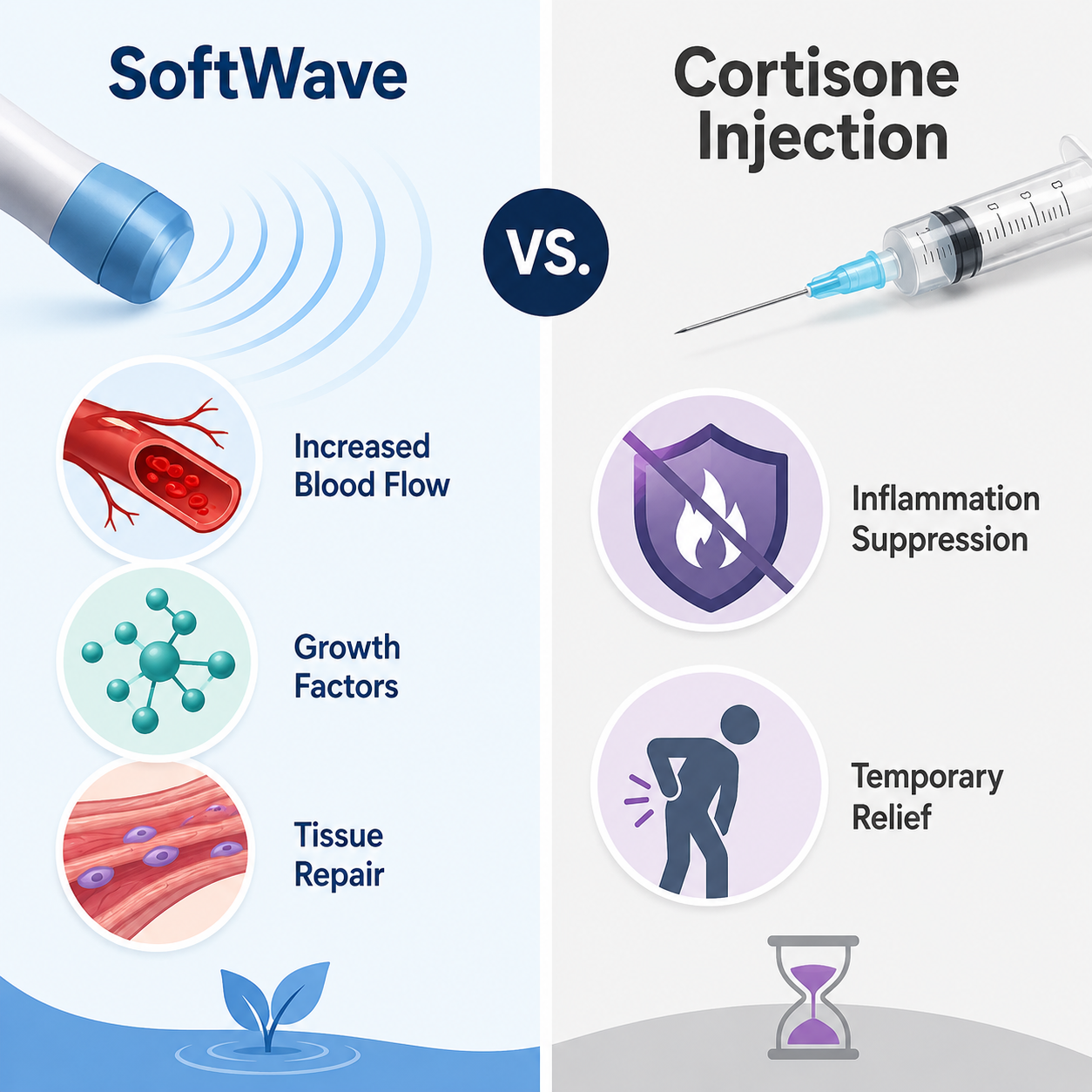
SoftWave stimulates neovascularization and growth factor release rather than suppressing the inflammatory response, which is a fundamentally different mechanism than a steroid shot.
Chronic, degenerative conditions tend to respond best to SoftWave, while acute, severe flares sometimes call for an injection.
Cost per lasting result, not cost per visit, is the number that actually matters when comparing the two.
When a Cortisone Shot Feels Like the Only Option
By the time a patient tells me they've got a cortisone shot booked, or they just had one that didn't hold, they're usually in that place where they just want the pain to stop. I understand that completely. Most have already tried rest and over the counter anti-inflammatories, and someone told them an injection was the next logical step without explaining what it actually treats.
Here's the honest answer. It treats inflammation and pain signaling. It does not treat the underlying tissue damage causing the pain in the first place. I'm not against steroid injections. They have a real place in medicine. But I want every patient making that choice with full information, not because it was presented as the only door open to them.
What SoftWave Actually Does That an Injection Doesn't
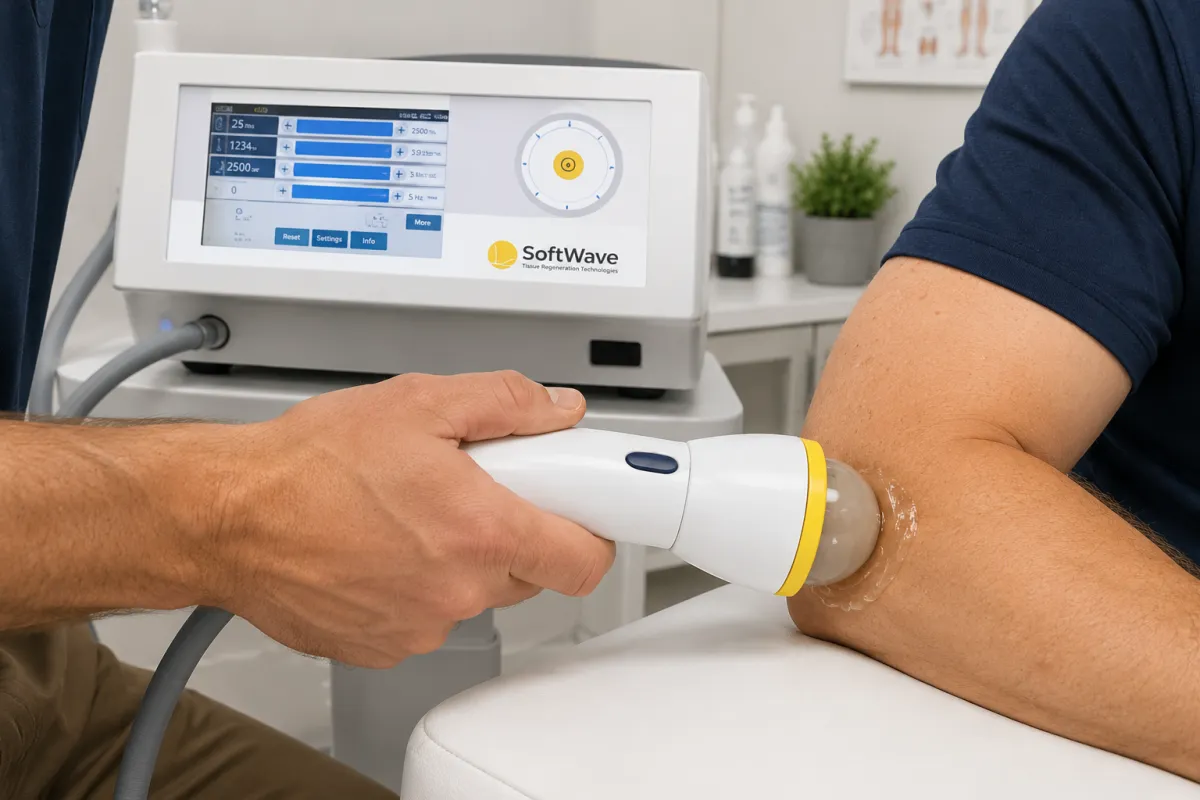
SoftWave uses unfocused shockwave technology to send acoustic pulses into damaged tissue. That stimulates the body's own healing response at a cellular level. It increases blood flow, triggers the release of growth factors, and kickstarts neovascularization, the formation of new blood vessels that supports tendon repair, in tissue that's been chronically under-supplied.
A steroid injection works differently. It floods the area with a synthetic anti-inflammatory that suppresses the immune response and quiets pain signaling. It doesn't rebuild anything. The tissue underneath is often exactly the same as before the shot, and sometimes worse, because inflammation is part of how your body initiates repair in the first place. Repeated steroid use can interfere with that process. If you want to learn more about how we approach regenerative, tissue-focused care at our practice, you can visit Optimal Health Members.
What the Research Shows Over Time
This is where the conversation gets real. Comparative studies looking at conditions like plantar fasciitis and lateral epicondylitis, better known as tennis elbow, have found that shockwave therapy holds up better than corticosteroid injections the longer you follow patients out. A systematic review of six randomized controlled trials comparing shockwave therapy to local corticosteroid injection for chronic tennis elbow found that while shockwave was less effective at one month, it delivered superior pain relief and function at three and six months, with similar and low rates of mild adverse events in both groups.
That pattern shows up again and again. Steroids tend to win in the first couple of weeks, patients feel great fast. But by three to six months a lot of that early benefit fades, while one comparative study of shockwave versus injection therapy found the percentage of improvement in pain and grip strength was higher in the shockwave group than the injection group at twelve weeks post-treatment. That's not me being biased toward my own equipment. One approach masks pain. The other addresses the tissue underneath it, and the outcomes reflect that difference over time.
The Risks of Repeated Steroid Injections Patients Aren't Always Told
I've seen the downstream effects of this in my own office, and I take it seriously. Repeated corticosteroid injections into the same joint or tendon can weaken tissue over time. Cortisone injections can weaken nearby tendons and make them more prone to tearing, which is why physicians take precautions to avoid placing an injection directly in or next to a tendon. There is also concern among Mayo Clinic sports medicine specialists that frequent steroid use may affect cartilage health, which is part of why providers typically limit how many injections a single joint receives over time.
Nobody wants to scare a patient out of a treatment that genuinely helps some people, and I'm not trying to. But informed consent means understanding that trade-off exists before you commit to it.
Who Actually Benefits Most From Each Treatment
SoftWave tends to work best for chronic, degenerative conditions, things that have been building for months or years. Plantar fasciitis, tennis elbow, rotator cuff tendinopathy, chronic Achilles issues, and trigger points that won't release all respond well. It's not a fast fix for an acute flare-up. It usually takes five to six sessions spaced a week apart, and improvement builds progressively across the course of treatment.
A steroid injection can genuinely be the right call for acute, severe inflammation, something like a bad bursitis flare keeping someone up at night, or a situation where a patient needs to function for a specific event and can't wait six weeks. I've referred patients out for injections when that was honestly the better fit for their situation. My job isn't to sell SoftWave to everybody. It's to match the treatment to the person in front of me.
For patients recovering from soft tissue injury or working through chronic inflammation between SoftWave sessions, I'll sometimes recommend RECOVER by AgeRecode as additional support. It's a peptide and antioxidant complex built around BPC-157, GHK-Cu, and carnosine, and its role is to help the body finish repair work in the days between visits, not to replace hands-on treatment. Patients already receiving SoftWave or Class 4 laser therapy tend to benefit most from it, since those therapies initiate the healing response and RECOVER helps sustain it. You can find more detail on it through Optimal Health Members.
A Patient Story: The Contractor Who Was Done With Shots
I had a gentleman, mid-fifties, a contractor, dealing with chronic tennis elbow from years of gripping tools. He'd had two cortisone shots from a previous provider over the course of a year. Each one gave him about six weeks of relief before the pain crept back, and the second shot helped noticeably less than the first. That's a pattern I hear constantly.
We started him on SoftWave, six sessions over six weeks, combined with soft tissue work and loading exercises he could do at home. By the end of the series he had close to full grip strength back, and his pain had dropped from an eight to a one on a good day. That was over a year ago, and it hasn't come back. That's the difference between calming a symptom and actually letting tissue heal.

Can the Two Work Together
They're not always either-or, though I don't personally administer injections in my office, so when I think a patient truly needs one, I coordinate with their physician. There are cases where a short course of anti-inflammatory support calms things down enough that a patient can tolerate SoftWave sessions and get moving again.
The nuance is timing. You generally don't want to stack them too close together, because steroids suppress the very inflammatory and healing response SoftWave is trying to stimulate. I'd rather sequence treatments thoughtfully than have a patient undo one with the other.
The Biggest Misconception I Hear
The biggest one is that SoftWave is just a gentler, more natural version of what an injection does. It's not. They're mechanistically opposite in some ways. One suppresses, one stimulates. The other misconception is that shockwave therapy should feel like nothing, like a massage. It doesn't. There's real pressure and sometimes real discomfort during treatment, especially in the first session or two, because you're working directly over inflamed or degenerated tissue. I tell patients upfront it won't feel like a spa treatment, but that sensation is usually a sign we're reaching the tissue that needs it.
What Cost and Insurance Actually Mean for This Decision
This is where a lot of patients get pushed toward injections that aren't necessarily their best long-term option, because insurance often covers a cortisone shot with a small copay, while SoftWave in most cases is an out-of-pocket investment. I don't pretend that isn't a real factor.
What I ask patients to weigh is cost per lasting result. If someone's had three injections in eighteen months and keeps coming back with the same pain, the cheaper option per visit hasn't actually been cheaper over time, and they've absorbed real tissue risk along the way. I'd rather have that honest conversation than let cost alone make the call.
What I Want You to Walk Away Understanding
Pain relief and healing are not the same thing, and it's worth knowing which one you're getting before you commit to a treatment. Steroid injections have a legitimate place in medicine, and I'm not here to demonize them. But if you've had one or two shots and the pain keeps returning, that's your body telling you something structural still needs to be addressed, not just quieted down.
Ask questions. Understand what a treatment is actually doing to the tissue, not just how fast it'll make you feel better. That's the kind of decision-making I want for my own family, and it's what I want for every patient who walks through my door. If you're dealing with chronic tendon or joint pain and want to talk through your options, Optimal Health Members is a good place to start that conversation.