Why You're Not Losing Weight: The Sleep Problem Nobody Is Talking About
You've been eating clean. You're walking every day. You cut the sugar months ago. And the scale is barely moving.
If that describes you, I want you to stop blaming yourself — because I've sat across from hundreds of patients in exactly that place, and the problem is almost never what they think it is.
In most of those cases, when I start asking the right questions, one answer keeps surfacing: sleep.
Not just sleep quantity. Sleep quality. The kind of sleep that actually resets your hormones, repairs your metabolism, and tells your body it is safe to let go of stored fat. When that kind of sleep is missing, everything else you are doing works against you. And you will not find that answer on another diet plan.
The Counterintuitive Truth That Took Me Years to Fully Appreciate
After nearly 30 years as a chiropractic physician, the thing that still surprises me — and still surprises my patients — is how completely sleep overrides every other healthy behavior.
Five or six hours of sleep a night can functionally undo a week of solid nutrition choices. That is not a motivational line. That is physiology. Your body decides whether to burn fat or store it based largely on hormonal signals that only reset during deep, restorative sleep. You cannot out-discipline a sleep deficit. I have watched patients lose 15 to 20 pounds by fixing their sleep — same basic diet, same activity level — simply because their body finally had the environment it needed to respond.
That still does not get old for me.
The research backs this up consistently. Short sleep duration is independently associated with weight gain and obesity, and the mechanisms are well-documented. Yet sleep almost never comes up in standard weight loss counseling. People get handed another calorie plan and sent home frustrated.
I want to change that conversation.
The Hormones Nobody Explains to You
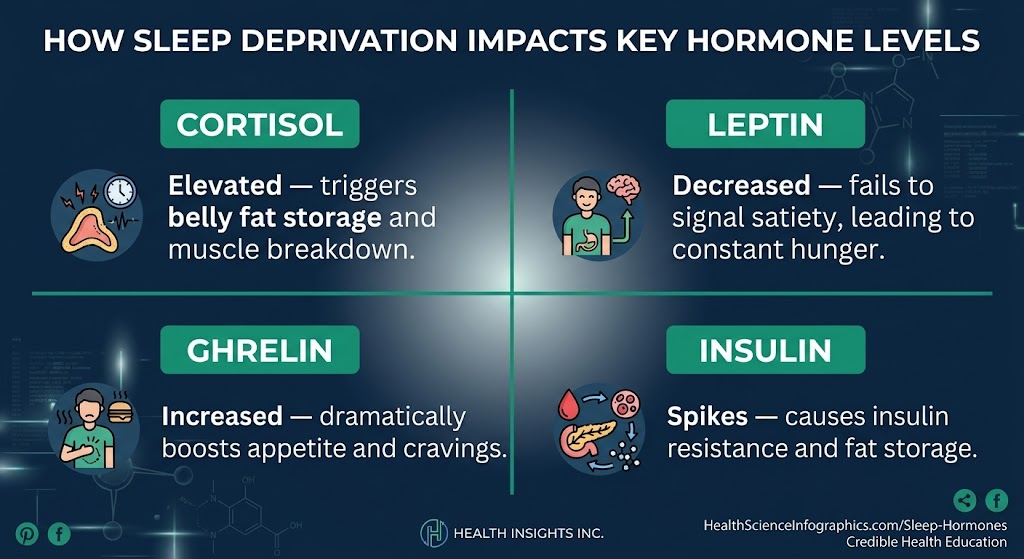
When I sit down with a patient who is losing the fight against their own metabolism, I do not start with food. I start with the four hormones I consider the master switches of metabolic health.
Cortisol is the disruptor. Chronically elevated cortisol from poor sleep directly stimulates fat storage, particularly in the abdomen. It keeps your body in a state of low-grade alarm — and a body in alarm does not release fat. It hoards it.
Ghrelin and leptin are your hunger and satiety signals, and sleep governs both of them. When you are sleep-deprived, ghrelin rises and leptin falls, which means you are hungrier, harder to satisfy, and your cravings shift hard toward carbohydrates and sugar. This is not weak willpower. This is biochemistry.
Insulin sensitivity is one that lands hard when I explain it. Even a single night or two of poor sleep can produce a degree of insulin resistance comparable to weeks of unhealthy eating. Insulin resistance means your cells stop responding properly to blood sugar signals, and fat storage accelerates.
And then there is growth hormone — a piece of this puzzle that almost nobody talks about outside of sports medicine. The majority of your daily growth hormone release happens during the first few hours of deep sleep. Growth hormone is essential for fat metabolism and muscle recovery. Disrupt that deep sleep window and you are robbing your own body of its primary fat-burning signal every single night.
Once patients understand these mechanisms, they stop treating sleep like a lifestyle preference and start treating it like medicine. That is the shift I am after every single time.
A Story I Will Never Forget
I had a woman come in a few years ago, mid-50s, completely defeated. She had been working with another provider, following a low-calorie plan, walking every single day. Three months in, she had lost maybe two pounds. She was done.
When I sat down with her and went through her full clinical picture, her sleep was a disaster. Five hours on a good night. Waking up two or three times. She had written it off as just part of getting older.
We addressed her nervous system function through chiropractic care. We added magnesium glycinate and some targeted nutritional support. We worked on her evening routine — eating window, screen use, room temperature. Within about six weeks she was sleeping through the night consistently.
The weight started moving almost immediately.
She ended up losing over 30 pounds. Same woman. Same basic lifestyle. But her body finally had the hormonal environment it needed to actually release fat.
She cried in my office the day she told me.
That is why I do this work.

What Your Spine Has to Do With Your Sleep
This is the part where most people's eyes get wide, because they have genuinely never heard this before.
Your nervous system runs through your spine. When there is structural interference — subluxations, misalignment, restricted movement — your nervous system is under low-grade stress all the time. You are stuck in sympathetic dominance, which is essentially a fight-or-flight state. And you cannot get into deep, restorative sleep from that state. Your body is too busy being on alert.
Chiropractic adjustments restore normal neurological function and shift the nervous system toward parasympathetic tone — the rest-and-repair mode your body needs to actually sleep. I have had patients tell me they slept better the night of their first adjustment than they had in years. Research supports the relationship between chiropractic care and improved sleep quality, and my clinical experience reflects that consistently.
Red light therapy adds another layer. Red and near-infrared light support mitochondrial function and help regulate circadian rhythm — the internal clock that governs your sleep-wake cycle. I use it in my own routine in the evenings as a wind-down signal for my body.
SoftWave therapy addresses systemic inflammation, which is one of the most overlooked disruptors of sleep architecture. Inflammation keeps the nervous system activated and interferes with the hormonal cascade that produces restorative sleep.
People think these are separate conversations — sleep, spine, inflammation, weight. They are not. They are all the same conversation, and they all live in the same body.
At Optimal Health Members, addressing the whole picture is the only way I know how to practice.
The Sleep Mistakes That Are Quietly Undoing Your Progress
Let me give you the five I see most often — the ones people would never connect on their own.
Alcohol in the evening. I know. A glass of wine feels relaxing, and it does help you fall asleep faster. But alcohol fragments the second half of your sleep cycle — the deep and REM stages where hormonal restoration actually happens. You get quantity without the recovery. That is a bad trade.
Eating too late. Your digestive system needs rest before your brain can move through proper sleep stages. A full meal at 9 or 10pm competes directly with recovery. Closing your eating window several hours before bed makes a measurable difference.
Screens and artificial light. Not just blue light — though blue light suppression of melatonin is well-documented. The mental stimulation keeps the nervous system activated long after the device is down. I stop looking at my phone at least 30 to 45 minutes before I close my eyes. That single change made a noticeable difference for me personally.
Exercising too late. Evening workouts elevate cortisol and core body temperature in ways that can push deep sleep back by hours. If late-night exercise is your only option, it is better than nothing — but morning or midday will always serve your recovery better.
Accepting poor sleep as normal aging. This one might be the most damaging of all. Poor sleep is common as we get older. It is not inevitable. Age-related sleep changes are real but treatable, and accepting them as unavoidable is exactly how people stay stuck for years. I see this in my practice constantly. That woman in her 50s I mentioned — she had been telling herself this for more than a decade.
Your Gut Is Making Your Sleep Hormone — Or It Is Not
This is one of my favorite things to educate patients on, because it connects two systems most people never think about together.
Your gut produces approximately 90 percent of your serotonin, which is the direct precursor to melatonin — your primary sleep hormone. If your gut is inflamed or dysbiotic, that serotonin production is compromised. That means poor gut health literally reduces your body's ability to make its own sleep hormone.
I see this clinically, not just theoretically. When patients clean up their nutrition — particularly moving toward a Paleo-style approach that eliminates processed grains, refined sugars, and industrial seed oils — they consistently report better sleep. Not because they are eating less. Because they are reducing the gut inflammation that was disrupting their neurochemistry.
Timing matters here too. Closing your eating window a few hours before bed gives the gut time to transition out of digestive mode, and the downstream effect on sleep quality is real.
I use APLGO digestive support with many of my patients as part of this protocol. Getting the gut right often unlocks sleep improvements that no supplement or sleep hygiene tip alone can produce. The gut-brain-sleep connection is not alternative medicine. It is increasingly well-supported science, and it deserves a central place in any serious weight loss conversation.
How Sleep Fits Into the GLP THREE Picture
Every person I consider a good candidate for the GLP THREE protocol at glpthreelife.com is also dealing with a disrupted metabolic environment. And poor sleep is one of the primary ways that disruption happens.
When sleep is chronically short or fragmented, ghrelin rises, leptin falls, insulin sensitivity drops, and cortisol stays elevated. You are hungrier, less satisfied, more prone to cravings, and your body is storing fat regardless of what you eat. GLP THREE supports the body's natural GLP-1 pathway, which helps regulate appetite and blood sugar — but if sleep is wrecked, the person is fighting upstream against their own biology.
I always address sleep as part of the full protocol. The product works better when the rest of the foundation is solid. This is not a one-lever problem, and I never treat it like one. If you are curious about whether GLP THREE is the right fit for your situation, starting that conversation at glpthreelife.com is a good first step.
What I Actually Do for My Own Sleep
I was not always serious about this. I used to grind late nights and tell myself I would catch up on the weekend. I know better now.
I try to be in bed by 10 and up by 6. The room is cool and dark. I stop looking at my phone 30 to 45 minutes before I close my eyes. I take magnesium glycinate most nights — magnesium supports GABA activity in the brain, which is the primary neurotransmitter responsible for calming the nervous system for sleep. I use red light therapy a few evenings a week to signal to my body that the day is winding down.
I try to get into a float tank at least once or twice a month. The combination of sensory deprivation and transdermal magnesium absorption is restorative in a way that is genuinely hard to describe until you have experienced it. My cortisol levels after a float session are noticeably different.
And I pray. That is not a throwaway line. Releasing the day and trusting God with what I cannot control is probably the most underrated recovery tool I have. Everything else supports the body. That part takes care of the rest of me.
If You Have Tried Everything and Nothing Is Working, Read This
I hear you. I mean that. I am not rushing past your frustration to get to my answer.
Here is what I want you to understand: your body is not broken. It is responding perfectly to the signals it is receiving. Sleep deprivation sends a very specific message to your metabolism — there is a threat, something is wrong, hold onto every resource you have. And the body listens. It stores fat. It slows the metabolism. It floods you with hunger hormones. You can fight that with willpower for a while. The biology wins every time.
So the answer is not to try harder. The answer is to fix the signal.
The moment people understand that their struggle is not a character flaw — it is a hormonal environment — something shifts in the room. I have seen people go from hopeless to genuinely hopeful in a single conversation, just because they finally understood the why. That is where real progress starts.

You Do Not Need Another Diet. You Need a Complete Picture.
If you read this and recognized yourself — the exhaustion, the doing-everything-right-but-nothing-moving frustration — I want you to reach out. Not to be sold something. To have a real conversation about what your body actually needs.
Whether that is chiropractic care to restore nervous system function, nutritional support for sleep and gut health, the GLP THREE protocol, or simply someone who will look at your whole picture instead of handing you another calorie plan — that is what I do. That is what I have done for nearly 30 years.
I would be genuinely honored to do it for you.
You can learn more about what we do at Optimal Health Members in Henderson, Nevada, or explore the GLP THREE protocol at glpthreelife.com. Either way, the conversation starts whenever you are ready.