Can Chiropractic Care Help If Sitting Is Causing Back Pain?
If you have ever said the words "my back hurts from sitting all day," I want you to know two things up front. First, you are not imagining it, and you are not being dramatic. Second, you almost certainly do not have to live with it. I have spent nearly 30 years helping people in Henderson and Las Vegas get out from under exactly this kind of pain, and the story is usually the same. Nothing dramatic happened. No fall, no accident. Just a body that has slowly molded itself to a chair, and a low back that is tired of paying the bill. Let me walk you through what is actually going on and what we can do about it.
What I Look For When You Tell Me Sitting Is Wrecking Your Back
The first thing I want to understand is the pattern. When does it hurt, when does it ease up, and what makes it worse? If you tell me you feel okay in the morning and then you are stiff and aching by two in the afternoon, that already tells me a great deal before I have laid a hand on you. Sitting related pain usually builds through the day and settles down when you move. That is a very different story than pain that wakes you at night or hurts no matter what you do.
Then I watch how you walk in, how you lower yourself into the chair in my exam room, and how you get back up. People show me their problem before they ever describe it. I am looking at how you hold your pelvis, whether you slump into one hip, and whether your head is parked out in front of your shoulders. After all these years, your posture tells me where to look.
On the exam table I check how your low back and pelvis move, whether your hips are tight, whether your core is actually firing or just along for the ride, and whether there is any nerve involvement running down the leg. And I am always screening for the things that tell me this is not a simple desk problem. More on that further down, because safety comes first, always.
Why Sitting Causes Back Pain Is Rarely Just One Thing
Honestly, it is almost never a single cause. It is usually a stack of things that add up.
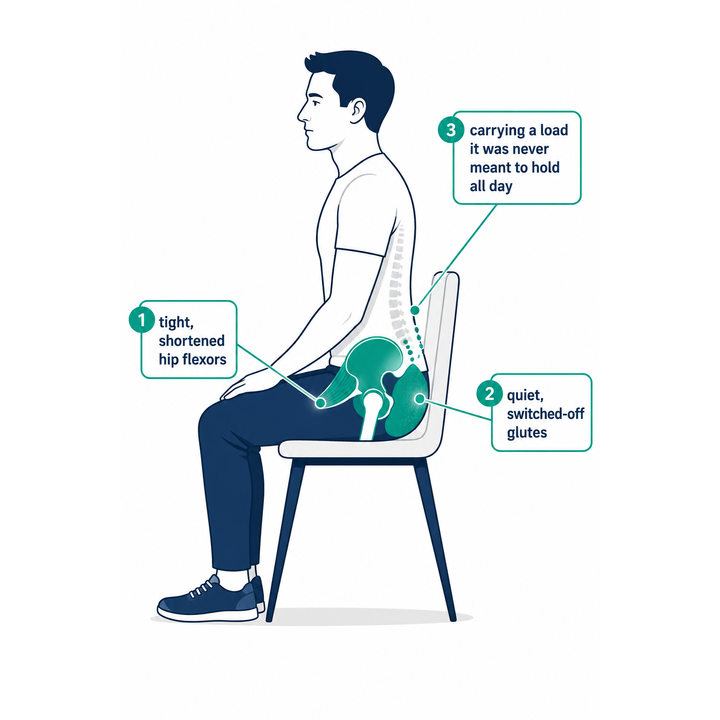
The biggest one I see is that sitting folds your body into a shortened position for hours at a time. Your hip flexors get tight and short. Your glutes go quiet because nothing is asking them to work. Your deep core stops engaging. And your low back ends up holding a load it was never designed to carry all day. So now you have a tight front, a sleepy backside, and a low back picking up everyone else's slack.
Layer the disc piece on top of that. Research has long shown that a seated slump can raise the pressure inside your lumbar discs compared with standing. Do that eight, ten, or twelve hours a day for years and you can start to irritate things.
Then add in the rest of it. A workstation set up wrong. A monitor too low, so the neck creeps forward. Not enough movement, which is probably the real villain here. Old injuries that never fully healed. And stress, which people underestimate. Stress lives in the body. It shows up as a clenched jaw, tight shoulders, and a guarded low back. I see it every week.
The Two Things Almost Everyone Gets Wrong About Sitting and Back Pain
There are two big misunderstandings, and clearing them up changes how people approach the whole problem.
The first is the belief that some perfect posture will save you. People buy the chair, they sit up straight the way their grandmother told them to, and they expect that to fix it. But your body was never built to hold any single position for hours, even a good one. The best posture is your next posture. Your spine and your discs are hungry for motion, because your discs have no blood supply of their own and depend on movement to push fluid and nutrients in and out. A perfectly upright statue still gets stiff.
The second mistake is treating the pain like it is the problem. The pain is the smoke. We have to go find the fire. That ache in your low back at three in the afternoon is often the result of tight hips, a core that is not doing its job, and seven straight hours without standing up. If you only chase the spot that hurts, you will be chasing it forever.
How a Chair Can Irritate Your Low Back, Hips, Neck, and Sciatic Nerve
I tell people to picture folding a garden hose. Leave a kink in it and walk away for the day, and that is basically what your hips and low back are doing when you sit for hours. Everything in that folded zone gets compressed, circulation slows, and tissues that want to move are stuck.
For the low back, the discs are loaded more in a seated slump than when you are standing or walking, so that steady pressure can start to irritate them over time. For the hips, the flexors at the front stay short while the glutes behind switch off, and that imbalance pulls on the pelvis and low back. For the neck, the trouble is usually the screen. When the monitor sits too low or the phone is in your lap, the head drifts forward, and your head is heavy. Every inch it travels forward multiplies the load your neck and upper back have to fight.
The sciatic nerve gets pulled in a couple of ways. Sometimes a cranky low back disc presses on the nerve root. Other times a tight muscle deep in the buttock, the piriformis, squeezes the sciatic nerve as it passes underneath. Either way, sitting on it all day does not help. People feel that as the burning, shooting, or numbness running down the back of the leg.
A Patient Story: The Software Engineer Who Molded Himself to a Chair
Picture a guy in his early 40s. He works in software, on calls and at a keyboard ten to twelve hours a day, and he games at night, so he is basically in a chair from morning until he goes to bed. He came in with a deep ache across the low back and a tightness in his right hip that he had been writing off as "just getting older." No big injury, no accident. It crept up on him over a couple of years.
When I examined him, his hip flexors were locked up, his glutes were barely firing, and his low back and pelvis were not moving well on the right side. No red flags, no true nerve damage. Just a body that had molded itself to a chair.
What helped him was not complicated, but it took his buy-in. We worked on restoring motion to the low back and pelvis, we used SoftWave on the hip and surrounding tissue to wake things up and calm the irritation, and we gave him a short list of things to do at his desk so he was not undoing our work every single day. The desk changes mattered as much as anything I did in the office. Within a few weeks he was a different person, and the part that surprised him most was how much better he slept once his hip stopped barking at him.

How We Treat Sitting Related Back Pain at Optimal Health Members
It depends on the person, but here is the toolbox I reach for.
Adjustments to restore motion to the joints of the low back and pelvis that have gotten stuck. That is the foundation. When the spine moves the way it is supposed to, a lot of the daily irritation settles down on its own.
SoftWave tissue regeneration therapy for the soft tissue around the area, the muscles, tendons, and ligaments that get angry and inflamed from sitting. It is one of my favorite tools because it works on the actual tissue and the body's own repair signals, not just the symptom.
Our robotic laser spinal decompression for the folks who have a disc component, the ones with leg symptoms or a deep ache that points to disc irritation. It takes pressure off the disc and the nerve in a controlled, gentle way.
Class 4 laser and red light to calm inflammation and help tissue recover. And then the part people love to skip and should not: posture and movement coaching, plus some basic rehab so the core and glutes start doing their job again. I will also work the hips and other extremities when they are driving the problem, because the low back is often paying for what the hips are not doing. You can see how these pieces fit together across the services we offer at Optimal Health Members.
Here is something I tell patients who want their results to last. Therapies like SoftWave, laser spinal decompression, and chiropractic care kick off the body's repair response, but the real healing happens in the hours and days between your visits, and that is where your body needs the right raw materials. For soft tissue and joint recovery, I often recommend RECOVER by AgeRecode, a regenerative complex of BPC-157, GHK-Cu, and Carnosine that supports tissue repair and helps calm inflammation between appointments. It is not a replacement for hands-on care. It is what helps the body finish the work we started in the office. Patients who are also receiving SoftWave or decompression tend to benefit the most, because we have already opened the door to healing and RECOVER gives the cells the tools to keep going. If you take blood thinners or anticoagulants, or you are pregnant, check with me or your provider before starting it.
The honest truth is that the people who get the best and longest lasting results are the ones who combine the in office work with the daily habits. I can get you out of pain. Keeping you there is a partnership.
When Chiropractic Is the Right Fit, and When You Need More
Chiropractic care is a great fit for the typical desk related back pain. The mechanical stuff, the stiffness, the muscle and joint problems, the irritated disc that has not crossed a line. That is the bread and butter of what we do, and most people in that bucket do really well without ever needing a scan.
But part of doing this job right for almost 30 years is knowing what is not mine to treat, and being honest about it. There are warning signs I take seriously. If someone has changes in bowel or bladder control, numbness in the saddle area, or leg weakness that is getting worse, that is an emergency, and they go for evaluation right away, not next week. A history of cancer, unexplained weight loss, fever along with the back pain, or pain that is worse at night and will not quiet down no matter how you lie, all of that needs imaging and a closer look. Same with significant trauma, a real fall or a car accident.
I would rather order the scan or send you to the right specialist and be wrong than miss something that matters. Trust is built on that. If your back pain is the normal kind, I can help you, and most of the time we do not need a picture to do it. If it is waving one of those flags, my job is to make sure you get the right care, even when that care is not me.
A Few Simple Changes That Help More Than Any Gadget
Here is what I actually tell patients, and none of it requires buying anything fancy.
Move every 30 to 45 minutes. Stand up, walk to get water, do a few hip and back motions, sit back down. Set a timer if you have to. This single change does more than any gadget you can buy, because it breaks up the loading and gets your tissues fed.
Get your screen up to eye level. Your eyes should land on roughly the top third of the monitor without you dropping your chin. Raise it with a stand or a stack of books. This saves your neck and upper back from carrying your head out in front of you all day.
Wake your glutes and open your hips. A couple of times a day, stand up, do a few standing hip openers, and squeeze your backside on purpose for a few seconds. It sounds almost too simple. It directly fights the two biggest sitting problems, tight hips and lazy glutes.
Drink water. Your discs and tissues need hydration to stay healthy, and getting up to refill the glass forces movement, so you get two wins out of one habit.
Take a real walk every day. Ten to twenty minutes. Walking is the closest thing there is to a reset button for a body that has been folded into a chair. If you only do the first one on this list, moving every half hour, you are already ahead of most people.
My Honest Take on Ergonomic Chairs, Standing Desks, and Posture Gadgets
It depends, and here is the catch most people miss. None of that gear fixes the real problem, which is staying still too long. A two thousand dollar chair that holds you in one position for ten hours is still ten hours in one position.
A good ergonomic chair is worth it if you are going to spend serious hours seated, because it gives you a better starting point and supports the low back. But it is a tool, not a cure. A standing desk is great, mostly because it makes it easy to change positions, which is the whole point. The trick is to alternate. Standing rigid all day will hand you a different set of aches than sitting all day. The magic is in the switching.
Lumbar cushions can help some people feel better in the moment, and that is fine, but I do not want anyone thinking a pillow rebuilt their core. Most of the little posture gadgets, the straps and the buzzers, are overrated. They can be a decent reminder for a few weeks, but they do not build the strength that holds you up, so the effect fades.
Bottom line. Spend your money on the chair if you sit a lot, get a way to stand for part of the day, and then understand that the best ergonomic upgrade you will ever make is free. It is getting up and moving.
If You Think It Only Hurts Because You Are Getting Older
I am going to push back on that, kindly but firmly, because I have watched too many people give up on their own body for no good reason.
Age is real. I am not going to tell you that you are 25 again. But "you are getting older" is not a diagnosis, and it is not a sentence. Most of the back pain I see in people in their 40s, 50s, and 60s is not really about the candles on the cake. It is about a body that has been sitting too much, moving too little, and never had anyone show it how to undo that. Those are things we can change at almost any age.
This one is a little personal for me. I have lost people in my own family to heart disease and metabolic problems, and a lot of that traces back to the same root, a body that was not being cared for and a belief that decline was simply the deal. I do not accept that, and I do not want you to either. Your body is built to heal and adapt when you give it the right inputs. I have seen people in their 60s and 70s climb out of pain they had carried for years, not because of some miracle, but because they finally addressed the cause instead of blaming the calendar.
So no, you do not just have to live with it. Let us find out what is actually going on, and let us do something about it.

Let Us Find the Cause, Not Just Chase the Pain
If your back has been aching from a workday spent in a chair, you do not have to keep white knuckling your way through it. The path out is usually straightforward once we know what is actually driving it. At Optimal Health Members in Henderson, I will look at the whole picture, the spine, the hips, the habits, and we will build a plan that gets you out of pain and keeps you there. You can learn more about how we work and reach out to the practice here, or call us at 702-541-9060 when you are ready. Your body is built to adapt. Let us give it the chance.