Red Light Therapy for Skin: Does It Actually Work?
If you have been Googling red light therapy for your skin, you have probably landed in a confusing place. Half the content out there looks like an influencer selling a $79 LED mask. The other half reads like a clinical white paper that makes your eyes glaze over. Neither one answers the question you are actually asking, which is: does this thing work, and is it worth my time?
I have been using a full-body red and near-infrared panel system at Optimal Health Members for years. I have used it on myself. I have watched it work in my patients. And I have read enough of the peer-reviewed literature to tell you what the science actually says, rather than what somebody's brand deal is paying them to say.
Here is the honest answer: yes, red light therapy can genuinely improve skin health. But the reason it works is not what most people think, and the way you have to use it is not what most people expect.
The Technology Behind It: Why Red and Near-Infrared Both Matter
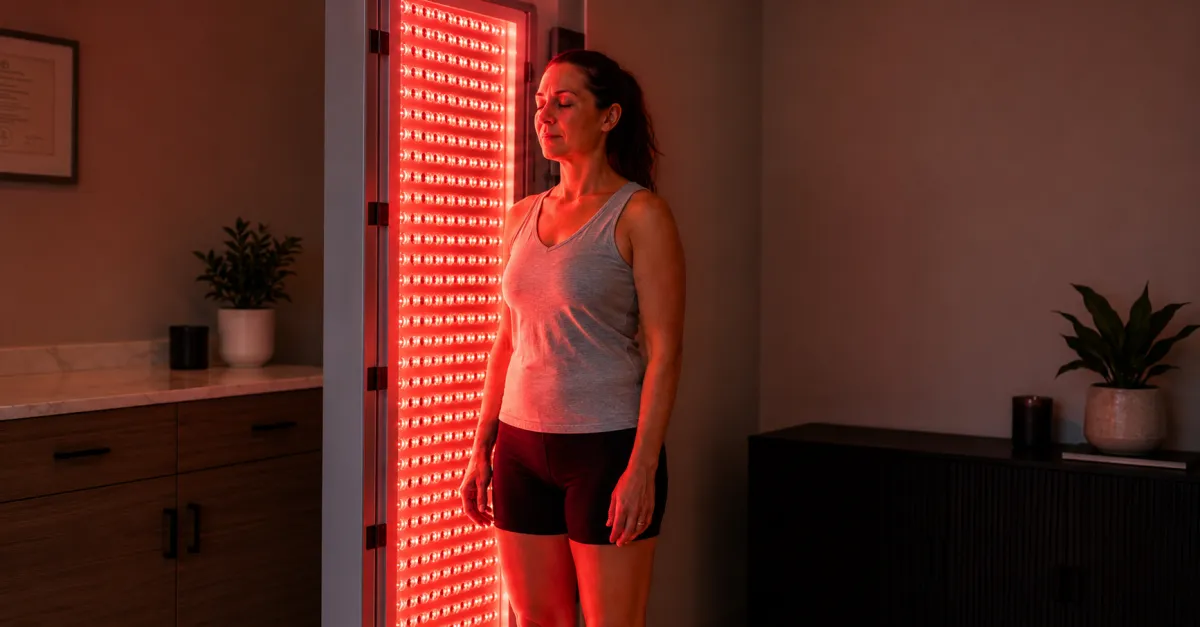
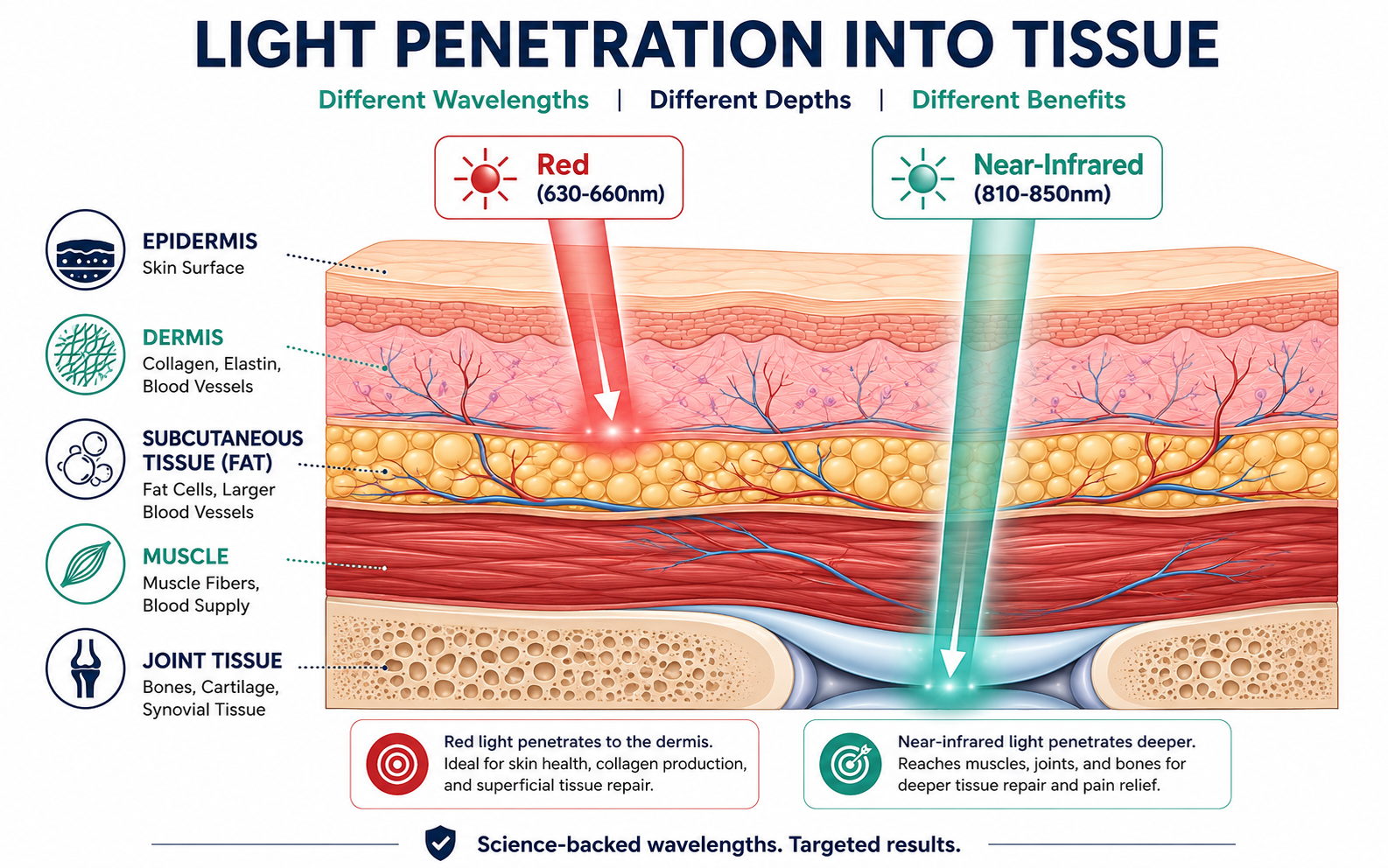
When I talk about red light therapy in my clinic, I am talking specifically about a full-body panel that delivers both red wavelengths, typically in that 630 to 660 nanometer range, and near-infrared wavelengths, typically around 810 to 850 nanometers. These are not interchangeable. They do different things.
The red wavelengths work closer to the surface. They support skin tissue repair, circulation at the dermal level, and collagen synthesis. The near-infrared goes deeper — joints, muscle, and most importantly, the mitochondria. Photobiomodulation at near-infrared wavelengths has been shown to enhance mitochondrial ATP production, which is essentially improving how efficiently your cells produce energy.
You want both. A device that only delivers one without the other is giving you half a treatment. Anyone selling you a single-wavelength panel and calling it complete red light therapy is leaving significant benefit on the table. That is not an opinion — it is how the mechanism works.
Sessions in my practice run 10 to 20 minutes depending on what we are addressing. I start most patients at three sessions per week for the first four to six weeks, then move to maintenance — one to two sessions per week — once we are seeing a response. The key word there is consistency, which I will come back to.
What Patients Actually Say About Their Skin
I want to be careful here, because the unsolicited feedback is often more meaningful than the prompted kind. When I ask patients directly how their skin looks, I get polite answers. When they bring it up on their own, around week four or five, that is when I pay attention.
The most common version of this goes something like: "My husband said I look different. Not like I did something, just... good. What are you doing?" They came in for spinal decompression or SoftWave Therapy for a shoulder or a knee. The skin improvement was a side effect of the cellular support they were getting. Tone, less puffiness around the eyes, better color. Nobody asked for it. It just showed up.
I also hear consistent reports about sleep quality. There is published research on red light therapy and circadian rhythm support, specifically its effect on melatonin production, and what patients describe matches what the literature predicts. Better sleep is not a glamorous outcome. But for a 52-year-old who has not slept well in years, it is transformative.
And then there is the wound healing and bruising feedback. Several of my patients have noticed that bruises and minor injuries clear noticeably faster. That one is not anecdote — it is documented mechanism. Photobiomodulation accelerates tissue repair by reducing oxidative stress and supporting cellular regeneration. The skin is just the most visible tissue in your body. Of course it reflects that.
One patient I think about often is a woman in her late 40s who came in primarily for chronic neck and shoulder tension she had been managing with medication for years. Around week five of adding red light to her care plan, she stopped me before her session and said, "I don't know what's different, but my skin looks better than it did ten years ago." She was not exaggerating for effect. She was genuinely surprised. What she was experiencing was the downstream result of reduced systemic inflammation — her skin was the report card.

My Personal Experience: What I Noticed and When
I did not start using red light therapy for vanity. I started because of inflammation and recovery. Being physically disabled, my body deals with chronic stress patterns that most people do not face, and I was looking for tools that supported cellular function without adding pharmaceutical burden. Red light therapy fit that goal.
What I noticed first was not in the mirror. It was how I felt. Less systemic soreness. Better sleep. A kind of baseline ease that is genuinely hard to describe unless you have experienced chronic inflammation and then had it meaningfully reduced. That shift started showing up around weeks three to four for me.
The skin changes came later and honestly surprised me. Better tone, less puffiness, a clarity that I was not expecting and had not been chasing. It happened as a downstream effect of everything else improving. I was going in three times a week for the first six weeks. That is what it takes.
I tell patients this story because it reframes what they are actually investing in. You might come in for the skin. But what you are really doing is improving your cellular environment, and your skin is just the most visible evidence of that.
Where the Hype Goes Wrong (and Where the Science Actually Holds Up)
I want to address this directly because the online conversation around red light therapy is a mess, and it does not have to be.
The research base for photobiomodulation is solid. We are not talking about a fringe technology. NASA developed early applications of LED-based photobiomodulation for wound healing in space. Military medicine uses it. The published literature on tissue repair, inflammation reduction, mitochondrial function, and wound healing is robust and peer-reviewed. I have no hesitation standing behind the science.
Where social media completely loses the thread is on timeline and on device quality. People post before-and-after photos after two sessions with a consumer LED mask they bought from an influencer link and call it transformative. That is not how this works, and it sets people up to dismiss a genuinely effective technology when the budget device does not deliver miracles.
The devices matter. The wavelengths matter. The power density, called irradiance, matters enormously. Therapeutic efficacy in photobiomodulation research is directly tied to the energy delivered to the tissue, which depends on wavelength, irradiance, and duration. A $79 consumer device and a clinical-grade full-body panel are not delivering remotely comparable doses. That distinction almost never gets made in the content people are actually consuming online.
The other overpromise I see constantly is people treating red light as a standalone solution for complex problems — weight, hormones, chronic disease. It is a powerful tool in a broader strategy. It is not a replacement for nutrition, movement, sleep, and addressing root causes. I say that as someone who genuinely believes in this technology. Believing in it means being honest about what it is.
What Realistic Results Actually Look Like: The Six-Week Arc
I tell every patient the same thing on day one: give this six weeks before you judge it, and do not expect a dramatic moment.
The changes are cumulative. Week two, you might sleep better. Week four, someone might mention that you look good. Week six, you look in the mirror and notice something has shifted — your skin has a different quality to it. More even. More alive-looking. That is the arc for most people.
This is not a facial. It is not a procedure. It is closer to exercise. The benefit comes from the repetition, not the single event. I use that analogy constantly because it reframes the expectation in a way people already understand. You would not go to the gym once and expect a six-pack. You go consistently, you support it with the right inputs, and over time your body responds. Red light therapy works exactly the same way.
And once people see results, maintenance matters. This is not something you do for six weeks and then you are finished. Your cells keep aging. The inflammation does not stay managed on its own. You have to keep showing up.
Who This Is Best For
My sweet spot for red light therapy is adults over 40 who are already bought into a wellness mindset. People who understand that their body requires investment and are willing to be consistent rather than desperate for a quick fix.
A lot of these patients are already working with me on chiropractic care, SoftWave Therapy, or spinal decompression. Red light stacks beautifully with those modalities. We are supporting the same underlying cellular environment from multiple directions.
I also find it particularly valuable for people dealing with chronic low-grade inflammation — the ones who do not have a dramatic diagnosis but just feel like their body is always working a little harder than it should. They feel it in their joints. Their energy is off. Their skin looks tired before they should. Their sleep is inconsistent. Red light addresses the cellular environment that underlies all of those symptoms.
And anyone who genuinely wants to age better and is willing to be consistent over time — those are my people. That is who I can actually help with this.
Who Should Be Screened Before Starting
I take this seriously, and I want to be direct about it.
Any patient with a personal history of or active skin cancer, or with suspicious lesions that have not been evaluated by a dermatologist, gets a referral before we do anything. Red light stimulates cellular activity and proliferation, and you do not want to apply that stimulus to tissue that may be malignant. That is non-negotiable in my practice.
Photosensitizing medications are on my screening list. Certain antibiotics, some acne medications, and specific psychiatric drugs can increase sensitivity to light. Patients on those need a conversation, and sometimes that conversation needs to include their prescribing physician.
Pregnancy I approach conservatively. The research is not there yet to establish clear safety parameters during pregnancy, so I wait. That is the right call with any emerging technology in that context.
Patients with light sensitivity conditions, including some autoimmune presentations like lupus, warrant careful evaluation. And anyone with a severe, active dermatologic condition that has not been properly diagnosed and managed gets a referral first.
I would rather slow-walk someone into this the right way than rush them in and cause a problem. That is just how I practice.
The Real Takeaway: What You Are Actually Investing In
Red light therapy works. The research supports it, the mechanism is real, and I have seen it in my own body and in my patients. But the skin benefits — the glow, the tone, the texture — those are symptoms of something deeper happening.
Your mitochondria are producing energy more efficiently. Your inflammation is being dialed down. Your tissue is repairing itself the way it was designed to. The skin just happens to be the most visible place that shows up.
So yes, come for the healthier skin if that is what motivates you. But understand that what you are really investing in is your cellular health. And that pays dividends in ways you will feel before you even see them. Better sleep. Less soreness. More energy. More resilience. That is the real win.
None of it happens in one session. It happens because you showed up consistently, you supported your body with the right inputs, and you gave the technology time to do what the science says it can do. That is the whole story.
If you are in the Henderson or Las Vegas area and you want to understand whether red light therapy makes sense for you, reach out to us at Optimal Health Members. We will start with a real conversation about what you are dealing with and what your body actually needs.