Red Light Therapy Session Length: How Much Is Enough?
You bought the panel, or you booked the sessions, and now you are staring at a timer wondering whether five minutes is too little or thirty is too much. One website says ten. Another says twenty. A third says as long as you can stand it. After nearly 30 years in practice, I can tell you why the answers are all over the place: most people are asking the wrong question.
I hear some version of this almost every week. Patients want a number they can set and forget. I understand that, and I wish it were that simple. What I can give you is something better than a number. I can show you how dose actually works, so you can stop guessing and start getting results.
Quick Answer
There is no single best red light therapy session length, because results depend on dose: the total light energy reaching your tissue. Device power, distance, and treatment goal all change the right time. Most people do best with moderate sessions a few times per week, held consistently for four to eight weeks before judging results.
Key Takeaways
Dose, not minutes alone, drives results. Dose depends on device power, distance from the light, and time.
Research describes a biphasic dose response, meaning too little does little and too much can reduce the benefit.
Consistency beats intensity. A moderate routine followed for weeks outperforms an aggressive routine abandoned early.
Skin tone, treatment goal, and device quality all shift the ideal session length from person to person.
Give red light therapy four to eight weeks of steady use before deciding whether it is working.
Why Dose Matters More Than the Minutes on the Clock
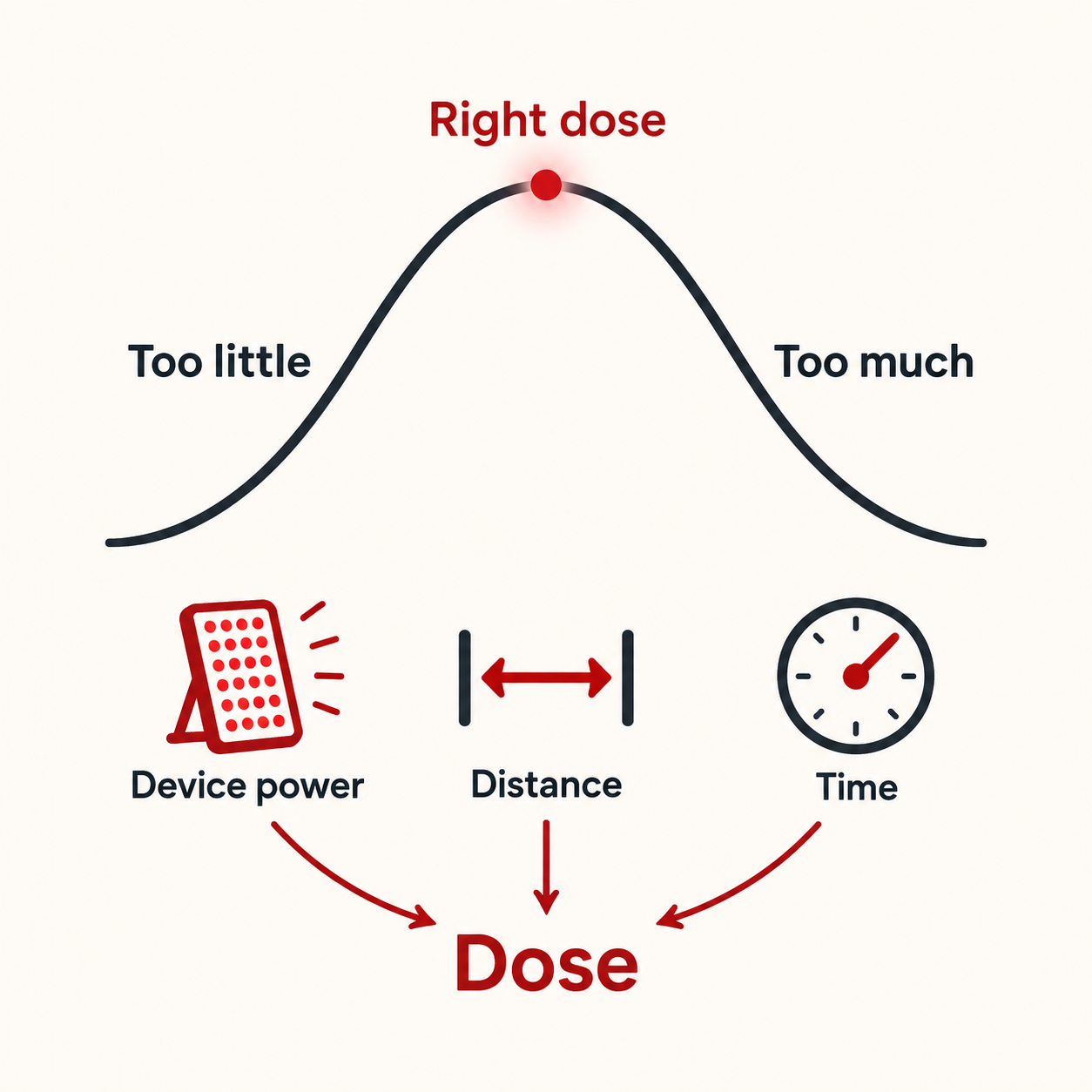
The first thing I tell patients is that time is only half of the equation. What your body responds to is the amount of light energy that actually reaches the tissue. That depends on three things working together: how powerful the device is, how far you are from it, and how long you stay in front of it.
Ten minutes under a strong clinical-grade device and ten minutes in front of a low-powered panel across the room are two completely different treatments. Light also loses intensity quickly as you move away from the source, which is why distance matters so much and why it gets ignored so often.
Researchers have struggled with this same problem. A review of dose in low level light therapy points out that disagreement about what even counts as a "dose" has made it hard to compare studies, and that poorly chosen dosing parameters have led to some of the negative studies in the literature. In plain language, a lot of the confusion you see online starts with people measuring the wrong thing.
When patients understand this, the question changes. It stops being "how long?" and becomes "how much light is my body really getting?"
What Happens When You Use Red Light Therapy Too Long or Too Often
This is the part that surprises people. Red light therapy follows what scientists call a biphasic dose response. Low levels of light tend to stimulate and repair tissue, and higher levels can be less effective. The classic review of this pattern describes it with the Arndt-Schulz curve, where too little light does almost nothing, the right amount helps, and too much can blunt the effect.
There is a cellular reason for this. An update to that review explains that reactive oxygen species can act as a helpful signaling molecule at low concentrations and a harmful one at high concentrations. The same molecule that helps your cells adapt in small amounts can work against you in large amounts.
I see the real-world version of this in my practice. Some patients assume more is better, so they double their time every day. A few weeks in, they tell me the improvement they felt early on has faded. When they dial it back to a consistent, moderate routine, the benefit returns. The patients who do best are rarely the most aggressive ones. They are the most consistent ones.
What the Research Says About Red Light Therapy Dosing
Here is what we know. Red and near-infrared light is absorbed by the mitochondria, the energy producers inside your cells. A review of proposed mechanisms identifies cytochrome c oxidase in the mitochondrial respiratory chain as one of the most important targets, with the leading hypothesis being that light helps release inhibitory nitric oxide from that enzyme, which supports energy production.
Wavelength matters as well. Hamblin's review of anti-inflammatory effects notes that results tend to be positive in the red range of roughly 600 to 700 nanometers and the near-infrared range of roughly 770 to 1200 nanometers, while the stretch between 700 and 770 is generally disappointing. Longer wavelengths also penetrate tissue better than blue or green light, which is why red and near-infrared are the ones used for therapy.
Here is what I will not do: pretend the research hands us a clean stopwatch number for every person. It does not. What it gives us is a therapeutic window and a framework. A recent workshop summary from the National Institute on Aging shows that scientists are still refining the mechanisms behind photobiomodulation, which is the formal name for this kind of light therapy. So at Optimal Health Members, we start inside that window, watch how the patient responds, and adjust. Session length is set by the area being treated and the goal, not by a generic timer.
What Changes the Ideal Session Length From One Person to the Next
Device power and distance come first, because they change how much light reaches you in a given minute. After that, I look at the goal. Surface skin concerns, sore muscles, and deeper joint problems do not all call for the same dose.
Skin tone matters too. In my experience, patients with more pigment in the skin absorb more light at the surface, so I start more conservatively and build up gradually. Age, current medications, and how inflamed the tissue is also play a role.
This is exactly why I get nervous when someone gives a flat answer like "twenty minutes for everybody." Your body is not everybody's body, and the best plan starts with knowing what you are trying to treat.
How Often to Use Red Light Therapy and How Long Before You Notice Results
For most people, a few sessions per week is a reasonable starting point. From there, we adjust as the tissue responds. I ask patients to think in weeks, not days.
Some people notice better sleep or less stiffness within a couple of weeks. For skin quality and more stubborn pain patterns, I ask for a solid four to eight weeks of consistent use before judging it. Red light therapy works at the cellular level, and that takes repetition.
It is not a one-visit fix, and I would rather set that expectation honestly than oversell it. A moderate routine for two months will serve you better than an extreme one for two weeks.
What a Well-Dosed Plan Looks Like in Real Life
I once worked with a patient who came in with a nagging ache that kept her from enjoying her mornings. She had already tried a home device and felt nothing, which left her frustrated and ready to write the whole thing off.
When we sat down and looked at what she was doing, the problem was clear. She was sitting several feet from a low-powered panel for a few minutes at a time, and only now and then. She was not failing the therapy. The therapy was never given a fair chance.
We moved her to a structured plan with the right distance, a consistent schedule, and the rest of her care in place. Over the next several weeks, her mornings got easier. She did not need a miracle. She needed the right dose, delivered consistently, alongside hands-on care.

The Biggest Mistakes People Make With At-Home Red Light Panels
The first mistake is guessing. People buy a panel, read a vague instruction card, and have no idea what the real output is. Many consumer devices advertise large numbers that do not reflect what reaches your skin at a normal distance.
The second mistake is inconsistency. Using a device hard for a week and then forgetting about it for a month does not give your cells the steady signal they respond to.
The third is expecting light to fix a structural or mechanical problem on its own. Red light can support healing, but it does not replace finding out why the problem is there in the first place. If your back hurts because of a joint that is not moving well, a glowing panel is not going to change that by itself.
Who Should Check With a Provider First
Red light therapy is generally well tolerated, but I do not hand it out without an evaluation. I begin with a history and an exam, because I want to know what we are treating before I choose a tool.
I ask patients to check with their provider first if they are pregnant, have a history of skin cancer or a suspicious lesion in the treatment area, take medications that cause light sensitivity, or have a condition that affects the eyes. Eye protection matters with any bright light source, so never stare into the panel.
If something looks off on an exam, I would rather pause and refer than rush into a treatment. This article is educational and is not a substitute for individual medical advice.
Where Red Light Therapy Fits With Chiropractic Care, SoftWave, and Class 4 Laser
I think of red light therapy as a supporting layer. Chiropractic adjustments restore motion and function. SoftWave and Class 4 laser therapy are more targeted for deeper tissue. Red light therapy is a gentler, broader way to support cellular energy and calm inflammation, and it helps the body keep doing its repair work between more focused treatments. You do not have to choose one over the other. The best results I see come from combining the right tools in the right order.
Healing does not stop when you leave the office, and for patients working through tendon, ligament, or joint issues, what happens between visits matters a great deal. That is where I sometimes recommend RECOVER™ by AgeRecode, a regenerative peptide and antioxidant complex made with BPC-157, GHK-Cu, and carnosine. It is not a replacement for hands-on care. It helps the body finish the repair work that therapies like SoftWave, Class 4 laser, and chiropractic care start. If you take blood thinners or anticoagulants, or you are pregnant, talk with your provider before using it.
My Honest Bottom Line on Red Light Therapy Session Length
Stop chasing the perfect number of minutes and start building a plan. Know your device, keep your distance consistent, stay within a reasonable dose, and give it several weeks before you decide. If you are unsure, get evaluated so you are treating the right problem.
I would rather see you do a moderate routine for two months than an extreme one for two weeks. Light is a helpful tool, but your body does the healing. Our job is to support it.

If you are not sure what dose is right for you, I would be glad to help you figure it out. At Optimal Health Members, we build care plans around the person, not a generic timer. You can learn more about our approach and how to schedule an evaluation at optimalhealthmembers.com, or call our office at (702) 541-9060. There is no pressure, just an honest conversation about what your body needs.