Red Light Therapy for Hair Growth: What I Tell People Before They Start
Nearly every week, someone in my office brings up their hair as an afterthought. We’ve finished talking about energy, sleep, or weight, and then they lower their voice and say, “And my hair’s been falling out.” They’ve noticed more in the shower drain. Their part looks wider under the bathroom light. The ponytail feels thinner in their hand. Then they open their phone and every other ad promises a glowing red fix.
I’ve been in practice since 1996, and we offer in-office red light therapy at Optimal Health Members in Henderson. So here’s what I tell people in the room: what red light actually does, who it helps, who it won’t help, and what I want checked before anyone starts.
Quick Answer
Red light therapy uses red and near-infrared light to support energy production inside hair follicle cells. That may help struggling follicles stay in the growth phase longer. It works best for early to moderate thinning, not scalp that has been bald for years. I ask people to get bloodwork first and then commit to consistent sessions over several months.
Key Takeaways
Red light therapy supports follicles that are still alive. It does not create new ones.
In systematic reviews of low-level light therapy for pattern hair loss, most trials showed improvement in hair count or density.
Most studies run about four to six months, so judging results after a few weeks is too early.
Wavelength and consistency matter more than how impressive the light looks.
Thyroid, iron, hormones, and stress should be checked before you treat only the scalp.
What Red Light Actually Does Inside a Hair Follicle
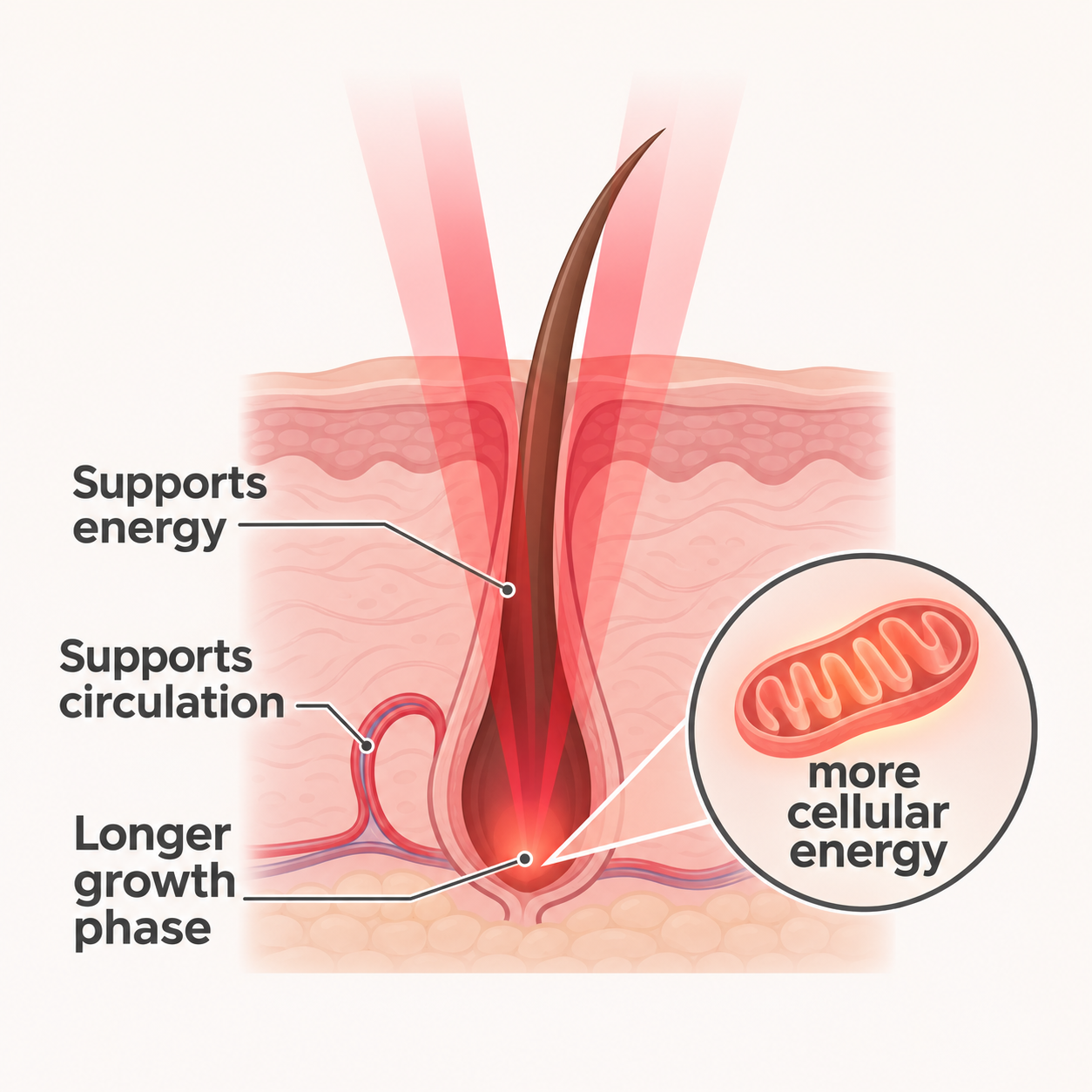
I describe a hair follicle as one of the busiest little factories in your body. It runs nearly nonstop, and like any factory it needs power, blood flow, and oxygen to keep producing. When the power drops, production slows. The hairs it makes get thinner and shorter until they barely show.
Red and near-infrared light in the right wavelengths is absorbed by the mitochondria, the power plants inside your cells. The leading explanation in the research is that this light frees up a key mitochondrial enzyme so the cell can make more ATP, its usable energy. Researchers also point to better local circulation and a longer growth phase for the follicle.
The point I make sure people hear on day one is this: red light does not create new follicles. It wakes up and supports the ones that are struggling but still alive. Get that one point and you’ll see past most of the hype online.
Who Red Light Therapy Can Help, and Who It Can’t
The person I’m most hopeful for is in the early or middle stage of thinning. Their part is widening, the crown is starting to look see-through, or their hair just doesn’t feel as full in their hand. Those follicles are shrinking, but they’re still there to work with.
Androgenetic alopecia, the hereditary pattern most people mean by thinning, affects about half of men by age 50 and half of women by age 80. That same systematic review found that 9 of the 11 studies measuring hair count or density reported statistically significant improvement with low-level light therapy.
I’m honest with the person whose scalp has been smooth and shiny for ten years. If the follicle is gone, the light has nothing to work on. I would rather tell you that in your first conversation with me than take your money and watch you get discouraged four months later.
Why I See Hair Loss as a Signal, Not Just a Scalp Problem
For years I thought about hair the way most people do, as a cosmetic issue off to the side of real health. That changed as I went deeper into metabolic health and started listening to what people mentioned on their way out the door. The hair comment kept showing up next to fatigue, blood sugar swings, poor sleep, and stress that never let up.
Here’s my opinion, and plenty of clinics won’t share it. Hair is one of the first things your body cuts when something upstream is off. You don’t need hair to survive, so when resources run short, the follicles lose their budget first. I’ve come to see thinning hair as the body raising its hand.
Shining a light on the scalp while ignoring what’s going on underneath is like painting a house that has a cracked foundation. The paint helps the house look better, but it doesn’t fix what’s wrong. Red light works best when the body underneath it is supported too, and that’s why I look at metabolic health alongside hair.
What I Want Checked Before You Start
Before anyone starts hair treatment, I want to know why the hair is thinning. Mayo Clinic lists heredity, hormonal changes from pregnancy, childbirth, and menopause, thyroid problems, and certain medications among the common causes. Each of those calls for a different conversation.
Here’s what I ask for:
Thyroid function
Iron stores, including ferritin, not just a basic iron number
Vitamin D
Blood sugar markers
For women, where they are hormonally: postpartum, perimenopause, or menopause
I also ask about the last six months. Sudden shedding that starts a few months after major stress, a crash diet, surgery, or an illness is common. MedlinePlus notes that this kind of shedding often shows up weeks to months after the event. If that’s the cause, addressing it may matter more than any light. Then red light becomes a support instead of a bandage.
The Mistake That Makes Most People Quit
The pattern I see most often is that someone gets excited, comes in for a handful of sessions, looks in the mirror, sees nothing new yet, and stops. They decide it doesn’t work before their hair has had time to respond.
The second mistake is uneven scheduling: a few sessions close together, then a three-week gap, then trying to catch up. Red light builds on itself over time, so cramming doesn’t make up for missed weeks. I tell people that boring consistency beats occasional intensity every single time. Put your sessions on the calendar the way you’d schedule anything else you refuse to miss, and protect that time.
How Long to Give Red Light Therapy Before You Judge It
I ask people to commit to several months of consistent sessions before they decide anything. Most of the published trials run about four to six months, and that matches how hair grows. Follicles move through cycles that take months, and no light speeds that up.
The first change people usually notice isn’t new hair. It’s less hair in the drain and on the pillow. I also have everyone take a photo once a month in the same spot, with the same lighting and the same angle. Your eyes lie to you in the mirror every morning, but a photo series doesn’t. Everyone responds differently, so I never promise a specific result or timeline.
Red Light Compared With Minoxidil, Finasteride, and PRP
All of these have a place, and I respect anyone who has thought it through with their doctor. My starting point is natural solutions first. Red light is non-invasive and drug-free, and its safety profile is gentle, which makes it a sensible first step for a lot of people.
Finasteride affects hormones, and some men aren’t comfortable with that trade-off. Minoxidil helps many people, but it’s usually a lifelong commitment, because stopping often means losing what you gained. It doesn’t have to be either-or. One review of the clinical trials included studies where light therapy showed benefit alongside minoxidil or finasteride. What matters to me is that you choose with full information, not out of panic at the bathroom mirror.
What Makes a Red Light Session Worth Your Time
Not all red light is equal. The wavelength matters more than the glow. The research on hair centers on red light in roughly the 630 to 670 nanometer range, plus near-infrared. A meta-analysis of light therapy devices for hair loss noted that many products on the market have very little research behind them. A bright red light is not proof of a useful one.
Before you start anywhere, here’s what I’d ask:
Does the light reach the whole scalp evenly, or just one spot?
Is someone checking your progress and making sure the plan makes sense for you?
Is anyone asking why your hair is thinning in the first place?
If the answer to that last question is no, you’re paying for a light, not a plan. In my office, the session is the easy part. Making sure it fits the rest of what your body needs is where the real work happens.
Is Red Light Therapy Safe for Your Scalp?
At the right wavelengths, red light has a strong safety record. It isn’t UV light, so it doesn’t tan or burn the skin the way people sometimes fear. Cleveland Clinic points out that misuse, such as overuse or unprotected eyes, can still cause problems. That’s one reason I like sessions done under supervision.
I want you to talk with your provider first if you:
take photosensitizing medications
have a history of skin cancer on the scalp
are pregnant
have a condition that makes you sensitive to light
A Cleveland Clinic dermatologist specifically warns people with photosensitive disorders to avoid it. If your hair loss is sudden or patchy, or comes with pain, itching, or scaling, get it looked at before you start any treatment.
Start With the Why, Then Add the Light
Thinning hair can make people feel older than they are, and it can quietly change how they show up in photos, at church, or across the dinner table. I don’t take that lightly. I also don’t think the answer is to grab the first glowing promise you see online.
Find out why it’s happening, give your follicles what they need from the inside, and then let red light do what it’s good at: supporting the follicles that are still there. If you’re in the Henderson or Las Vegas area and want to talk it through, Optimal Health Members is a good place to start.