
Pinched Nerve Symptoms and When to See a Chiropractor
Maybe it started as a stiff neck you slept on wrong. Now your fingers feel thick and clumsy, and you’ve dropped your coffee cup twice this week. Or there’s a hot wire running down the back of your leg every time you get out of the car. You’ve iced it, rested it, and taken ibuprofen, and you’re still waking up with it.
I’ve been a chiropractic physician for nearly 30 years, and this is one of the most common conversations I have in my Henderson office. People want to know two things: is this a pinched nerve, and can I wait it out? Here is how I answer both, the same way I would if you were sitting across from me in the exam room.
Quick Answer
A pinched nerve happens when a disc, bone spur, swollen joint, or tight muscle presses on a nerve, causing pain, tingling, numbness, or weakness that often travels into the arm or leg. See a chiropractor if symptoms last more than a few days or keep returning. In my practice, new weakness worries me more than high pain.
Key Takeaways
Pinched nerve symptoms usually show up away from the source: a neck problem shows up in the hand, a low back problem in the calf or foot.
Burning, buzzing, electric, or pins-and-needles sensations point toward a nerve, not a sore muscle.
Loss of strength, reflexes, or feeling tells me more about how the nerve is doing than your pain score does.
Loss of bladder or bowel control, numbness in the groin or inner thighs, or worsening weakness means go to the ER now.
If symptoms last more than a few days or don’t respond to rest, get a proper exam before anyone adjusts your spine.
Why Pinched Nerve Pain Shows Up Far From the Problem
I tell patients a pinched nerve is a nerve that has run out of room. Something is pressing on it or irritating it: a disc bulge, a narrowed opening where the nerve exits the spine, swollen joint tissue, or a tight muscle. Mayo Clinic describes it the same way, as too much pressure from the bones, cartilage, muscles, or tendons around the nerve.
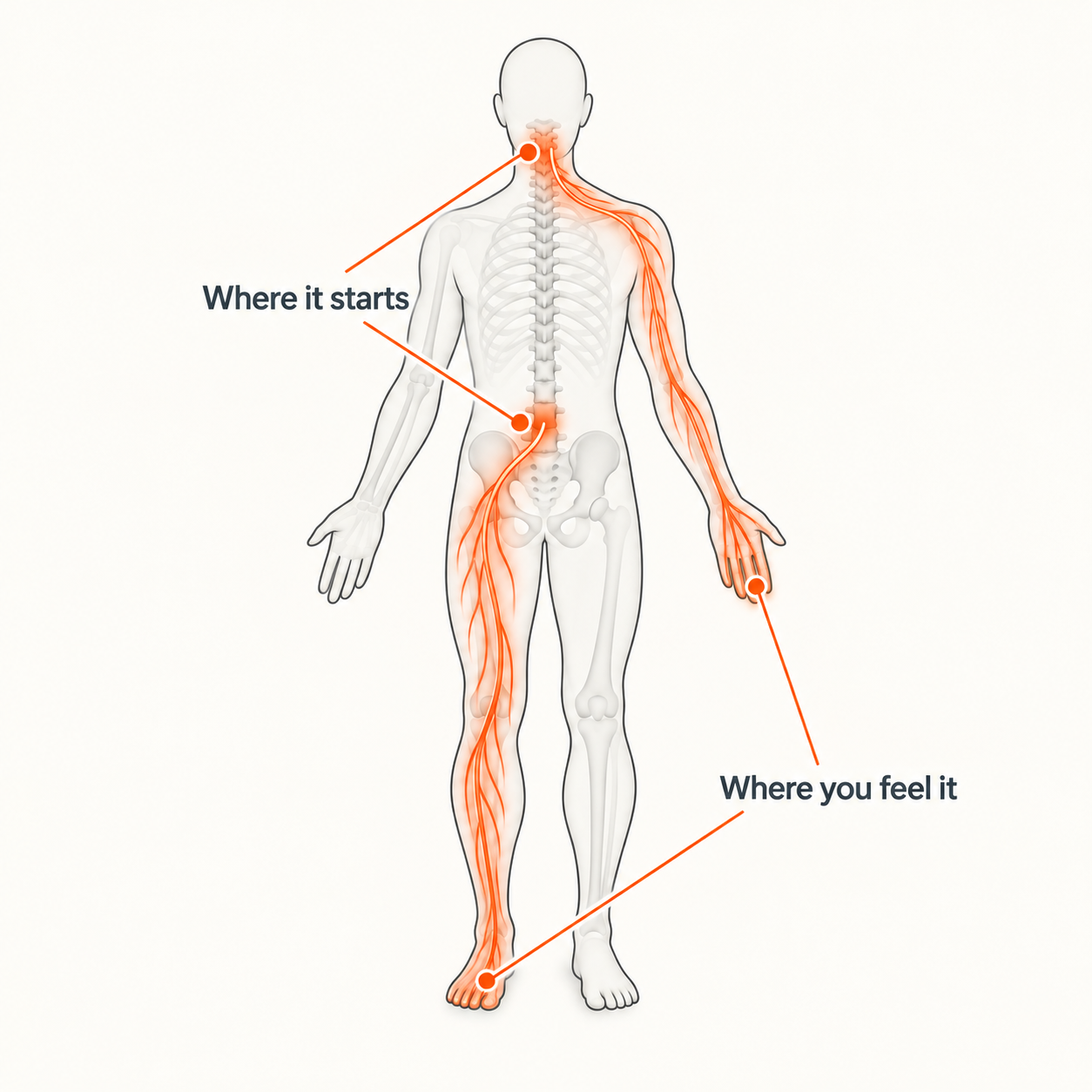
Here is the part most people don’t expect. The pain usually doesn’t show up at the spot of the pinch. The nerve sends its distress signal along its whole length. With a pinched nerve in the neck, the pain typically starts at the neck and travels down the arm into the area that nerve supplies. Cleveland Clinic notes that the C7 nerve root, which runs toward the middle fingers, is involved in more than half of neck cases.
That is why I see so many people who have been rubbing their shoulder or wearing a wrist brace for weeks when the real issue is two levels up in their neck. They were treating the spot that hurt, not the spot that was causing it.
What Pinched Nerve Symptoms Actually Feel Like
Patients rarely walk in and say “I have a pinched nerve.” They say things like “my arm feels like it’s asleep and won’t wake up,” “my fingers feel fat,” or “I keep dropping things.” They describe burning, buzzing, a hot wire, or a deep toothache feeling in the arm or leg.
When someone uses electrical words, burning or shocking or zinging, my ears perk up. Muscles don’t usually describe themselves that way. Nerves do. Many people also tell me it’s worst at night, which lines up with Mayo Clinic’s observation that pinched nerve symptoms can get worse during sleep.
Pinched Nerve or Pulled Muscle: How I Tell the Difference
Muscle pain tends to stay put. It’s achy, you can point to it, and it hurts when you press on it or use that muscle. Nerve pain travels. It follows a line, often past the elbow or below the knee, and it brings tingling, numbness, or weakness that a simple strain doesn’t cause.
In the exam, I check reflexes, skin sensation along specific nerve paths, and muscle strength side to side. If your right big toe can’t push up as hard as your left, that is not a sore muscle. That’s a nerve telling me something, and it changes how I treat you.
The Two Mistakes I See People Make Most
The first mistake is stretching it hard. Someone feels tightness down the back of the leg, assumes it’s a tight hamstring, and pulls on it every morning. An irritated nerve does not want to be yanked on, and I have watched good intentions make people noticeably worse.
The second mistake is waiting out the numbness because the pain calmed down. Pain fading feels like progress. But if the pain backs off while the numbness or weakness stays the same or gets worse, that is not always good news. Sometimes it means the nerve is under more pressure, not less.
Why I Watch What You’ve Lost More Than How Much It Hurts
This is an opinion I hold firmly. A 9 out of 10 pain with full strength and normal reflexes often worries me less than a 4 out of 10 with a weak grip. Pain gets all the attention, but loss of function is the signal that tells me how much the nerve is struggling.
I’ll say something else some of my colleagues won’t love. Not every pinched nerve should be adjusted on day one. A good chiropractor examines first, and sometimes the right call is to calm things down, order imaging, or send you to a specialist before touching your spine. Adjusting everything that walks through the door is not good care.
The Shift That Changed How I Measure Progress
Early in my career, I was focused on getting the pain number down, and I measured success by it. Over the years, I learned to measure what people can do again: sleep through the night, pick up a grandchild, button a shirt without fumbling.
That shift changed how I examine, how I set goals with patients, and when I refer out. As a believer and a dad, I see it simply. People don’t come to me for a lower pain score. They come because they want their life back with the people they love.

Red Flags: When to Skip the Chiropractor and Go to the ER
I want every reader to know these by heart:
Loss of bladder or bowel control, or trouble urinating
Numbness in the groin, buttocks, or inner thighs, the area that would touch a saddle
Weakness that gets worse by the day, like a foot that starts slapping the ground when you walk
Symptoms after a serious fall or car accident
Nerve pain along with fever, unexplained weight loss, or a history of cancer
The first two can point to cauda equina syndrome, a rare but serious compression of the nerves at the base of the spine. Emergency medicine researchers list reduced sensation in the saddle area and painless urinary retention among its warning signs, and note that delayed diagnosis can lead to poor outcomes.
Any of these means go now, not Monday. I would much rather you go to the ER and find out it was nothing than sit at home with a condition where hours matter. I have referred patients straight out of my office for this, and I will keep doing it.
When to See a Chiropractor for a Pinched Nerve, and What Happens First
If you don’t have any of those red flags, here is my rule of thumb. Come in if symptoms last more than a few days, keep coming back, or change when you move your neck or back. Same if you’ve rested, iced, and taken over-the-counter pain relievers and you’re still waking up with it. That matches Mayo Clinic’s guidance to see a professional when symptoms persist for several days and don’t respond to self-care.
At your first visit at Optimal Health Members, you’ll be examined before anything else happens: history, neurological testing, orthopedic tests, posture, and movement. We order imaging only when the exam says we need it. Then I explain what I found in plain language and what I think the plan should be. If I don’t think you’re a good fit for chiropractic care, I’ll tell you that too.
How We Care for Pinched Nerves at Optimal Health Members
The goal is to take pressure off the nerve and calm the irritated tissue around it. That usually means gentle, specific chiropractic adjustments to restore motion where the spine is stuck. Research supports this for the right patient: in a small randomized trial of people with lumbar radiculopathy lasting more than four weeks, adding spinal manipulation to physical therapy led to better results than physical therapy alone. For many patients, we also add Class 4 laser therapy or SoftWave to support the tissue around the nerve.
One thing I watch for during care is when symptoms start pulling back toward the spine, when the tingling leaves the fingers and settles in the shoulder blade. Patients sometimes think that’s worse because their neck hurts more. Clinicians call this centralization, and a systematic review of 62 studies found most supported it as a sign of a better outlook. I explain it ahead of time so nobody panics when it happens.
[PATIENT STORY NEEDED: a patient whose symptoms moved back toward the spine during care, and how you explained it to them; should show what that progression looks and feels like. Describe as one person’s experience, not a typical result.]
When a nerve has been irritated for a while, the joints, discs, and soft tissue around it often need support to finish their repair work between visits. That is where I sometimes bring up RECOVER™, a peptide and antioxidant complex from AgeRecode that combines BPC-157, GHK-Cu, and carnosine in a multi-phase capsule built to protect the peptides through digestion. It is not a replacement for hands-on care. The way I explain it, SoftWave, laser, and adjustments get things moving in the office, and RECOVER™ helps support the body’s normal tissue repair between appointments. If you take a blood thinner or are pregnant, talk with your provider before starting it.
The Daily Habits That Set Up a Pinched Nerve
The phone is number one for neck problems now. Your head gets heavier on your neck the farther it tips forward. A spine surgeon’s analysis estimated that tilting the head forward 60 degrees, the classic texting posture, puts roughly 60 pounds of force on the neck, compared with 10 to 12 pounds in neutral.
For low backs, I see the same pattern over and over: long sitting followed by sudden lifting, like driving two hours and then hauling luggage out of the trunk. For neck and arm symptoms, stomach sleeping with the head cranked to one side comes up a lot.
I don’t hand patients a list of ten changes. I ask them to fix the one position they spend the most hours in. Usually that’s the phone or the pillow, and it’s the change people actually keep.

If This Sounds Like You
If you recognized yourself in this post, the buzzing hand, the hot wire down the leg, the coffee cup that slipped, don’t wait until it becomes weakness. Start with an honest exam. If what you have needs a different specialist, I’ll tell you and help you get there. If it’s something we can help with, we’ll build a plan around what you want to be able to do again.
You can learn more or request a visit at optimalhealthmembers.com.