
The Natural Alternative to GLP-1 Injections That Your Doctor Probably Hasn't Told You About
By now you have heard about GLP-1 drugs. Ozempic. Wegovy. Mounjaro. They are everywhere — in the news, in celebrity conversations, in your social media feed. And the results people are reporting are real. I am not here to tell you the weight loss is fake.
What I am here to tell you, as someone who has spent nearly 30 years working with patients on their health at a root-cause level, is that there is a conversation happening around these drugs that is not complete. And there is an alternative that most people have never been told exists.
It is called GLP THREE™, and it is what I am recommending to patients and colleagues right now who want the metabolic benefits of GLP-1 support without the synthetic pharmaceutical approach.
Let me explain why — starting with what GLP-1 actually is, what the drugs do to your body, and why a natural pathway to the same outcome is worth understanding.
What Is GLP-1 and Why Does It Matter for Weight Loss
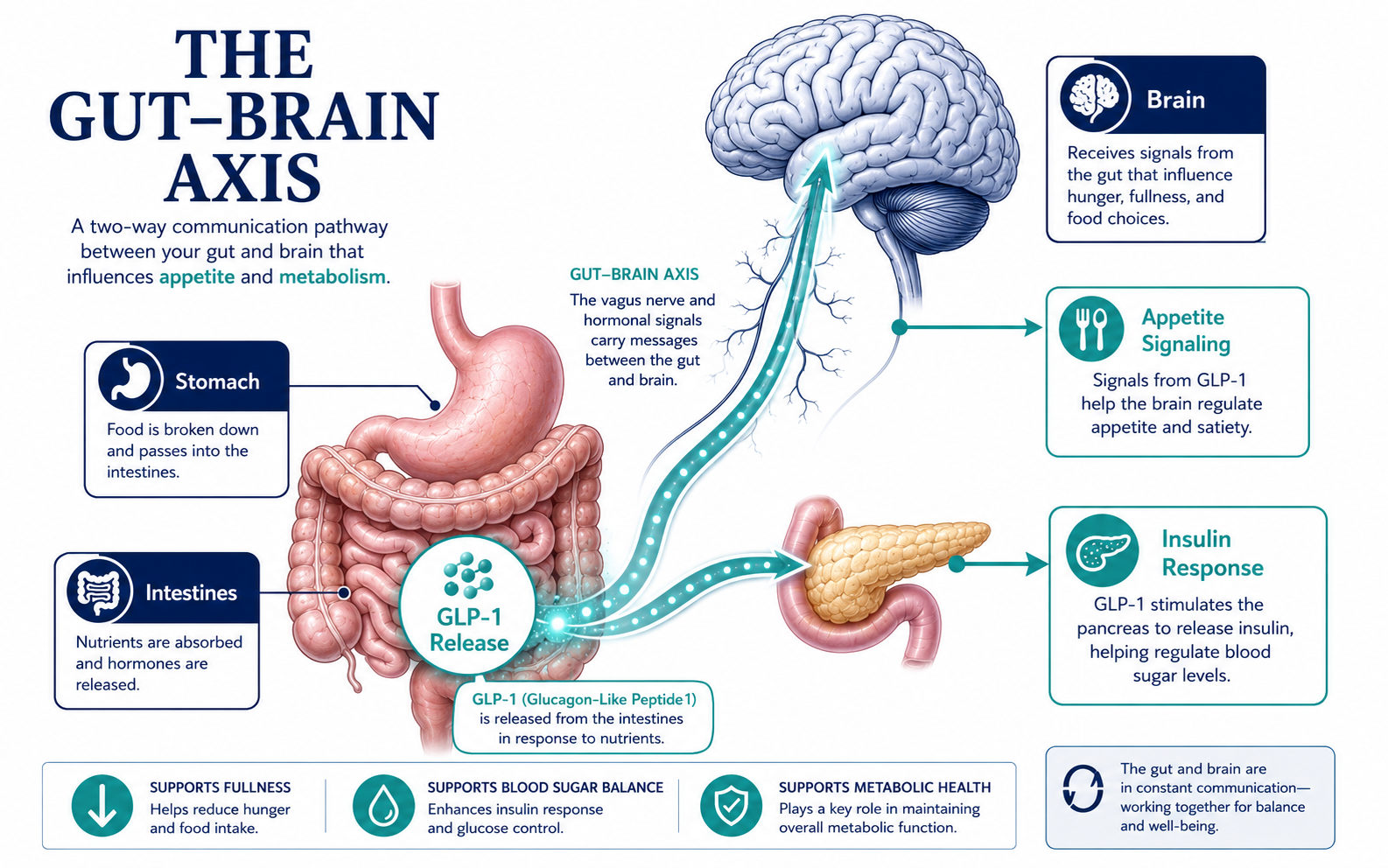
GLP-1 stands for glucagon-like peptide-1. It is a hormone your own body produces — primarily in the gut — in response to eating. When it is released, it does several important things at once: it signals your brain that you are full, it slows gastric emptying so you feel satisfied longer, it stimulates insulin release in response to blood sugar, and it suppresses glucagon — the hormone that tells your liver to dump more glucose into your bloodstream.
In other words, GLP-1 is your body's built-in metabolic regulator. People with obesity, type 2 diabetes, and metabolic syndrome often have impaired GLP-1 responses — meaning their bodies are not producing or responding to this hormone the way they should. That impairment drives overeating, blood sugar dysregulation, fat storage, and the frustrating cycle most people know all too well.
The pharmaceutical GLP-1 drugs work by flooding the system with a synthetic version of this hormone — or a molecule that mimics it — at doses far above what your body would naturally produce. That is why the appetite suppression is so dramatic. And that is also where the problems begin.
What the Pharmaceutical Approach Is Not Telling You
I want to be fair here. The GLP-1 drugs produce real, measurable weight loss results for many people. The clinical data supports that. What the clinical data also shows — and what is not making it into most mainstream conversations — is a set of consequences that matter deeply to anyone thinking long-term about their health.
Muscle mass loss is one of the most significant concerns. Studies on semaglutide have shown that a substantial portion of the weight lost comes from lean muscle tissue, not just fat. For anyone over 40, that is not a side effect to brush off. Muscle mass is directly tied to metabolic rate, bone density, insulin sensitivity, and long-term functional independence. Losing it rapidly while chasing a number on a scale is a trade-off most patients are never fully informed about.
Then there are the gastrointestinal effects — nausea, vomiting, diarrhea, and gastroparesis — which affect a significant percentage of users and in some cases become severe enough to require discontinuation. There are emerging concerns about thyroid C-cell tumors observed in animal studies, pancreatitis risk, and the well-documented reality that most people regain the weight when they stop the medication because the underlying metabolic dysfunction was never addressed.
I am not anti-medication. I am pro-information. And I think people deserve the full picture before they commit to an indefinite pharmaceutical regimen.
The Question Nobody Is Asking: Can You Support GLP-1 Naturally?
This is where it gets interesting, and where my clinical background and my personal commitment to root-cause health converge.
Your body already has the machinery to produce and respond to GLP-1. The question is not whether you need a synthetic version injected into your system. The question is: what is blocking your body's own GLP-1 response, and what can you do to restore it?
Research has identified several natural compounds that meaningfully support endogenous GLP-1 production and signaling. Specific dietary fibers, berberine, certain polyphenols, and targeted probiotic strains have all shown measurable effects on GLP-1 secretion, insulin sensitivity, and appetite regulation in peer-reviewed studies. This is not fringe science. This is published, reproducible research that the pharmaceutical conversation is simply not making room for.
GLP THREE™ by Three International is built around this science. It is a nutraceutical system designed to support your body's natural GLP-1 pathways — appetite regulation, blood sugar balance, metabolic function, and gut health — without synthetic hormones, without injections, and without the dependency and rebound cycle that comes with the pharmaceutical approach.
As a clinician with nearly 30 years of experience in natural health, this is the kind of solution I have been waiting for. Not a workaround. Not a lesser option. A smarter one.
What Makes GLP THREE™ Different

I have been in natural health long enough to be appropriately skeptical of anything that sounds too good. So let me tell you what I actually look for when I evaluate a product for my patients and my own practice.
First, I want to know what is in it and whether the ingredients have published research behind them — not just marketing claims. The compounds in GLP THREE™ target the actual biological mechanisms of GLP-1 support: gut hormone secretion, insulin sensitivity, inflammatory modulation, and satiety signaling. These are mechanisms with legitimate peer-reviewed backing.
Second, I want to know whether it is addressing root causes or just symptoms. A drug that suppresses appetite by flooding your system with synthetic hormones is addressing a symptom. A nutraceutical system that improves your gut's ability to produce and respond to its own metabolic hormones is addressing a root cause. That distinction matters enormously in long-term outcomes.
Third, I want to know whether the approach is sustainable. One of the most troubling things I see in clinical practice is people building their health around interventions they cannot maintain. The rebound data on GLP-1 drug discontinuation is sobering. A natural approach that trains the body to regulate itself more effectively is sustainable in a way that pharmaceutical dependency simply is not.
GLP THREE™ checks all three of those boxes for me. That is not something I say lightly.
Who This Is For

Let me be specific, because not every solution is right for every person.
GLP THREE™ is a strong fit for someone who is dealing with stubborn weight that is not responding to diet and exercise alone — particularly if blood sugar regulation, cravings, or appetite control are part of the struggle. It is well-suited for someone who has been considering a GLP-1 drug but has concerns about the side effects, the cost, or the long-term dependency. It is also a strong option for someone who has been on a GLP-1 drug and is looking for a way to transition off it while maintaining their results.
It is also worth considering for anyone with metabolic syndrome — the cluster of conditions that includes abdominal obesity, high blood sugar, elevated triglycerides, low HDL, and high blood pressure — because the underlying mechanisms GLP THREE™ targets are directly relevant to that entire cluster, not just the weight piece.
What this is not: a magic pill. No legitimate product is. What it is: a clinically informed, naturally derived system that gives your body the tools to do what it was designed to do, more effectively.
How I Use This in My Practice
I am a chiropractic physician first. My primary work is spinal and nervous system health. But I have spent three decades watching the limits of treating the body in isolation — the spine over here, the metabolism over there, the gut somewhere else — and I stopped practicing that way a long time ago.
When a patient comes to me struggling with weight and metabolic health, I am looking at the whole picture. Is there spinal interference affecting their nervous system function and their metabolic signaling? Are they getting the structural support they need as their body changes? And are they supporting their body's own biochemical pathways for metabolic regulation?
The gut, the nervous system, and metabolic function are deeply interconnected. You cannot fully optimize one without considering the others. GLP THREE™ fits into the metabolic and gut health piece of that picture in a way I can recommend with confidence — because it is working with the body's design, not overriding it.
I also tell my patients this: sustainable health transformation requires addressing structure, nervous system function, nutrition, and metabolic chemistry. GLP THREE™ handles a piece that diet and chiropractic alone do not fully cover. That is why it is part of what I recommend.
The Business Side: Why Health Professionals Are Paying Attention
I want to be transparent about something, because I think transparency is what builds real trust.
I am not only a clinician who recommends GLP THREE™. I am also a participant in the Three International business. That means I have a financial interest in sharing this product. I am telling you that upfront because I think you deserve to know it, and because I also think the product stands on its own merits whether or not there is a business attached to it.
The reason I got involved in the business side is the same reason I got involved in the clinical side: I saw something that worked and I wanted more people to have access to it. After nearly 30 years of watching patients struggle with metabolic health and the medical system's answers to it, finding a natural, science-backed alternative that also creates an income opportunity for health professionals who recommend it honestly — that is a combination I could not walk away from.
If you are a chiropractor, a health coach, a functional medicine practitioner, or anyone in the wellness space who is watching your patients turn to GLP-1 injections and wishing there was a better conversation to have with them — this is worth a serious look. Not because of the income potential alone, but because it gives you a tool that serves your patients and a business model that rewards you for doing what you were already doing: helping people get healthy.
You can learn more about the product and the opportunity at glpthreelife.com.
The Bottom Line

The GLP-1 conversation is not going away. Millions of people are turning to these drugs because they are desperate for something that works, and the medical system has not given them a better option.
I believe GLP THREE™ is a better option — not because it is natural for the sake of being natural, but because it works with the body's own design to restore something that was never supposed to require a pharmaceutical override in the first place.
Your body knows how to regulate appetite, manage blood sugar, and maintain a healthy weight. It was built with those systems intact. What breaks them down is years of processed food, chronic stress, sedentary living, gut dysbiosis, and systemic inflammation. The answer to that is not a lifetime on an injectable drug. The answer is giving your body back the tools it needs to do its own job.
That is what I have believed for 30 years. And that is why I am recommending this.
Want to Learn More or Get Started?
Whether you are a patient looking for a natural approach to metabolic health, or a health professional interested in adding GLP THREE™ to your practice and your income, I am happy to have that conversation.
Visit: glpthreelife.com