
Why Does My Lower Back Hurt First Thing in the Morning?
You swing your legs out of bed, set your feet on the floor, and your lower back announces itself before you have even stood up. The first few steps feel stiff and guarded, like you are carrying something heavy you cannot see. Somewhere between the bathroom and the coffee pot, it loosens. By lunch you hardly think about it. Then tomorrow morning arrives and it starts all over again.
If that is your routine, you are far from alone. About one in four U.S. adults reports low back pain lasting at least a day in any given three-month period. I have been a chiropractic physician for nearly 30 years, and "I'm fine once I get moving" may be the sentence I hear most in my exam rooms. The good news is that this pattern usually has an explainable cause, and most of the time it can be improved without drugs or surgery. Here is what I tell my patients.
Quick Answer: Your lower back usually hurts first thing in the morning because your spine has been still for hours, your discs have absorbed fluid and built up pressure, and irritated joints and tight hip muscles stiffen without movement. Most cases are mechanical and treatable. Stiffness lasting beyond 30 to 45 minutes deserves a proper evaluation.
Key Takeaways
Morning low back pain is most often mechanical: restricted joints, tight hips and glutes, and weak deep core muscles, made worse by hours of stillness.
Spinal discs hold more fluid in the early morning, which is one reason an already irritated back feels tighter at that hour.
Stiffness that fades within 10 to 20 minutes is usually mechanical. Stiffness that lasts longer than 30 to 45 minutes, wakes you at night, or comes with leg numbness or weakness needs a closer look.
The American College of Physicians recommends non-drug care first for low back pain, including spinal manipulation, exercise, and low-level laser therapy.
Simple habits, including gentle bed mobility, a better sleep position, and moving every 30 to 45 minutes, often help more than people expect.
What Is the Most Common Reason Your Lower Back Hurts in the Morning?
The complaint is almost always the same: "The first 15 to 30 minutes are rough, and then I'm fine." When I examine these patients, what I most often find is a mechanical problem, not a broken back. There is restricted motion in the lower lumbar joints or the sacroiliac joints, where the spine meets the pelvis. There are tight hip flexors and glutes from too much sitting. And there is weakness in the deep core muscles that are supposed to support the spine.
Your back is not failing overnight. It is being asked to hold one position for seven or eight hours, and a spine that is already irritated stiffens up. That is a very different situation from damage, and it is one of the reasons I stay optimistic with these patients. Most back pain improves within a few weeks, and the mechanical kind responds well when we address the actual cause and not just the sore spot.
What Is Actually Happening in Your Spine While You Sleep?
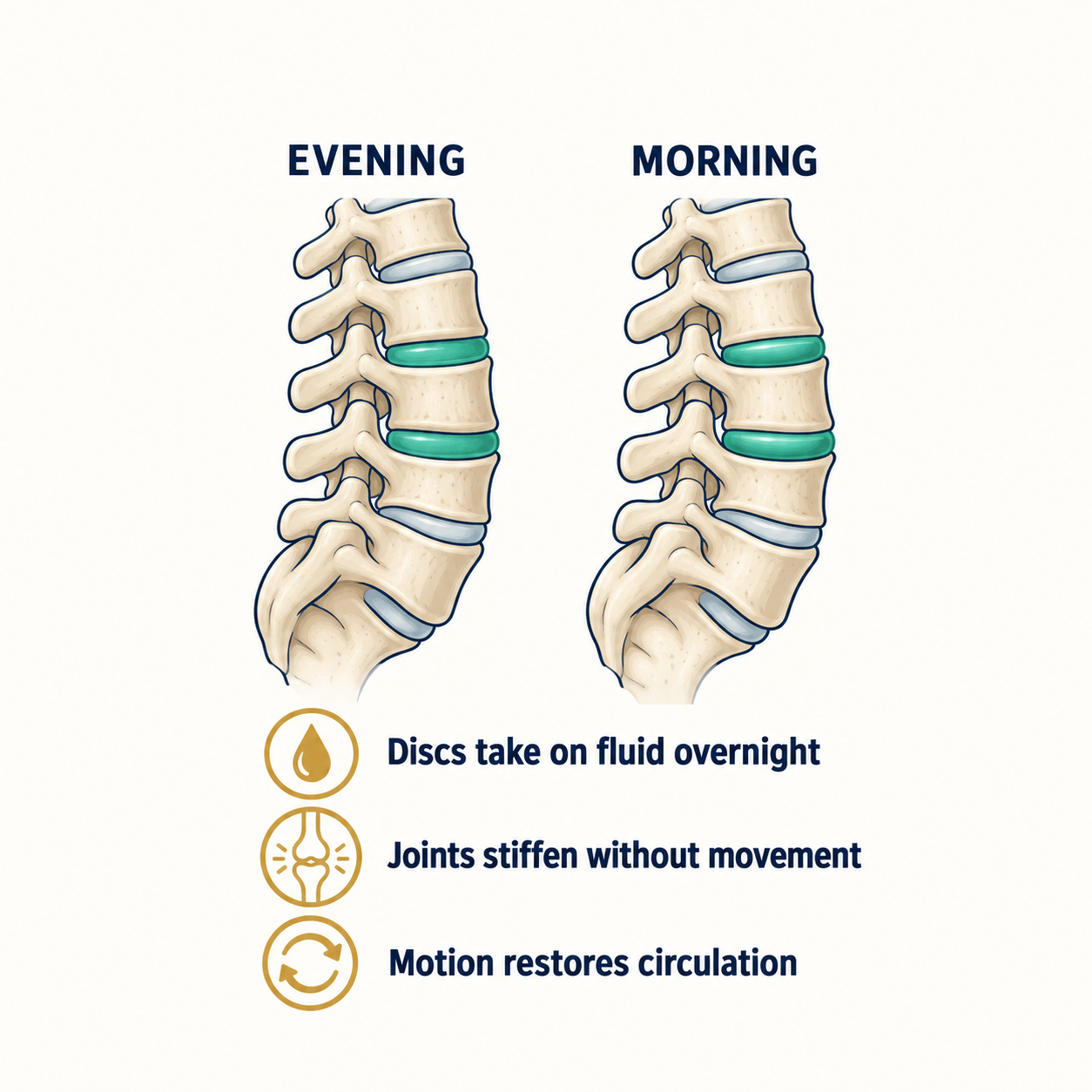
When you lie down, the discs between your vertebrae unload and take on fluid, so they are fuller and more pressurized in the morning than at night. Researchers studying early morning back pain have long pointed to the higher fluid content of the discs at that time of day as a reason the spine behaves differently first thing after waking.
If a disc or joint is already irritated, that extra pressure can feel tight and achy. On top of that, you have gone hours without the pumping action of movement, which is how your joints and soft tissues get fresh circulation. In my clinical experience, irritated tissue also tends to hold on to inflammatory byproducts while you are still. That is why the first steps out of bed can feel like you aged 20 years overnight, and why it eases as you start to move.
How Can You Tell Normal Morning Stiffness From Something More Serious?
Stiffness that fades within 10 to 20 minutes and comes and goes is usually mechanical and very treatable. I get more careful when morning stiffness lasts longer than 30 to 45 minutes, returns day after day, wakes you in the middle of the night, or shows up in a younger person with no clear cause.
That pattern can point to an inflammatory condition such as axial spondyloarthritis. A 2025 review in JAMA describes its classic picture: back pain that starts gradually before age 45, prolonged morning stiffness, improvement with exercise, and no improvement with rest. When I see that pattern, I refer out for lab work or imaging, because early diagnosis matters.
Pain that travels down the leg, or comes with numbness or weakness, also moves the case up my priority list. I cover the full list of warning signs near the end of this article.
Do Your Mattress, Pillow, and Sleep Position Really Matter?
They matter, but I do not think they are the whole story, and I do not want anyone spending $3,000 on a mattress hoping it fixes everything.
There is real research here, though. In a randomized, double-blind trial published in The Lancet, adults with chronic low back pain who slept on a medium-firm mattress had better pain and disability outcomes over 90 days than those on a firm one, including less pain on rising. So firmer is not automatically better. My own rule of thumb is that a mattress that sags in the middle, or one that is more than 8 to 10 years old, is worth replacing. If your back feels better in a hotel bed, that is useful information.
The biggest offender I see is stomach sleeping. It holds the lower back in extension and twists the neck for hours. Side sleepers do best with a pillow between the knees to keep the pelvis level, and back sleepers do well with a pillow under the knees.
How Do Sitting, Weight, and Stress Add to Morning Back Pain?
Everything you do during the day shows up in your back at night. Long hours of sitting shorten the hip flexors, and tight hip flexors pull on the lumbar spine. Extra weight around the midsection shifts your center of gravity forward and loads the lower back all day. A large meta-analysis in the American Journal of Epidemiology found that overweight and obesity are associated with a higher prevalence of low back pain, and I see that connection often in my weight loss patients. If that is part of your picture, it is one of the reasons we approach metabolic health as part of back care through our GLP THREE program.
Poor sleep and chronic stress also make the body more sensitive to pain, in my experience. Dehydration and a diet that keeps inflammation high do not help either. That is why I look at the whole person, not only the spot that hurts.
What Does This Look Like in Real Life?
A gentleman in his early fifties came to see me after about two years of waking up with a stiff, aching low back. He had tried new mattresses, ibuprofen, and stretches he found online. He told me the worst part was dreading the first ten minutes of every day and being short with his family because of it.
On exam, he had a stuck joint at L5 and the sacrum, very tight hip flexors from a desk job, and almost no deep core activation. We started with chiropractic adjustments, added Class 4 laser to calm the inflamed tissue, and gave him three simple mobility drills to do before he stood up. Within a few weeks, he told me mornings were no longer something he had to brace for.
Nothing about his story was unusual. That is exactly why I share it. When we find the real drivers, the body often responds faster than people expect.

What Should a Proper Evaluation Include?
I start with a thorough history: when the pain began, how long it lasts each morning, what makes it better or worse, and how you sleep. Then I look at posture, gait, and how the spine, hips, and pelvis move. I test muscle strength and check neurological function, meaning reflexes, strength, and sensation. If something looks off, I order imaging or refer out.
What a rushed visit often misses is the hips and the pelvis. Many people with low back pain have a hip or sacroiliac problem driving it, and treating only the sore spot gives short-lived relief. Finding the true source is the difference between feeling better for a day and feeling better for good.
How Do We Treat Morning Low Back Pain at Optimal Health Members?
I match the care to the cause. Chiropractic adjustments restore motion to restricted joints. Class 4 laser therapy reduces inflammation and supports tissue healing, and many patients feel a noticeable change quickly. SoftWave therapy is a good option for stubborn, chronic tissue problems because it stimulates the body's own repair response. I pair those with targeted rehab exercises so the results last.
This approach lines up with what the medical literature supports. The American College of Physicians recommends non-drug treatment first for low back pain. For acute and subacute pain, that includes heat, massage, acupuncture, and spinal manipulation. For chronic pain, it includes exercise, low-level laser therapy, and spinal manipulation, among others. To be fair, the evidence for manipulation is rated low quality, which is one reason I never rely on it alone. On the laser side, one randomized trial of high-intensity laser therapy found that combining it with exercise worked better than placebo laser plus exercise in chronic low back pain. It was a small study, so I treat it as encouraging, not final.
Tissue that has been irritated for months also needs help finishing its repair work between visits. Adjustments, Class 4 laser, and SoftWave get the healing process started, and for patients who need extra support I sometimes recommend RECOVER™, a regenerative peptide and antioxidant complex, to help the body sustain that repair between appointments. It is not a replacement for hands-on care. If you take blood thinners or are pregnant, please check with your provider first.
Most patients notice their mornings improving within the first several visits, though every case is different and I do not make promises I cannot keep.
What Can You Do Tonight to Make Tomorrow Morning Easier?
Keep it simple. None of this is fancy, but done consistently it works better than most people expect.
Before you get out of bed:
Do a few gentle knee-to-chest pulls, one leg at a time.
Do some slow pelvic tilts with your knees bent.
Rock your bent knees slowly from side to side.
Then get up and walk for a few minutes instead of sitting right back down.
Tonight and through the day:
Skip stomach sleeping. Put a pillow between your knees if you sleep on your side, or under your knees if you sleep on your back.
Do a few minutes of hip flexor stretching before bed.
Drink a glass of water first thing in the morning.
Get up from your desk every 30 to 45 minutes.
When Should You Stop Handling It Yourself and Get Care?
Some situations are not wait-and-see. Mayo Clinic advises getting emergency care if back pain follows an injury such as a fall or accident, causes new bowel or bladder control problems, or comes with a fever. It also recommends scheduling a visit if the pain is constant or intense, spreads down a leg, causes numbness, tingling, or weakness, or comes with unintended weight loss.
For everyone else, if morning pain has lasted more than a couple of weeks or is getting worse, please do not just live with it. Most back pain is treatable without drugs or surgery, and finding the real cause early keeps a small problem from becoming a chronic one. Your body is built to heal when it gets the right help. Stiff, painful mornings are not a normal part of getting older, and you do not have to accept them.
If your mornings have been something you brace for, I would love to help you change that. If you live in the Henderson or Las Vegas area, you can learn more about our care at Optimal Health Members. If you are farther away and want to talk about how weight and metabolic health may be loading your back, you can explore our online option at glpthreevegas.com. Either way, the first step is simply deciding that stiff mornings are not something you have to accept.
This article is for education and is not a substitute for an individual evaluation by your healthcare provider.