
Is Your Metabolism Really Slowing Down With Age?
I hear a version of this sentence in my office almost every week. "Doc, my metabolism must be slowing down, because nothing I do is working anymore." Usually it comes from someone in their 40s or 50s who has done everything they know how to do. They have cut calories. They have tried a new diet plan. They are exhausted, a little discouraged, and convinced their body has turned against them.
Here is what almost thirty years of clinical practice has taught me. Your metabolism did not betray you. It adapted to years of signals you have been sending it, some helpful and some not. That distinction matters, because it changes the whole conversation from "my body is broken" to "my body is responding, and I can change what I'm asking of it."
Quick Answer
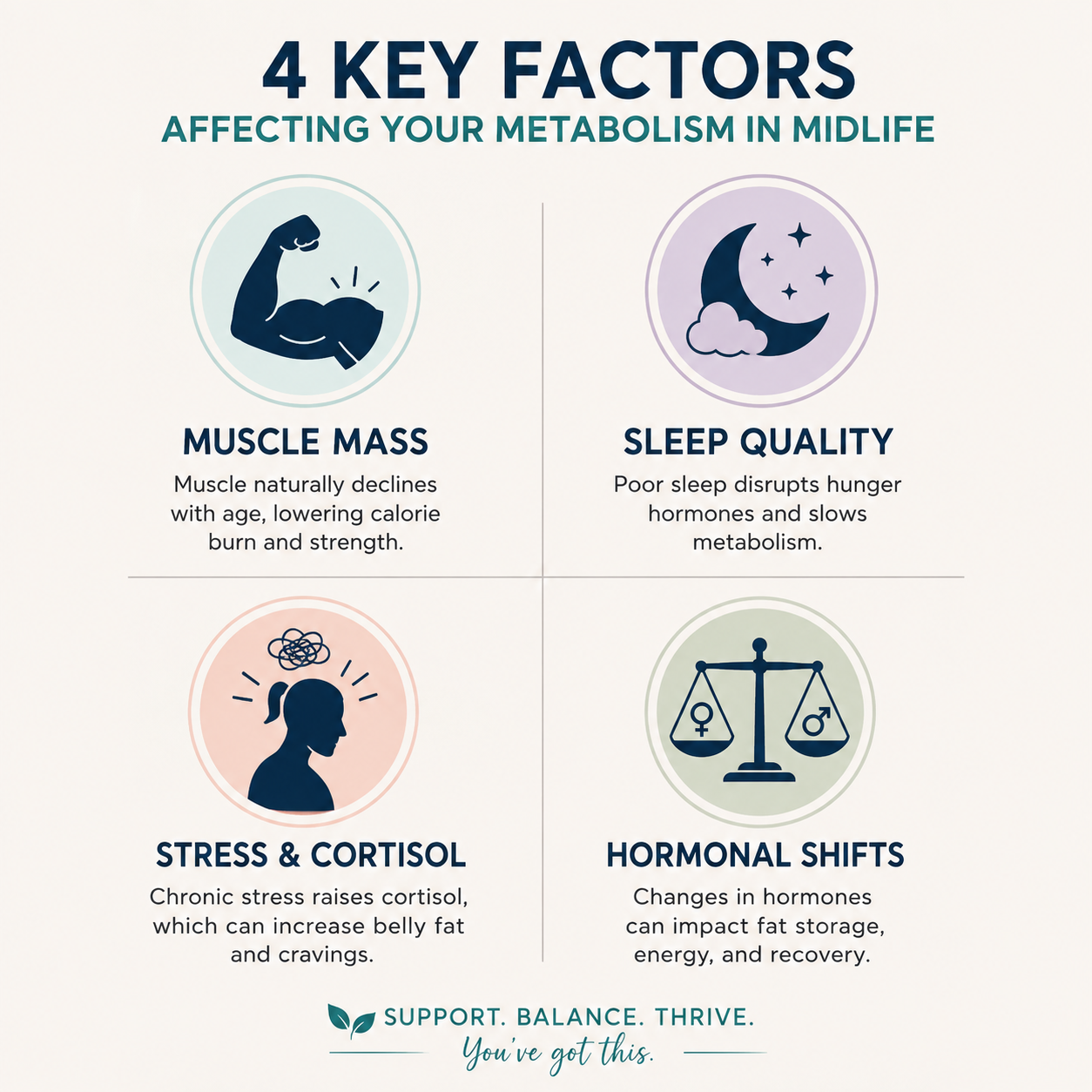
Metabolism does slow with age, but not the way most people think. The bigger drivers are muscle loss, poor sleep, chronic stress, and hormonal shifts, not some fixed biological shutdown. Most of these are influenceable well into your 50s and 60s with the right approach to strength, sleep, and stress, not just diet.
Key Takeaways
Muscle mass naturally declines by roughly 3 to 8 percent per decade after age 30, and this rate accelerates after 60.
Chronic stress keeps cortisol elevated, which shifts fat storage toward the abdomen and worsens insulin sensitivity.
Even a single night of short sleep can raise ghrelin and lower leptin, the hormones that drive hunger and fullness.
Menopause is associated with a significant shift toward visceral fat storage and reduced insulin sensitivity, independent of total weight change.
In men, testosterone declines gradually starting in the 40s, and low testosterone is directly linked to reduced muscle mass and strength.
What Is Actually Happening To Your Metabolism As You Age
Your metabolism is not an engine that quietly loses horsepower every year against your will. For most people, what looks like "metabolic slowdown" is really a slow accumulation of lifestyle drift. Less muscle mass. More sedentary hours. Worse sleep. More stress hormones circulating through the body day and night. None of that is a personal failure. It is simply what happens when daily habits shift gradually over years, often without anyone noticing until the scale or the mirror forces the conversation.
I start seeing these changes show up clinically in the late 30s to mid 40s, though it is rarely dramatic at first. Patients tell me their clothes fit differently even though their eating has not changed much. They are more tired by mid afternoon. Recovery from workouts takes longer than it used to. On exam, I am often watching for reduced muscle tone, changes in posture and movement patterns, and sleep disruption that the patient has not yet connected to their weight or their energy.
A Patient Story That Changed How I Explain This
I had a patient, a woman in her late 40s, who was convinced her metabolism had shut off completely. She had tried three different diets that year, each one stricter than the last, and each one had left her more frustrated. When we actually sat down and went through her daily routine together, the picture became clear. She was sleeping about five hours a night and had not done any resistance training in over a decade.
It was not her metabolism failing her. It was a body running on a deficit it could not recover from. We did not start with another diet. We started with sleep, and we added strength training twice a week. Within a month, before her scale weight had even changed much, her energy had shifted noticeably. That case has stuck with me because it is such a common pattern. People chase the food piece first when the food piece is often not the real problem.
Why Muscle Mass Deserves More Of The Conversation
Muscle is metabolically active tissue. It burns calories even at rest, and we begin losing it steadily after age 30 if we are not actively working to preserve it, a gradual process researchers call sarcopenia. That loss accelerates further after age 60. I think this piece gets left out of most weight and metabolism conversations because it is not a quick fix. Nobody wants to hear "lift weights consistently for the next year" when they are hoping for a fast answer. But muscle is one of the most controllable levers we have against age-related metabolic decline, and it responds to effort at almost any age.
How Stress And Sleep Quietly Work Against You
This is one of the most underestimated pieces of the puzzle. Chronic stress keeps cortisol elevated, and elevated cortisol shifts the body toward storing fat in the abdominal region while impairing insulin sensitivity. Poor sleep compounds the problem. Research on sleep restriction shows it reduces leptin, raises ghrelin, and increases hunger and appetite, especially cravings for calorie-dense food. I have had patients who ate cleaner than almost anyone in my practice and still could not lose weight, because their nervous system was stuck in a stress response around the clock.
If you are dealing with ongoing muscle tension, poor sleep, or a body that feels like it never fully recovers, our team at Optimal Health Members looks at the whole picture, not just diet and exercise in isolation.
The Biggest Mistake I See People Over 40 Make
Cutting calories aggressively without addressing muscle or stress is the fastest way to feel worse and see less progress. Severe restriction can signal the body to hold onto fat stores more tightly, especially when it is already managing elevated stress hormones. I would rather see a patient eat enough to fuel their body, build muscle, and manage their nervous system than starve their way toward a number on the scale that will not hold anyway.

Where Hormonal Change Fits In
Hormonal shifts are real and they matter. Women moving through perimenopause and menopause experience changes in estrogen that are associated with a significant increase in visceral fat storage and reduced insulin sensitivity, even when total body weight has not changed much. Men see a gradual decline in testosterone, typically beginning in the 40s, and lower testosterone is linked to reduced muscle mass, strength, and increased visceral fat.
I do not ignore this piece of the picture, but I also do not let it become the whole story. Hormones shift the terrain. Daily habits still determine a lot of what grows on it.
How I Approach Metabolic Health Differently
I look at the whole system rather than handing someone a generic "eat less, move more" answer. Sleep, stress, movement, nutrition, and how well the nervous system and spine are functioning all factor in, because chiropractic care is not separate from metabolic health. It is connected to how well the body communicates with itself. I am not interested in a number on a scale. I am interested in a patient who has real energy, stable blood sugar, and a body that is actually working with them instead of against them.
When The Body Needs More Support
For patients who have hit a wall, especially those who have done everything right and still feel stuck, GLP THREE gives us another tool to support metabolic function while we work on the foundational pieces together. It is not a shortcut around the work. It is support for a body that needs help regulating appetite and metabolic signaling while we rebuild muscle, improve sleep, and reduce inflammation. I have seen it help patients gain enough momentum to make the harder, more sustainable changes actually stick.

You Are Not Working Against Your Body
Your body is not working against you. It is responding to years of signals, and it can change how it responds once you change what you are sending it. I have watched patients in their 50s and 60s rebuild strength and energy they thought they had lost for good. It is never too late to start speaking a different language to your body. It is still listening.
If you are ready to figure out what is actually driving your metabolism instead of guessing, our team at Optimal Health Members in Henderson would be glad to help you build a real plan, and if appetite regulation has been the missing piece, GLP THREE may be worth a conversation as well.