Is Laser Spine Surgery Really Better Than Traditional Surgery?
You have been living with the pain long enough that surgery is starting to feel like the only door left. Then someone mentions laser spine surgery, and something in you lifts a little. Laser. That sounds precise. Clean. Safe. Maybe even easy.
I understand exactly why that word lands the way it does. And I want to give you the honest clinical conversation that too many people never get before they walk into a surgical consult.
After nearly 30 years of treating spine patients, I have seen what happens before surgery, after surgery, and in the long space between. Here is what I know.
What Most People Think "Laser Spine Surgery" Means
Most of my patients arrive thinking laser spine surgery is essentially magic. They picture a pinpoint beam of light that vaporizes the problem with no real cutting, no real recovery, and none of the fear that comes with traditional surgery. The word "laser" carries psychological weight for good reason. We use lasers to correct vision, remove tattoos, and resurface skin. The assumption follows naturally: surely they can fix a disc without really touching me.
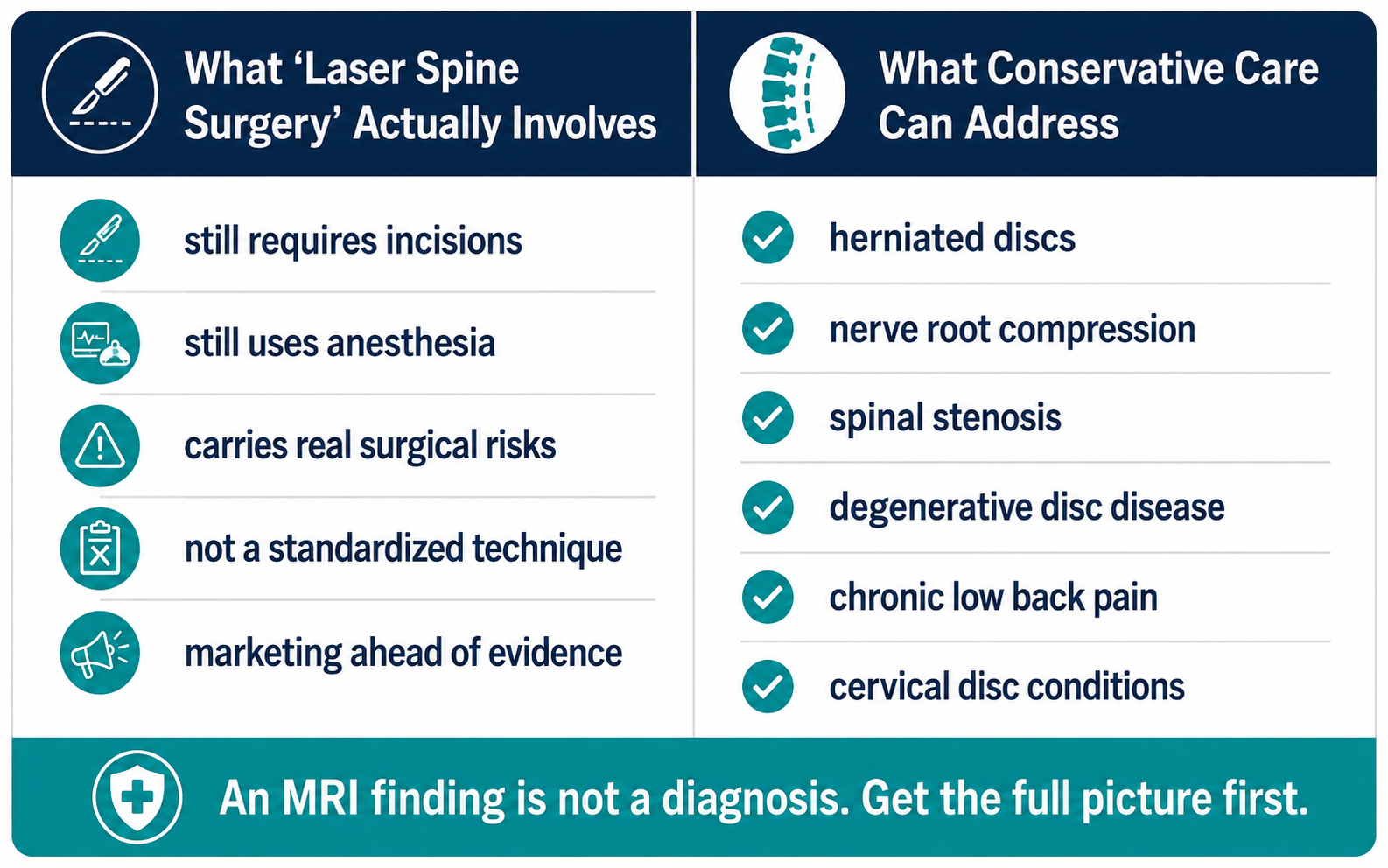
What most people do not realize is that laser spine surgery still requires incisions, still involves anesthesia, and still carries real surgical risks. The laser is a tool used during the procedure. It is not a replacement for surgery. The marketing has done a remarkable job of positioning it as a category above traditional surgery, when in clinical reality it is often a variation of it.
The American Academy of Orthopaedic Surgeons notes that the term "laser spine surgery" is not a standardized surgical classification, and different surgeons use it to mean different things. There is no uniform technique. There is no outcome data that specifically attributes success to the laser itself versus the surgical approach as a whole.
I see patients who have already scheduled their consultation before they even fully understand what they have signed up for. That is the gap this conversation is meant to close.
The Conditions That Most Often Lead Patients Toward Surgery
Almost every day I hear some version of the same short list: herniated discs, sciatica, spinal stenosis, degenerative disc disease, chronic low back pain, and cervical disc issues that are becoming more common as people carry their heads forward over phones and screens for hours at a time.
These are real, painful, life-disrupting conditions. I am not minimizing them. What I am pushing back on is the assumption that they inevitably require surgery.
Degenerative disc disease is one that frustrates me in particular, because DDD is largely a radiological description of a normal aging process, not an automatic predictor of pain or dysfunction. I have 40-year-olds with degenerative changes on MRI who are training for marathons. I also have patients in genuine misery with relatively unremarkable imaging.
That brings me to the single most important thing I can tell you: an MRI finding is not a diagnosis. Research has shown that a substantial percentage of asymptomatic adults over 40 have disc bulges, degeneration, or narrowing visible on imaging — and feel nothing. The image does not tell the whole story. And yet we have built an entire surgical referral pattern around it.
My Honest Clinical Assessment of Laser Spine Surgery
I want to be fair here, because fairness is how I earn the trust of patients who have already been told contradictory things by multiple providers.
Laser spine surgery has a place. In specific situations, particularly with a contained, well-localized soft tissue issue like a small herniation impinging a nerve root, a minimally invasive approach using laser technology can be appropriate. I am not dismissing it categorically.
But my real concern is this: the marketing is significantly ahead of the evidence. And the centers that market laser spine surgery most aggressively tend to attract patients who have not been told about, or have not genuinely tried, conservative alternatives.
I have also seen patients who had laser spine procedures and ended up right back where they started. Still in pain. Still with nerve symptoms. Sometimes with scar tissue or instability that made their situation more complex than before they went in. Epidural fibrosis following spinal surgery is a well-documented complication that can create a new layer of chronic pain on top of the original problem.
The phrase "minimally invasive" does not mean "minimal consequences if it fails." That is the part that gets left out of the brochure.
What "Less Invasive" Does Not Mean
I use an analogy with my patients that tends to land clearly. If you had a slow leak in your roof and someone offered to patch just the visible drip spot with the smallest possible patch, versus someone who wanted to pull back the section and actually fix the underlying structure — which one is less invasive? The patch, clearly. But which one is more likely to hold for ten years?
Less invasive means a smaller entry point. It does not mean more thorough. It does not mean more durable. It does not mean the underlying pathology was more completely addressed.
The goal is not to have the smallest surgery. The goal is to have the right intervention for your specific situation, with the highest probability of a durable outcome. Sometimes those two things align. Sometimes they do not. You need someone being honest about that distinction — not leading with "no big incisions" as the primary selling point.
Patterns I Have Seen After Spine Surgery Over 30 Years
The patients who do best after surgery are the ones who had a clearly defined, anatomically confirmed cause of their pain — a specific disc compressing a specific nerve root, confirmed by both imaging and consistent clinical presentation — and who had experienced surgeons followed by proper rehabilitation. Those outcomes can be genuinely good.
But the pattern I see far more often is what I call "some better, not resolved." The acute crisis is gone. The searing nerve pain that was waking them up at 3 AM has quieted. But there is still chronic background pain, still limited function, still nerve sensitivity. And they were not told that could happen.
Nobody sat down and said: surgery can relieve compression, but it cannot undo years of degenerative change, it cannot restore disc height, and it cannot reverse the muscular and neurological adaptations your body has made over months or years of guarding and compensation.
Adjacent segment disease following spinal fusion is a documented and clinically meaningful phenomenon — the level above or below a fusion can begin breaking down under increased mechanical load within a few years. This is not a rare complication. It is a pattern with enough prevalence that it has its own clinical name.
The patients who had unrealistic expectations struggle the most. Not just physically, but emotionally. They feel betrayed. That outcome is preventable with honest conversations before surgery, not after.

The Patient Who Was Told He Needed Surgery Twice
A gentleman in his late 40s came to me after two separate orthopedic surgeons had recommended a lumbar discectomy. He had a large L4-L5 herniation on MRI, significant right leg sciatica, pain consistently rating 7 or 8 out of 10, and difficulty sitting for more than 20 minutes. He had been dealing with it for about four months.
He was scared of surgery but also desperate. He told me he was ready to go ahead with it because he could not keep living like that.
We started him on a structured protocol: spinal decompression three times a week, chiropractic adjustments focused on restoring lumbar and sacroiliac mechanics, Class 4 laser over the lumbar spine and along the sciatic distribution, and targeted soft tissue work on his hip flexors and piriformis, which were contributing significantly to the nerve irritation. We also talked about his diet, because he was eating in a way that was actively feeding systemic inflammation.
By week four, he was at a 4 out of 10. By week eight, he was back to hiking on weekends. He never had surgery. That was over two years ago. He checks in periodically. The disc did not disappear from his MRI. But his body adapted, the inflammation resolved, and the nerve healed.
Research supports the likelihood of spontaneous disc herniation resorption over time, particularly with conservative care that reduces inflammation and restores proper mechanics. That process happens more often than most surgical consult offices will tell you.
What I Offer Before Anyone Considers Surgery
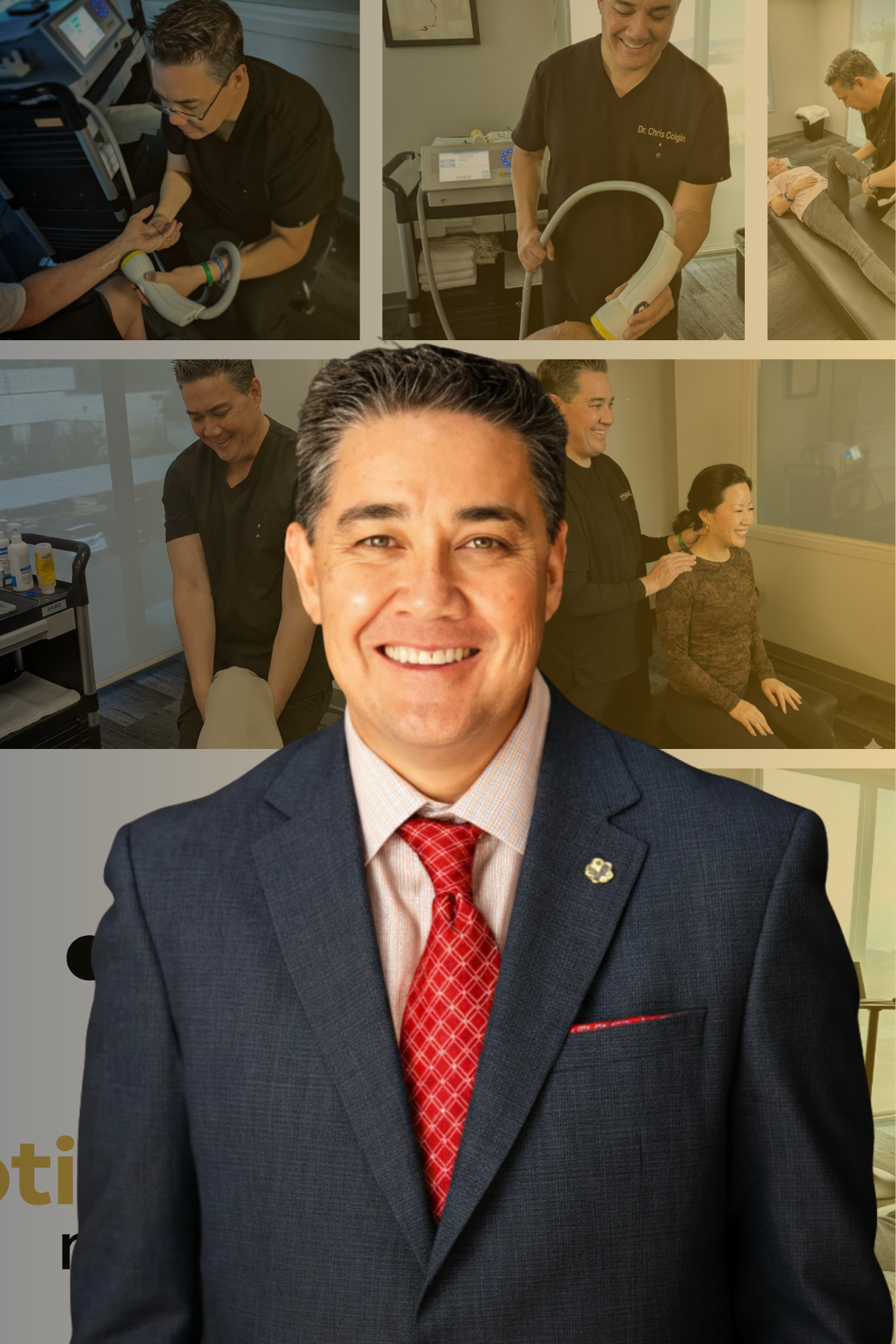
At Optimal Health Members in Henderson, we have built a genuinely comprehensive non-surgical toolkit, and I am proud of what it can do for the right patient.
Chiropractic care is the foundation, but not the version people picture where someone pops your back and sends you home. We do specific segmental analysis, motion palpation, and targeted adjustments based on what that individual spine is actually doing biomechanically.
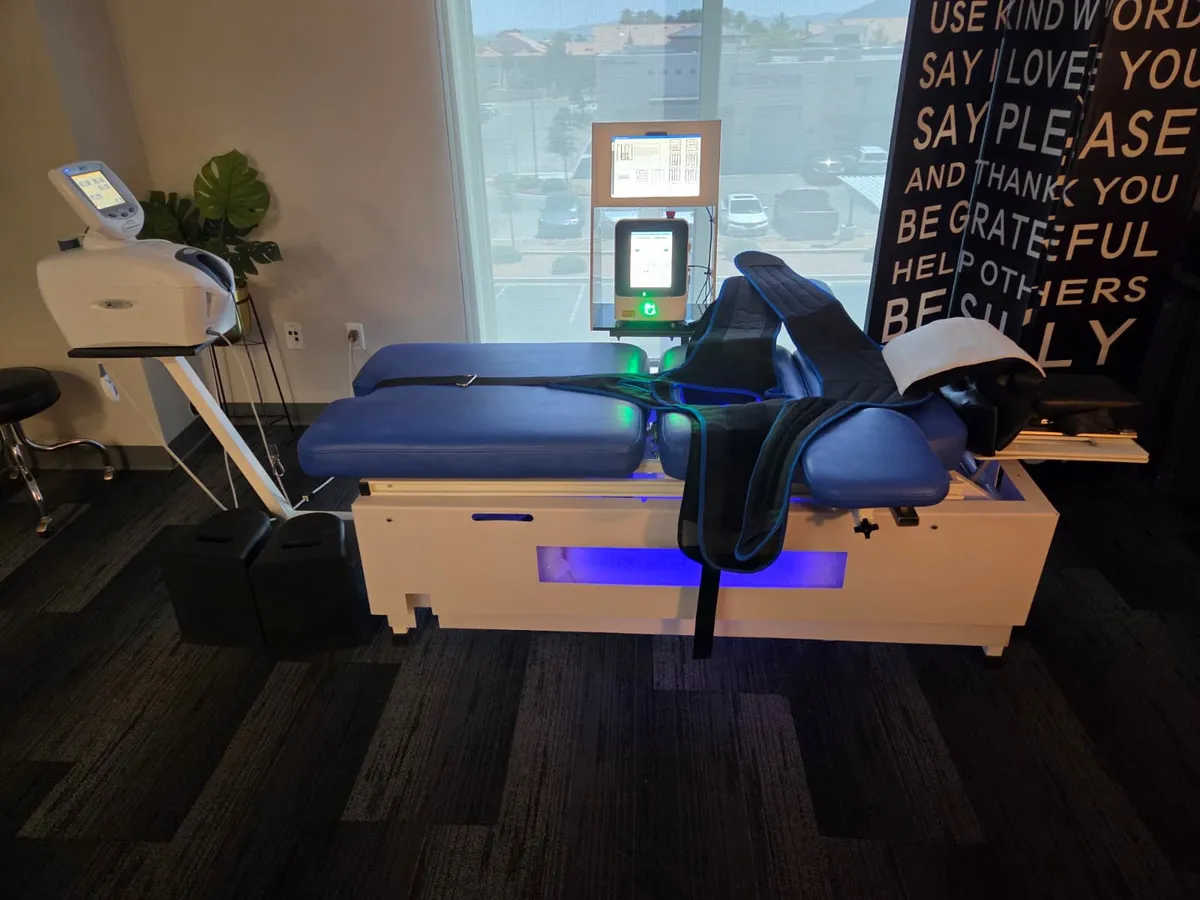
Spinal decompression therapy is a significant part of how we manage disc-related conditions — herniations, degenerative disc disease, stenosis. Mechanical decompression creates negative intradiscal pressure that supports disc retraction and promotes nutrient diffusion back into the disc in a controlled, position-specific way.
SoftWave Tissue Regeneration Therapy operates at a cellular level, activating the body's own healing cascade, recruiting the body's repair mechanisms to the site of injury, and reducing inflammation without suppressing the healing process. For chronic pain patients, the results have been meaningful.
Class 4 laser therapy uses photobiomodulation to accelerate tissue healing, reduce nerve inflammation, and support cellular repair along the pain pathway.
Red light therapy for systemic inflammation and mitochondrial support.
Functional medicine evaluation, because I have seen too many patients whose chronic spine pain had a significant inflammatory or metabolic component that nobody ever addressed. Systemic inflammation is a documented contributor to disc degeneration and spinal pain chronicity. If your gut is dysbiotic, if you are running on chronic inflammation, if your hormones are out of balance, your body cannot heal efficiently.
And increasingly, I am integrating nutraceutical and natural metabolic support, including natural GLP-1 pathway support through GLP THREE at glpthreelife.com, because metabolic health and musculoskeletal health are not separate conversations. Excess weight, insulin resistance, and inflammation all directly affect the spine's ability to heal and function.
When Surgery Is Actually the Right Answer
I want to be direct about this, because I think it builds trust and because it is simply the truth: surgery saves lives and saves function. I believe that without equivocation.
Progressive neurological deficit — weakness that is getting worse week over week, not just pain — is a time-sensitive situation where surgery may be the right call. Bowel or bladder dysfunction is a red flag that requires immediate evaluation and potentially emergency surgical decompression. Cauda equina syndrome is a surgical emergency, full stop. That is not something you treat conservatively and hope for the best.
Significant trauma, fractures, dislocations, instability from injury, tumors, spinal infections, severe progressive deformity — these are surgical indications, and I would be the first to say you need to see a surgeon today.
And genuinely failed conservative care — meaning a proper, structured, monitored trial of multiple non-surgical approaches over an adequate timeframe — that too warrants a surgical conversation. I am not in the business of keeping people out of surgery at the cost of their quality of life. I am in the business of making sure surgery is the right tool for the right problem at the right time.
What I Want You to Take Away From This
The fear of traditional surgery is real. The appeal of something that sounds gentler and faster makes complete sense. But do not let fear of one option push you into another option you have not fully evaluated. That is still a reactive decision, and your spine deserves better than a reactive decision.
Before you sign anything, ask yourself honestly: have I truly exhausted conservative care? Not "tried a few things" — but actually committed to a structured, supervised, multi-modal non-surgical program with a provider who specializes in spine? There is a meaningful clinical difference between failed conservative care and undertreated conservative care. Most people who tell me they have tried everything have tried a few weeks of generic physical therapy and some anti-inflammatories. That is not the same thing.
If you have done that work and you are still suffering — if there are neurological symptoms that are not resolving, if you have confirmed structural compromise that is progressing — then surgery may genuinely be right for you. And if that is where you land, please get more than one surgical opinion, understand exactly what is being done and why, ask your surgeon directly what the evidence base is for the specific technique they are recommending, and have a post-surgical rehabilitation plan in place before you go in.
You get one spine. Treat that decision accordingly.

Ready to Explore What Is Actually Possible Before Surgery?
If you have been told you need spine surgery and you are not sure you have fully explored your options, I want to talk with you. Not to keep you out of surgery at any cost — but to make sure you have the complete picture before you make an irreversible decision.
Call or text us at 702-541-9060 or schedule a consultation at OptimalHealthMembers.com. We will take the time to understand your case, your imaging, your history, and what has and has not been tried. Then we will give you our honest clinical assessment.
No pressure. No agenda other than getting this right for you.