
How to Stay Motivated During Long-Term Weight Loss
Most people do not fail at weight loss because they are lazy. They fail because they run out of answers — and no one around them had better ones.
I have been in clinical practice for nearly 30 years. I have sat across from thousands of patients who came to me frustrated, defeated, and genuinely convinced something was wrong with them. They had tried everything. They had done the programs, cut the calories, hired the coaches. And they still hit a wall somewhere around month three or four — right when, biologically and physiologically, they were closer to a real breakthrough than they had ever been.
That pattern — and what actually changes it — is what this post is about.
The Moment Most People Quit Is the Moment Right Before It Gets Real
If I had to name one pattern I have watched repeat itself across three decades of practice, it is this: patients quit at the plateau.
Not at the beginning when it is hard to start. Not in the middle when they hit a slow week. They quit after they have been doing the work for months, the scale stops moving, and nothing in their environment reflects the progress their body is actually making.
That is the breaking point. And it is brutally predictable.
What makes it worse is that most people interpret a plateau as evidence that they have failed. They think their body is broken, the program is a scam, or they just do not have what it takes. What they do not understand — because no one has ever explained it to them — is that a plateau is usually a sign of metabolic adaptation, not failure. The body is recalibrating. Hormones are shifting. The system is reorganizing.
The patients who push through that window almost always see results on the other side. The ones who quit take those unearned results to their next program, and the cycle starts again.
The Framework I Come Back to Over and Over Again
I do not teach my patients to "stay motivated." Motivation is an emotion. Emotions are temporary. What I teach them is to build a relationship with their own biology — one that is based on information, not feeling.
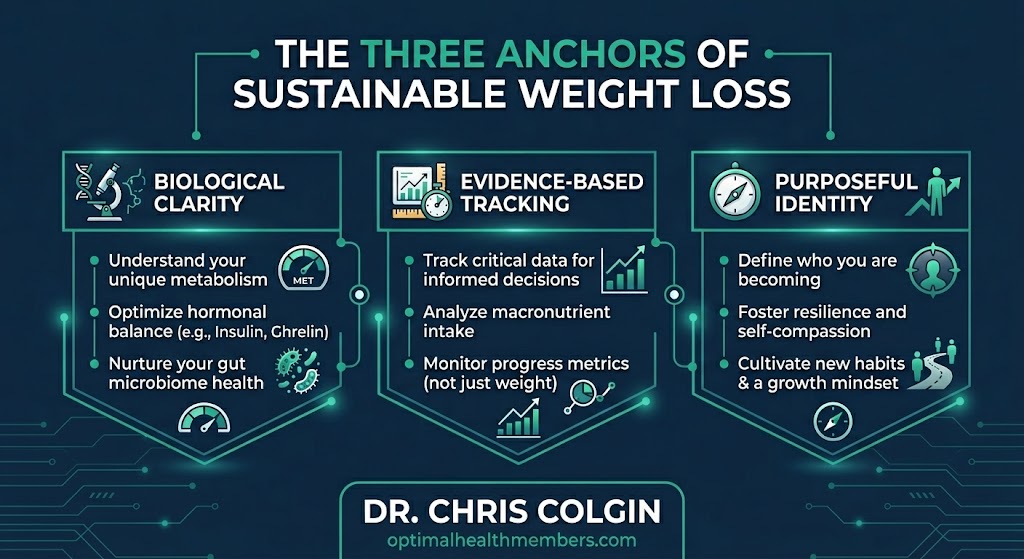
My framework is simple: I call it the Three Anchors model.
The first anchor is biological clarity — understanding what your body is actually doing and why. When patients understand that leptin and ghrelin — the hormones that regulate hunger and satiety — change significantly during caloric restriction, they stop blaming themselves for being hungry. They start working with their physiology instead of fighting it.
The second anchor is evidence-based tracking — measuring things that actually reflect metabolic health, not just scale weight. Energy levels. Sleep quality. Inflammatory markers. Waist-to-hip ratio. Fasting glucose. These numbers tell a more honest story than a single number on a scale ever will.
The third anchor is purposeful identity — knowing specifically why you are doing this and making sure that reason is bigger than how you look in a mirror. Appearance goals run out of fuel. Health goals, legacy goals, "I want to keep up with my grandchildren" goals — those burn longer and cleaner.
When all three are in place, motivation becomes less relevant. You are not white-knuckling it. You are navigating.
What One Patient's Story Taught Me About Hitting the Wall
I want to share a case — details changed to protect privacy — that I think about often because it captures exactly what I am talking about.
A woman came to me about four years ago. She was in her late 50s, post-menopausal, and had been working with a weight loss program for four months. She had lost 14 pounds in the first eight weeks and then nothing for the last six. Her doctor had told her to "just keep going." Her program coach had told her to "tighten up her diet." She came to me because her back pain was worsening and she mentioned, almost in passing, that she was about to quit everything.
When I actually looked at her numbers — not just her weight but her labs, her sleep history, her stress load, her inflammatory markers — the picture was completely different from what she had been told. She had significant subclinical hypothyroidism that was affecting her metabolism. Her cortisol pattern suggested she was in chronic stress-response. And she was sleeping five hours a night because she was waking at 3 a.m. with racing thoughts.
None of those things were willpower problems. Every one of them was a clinical issue with a clinical answer.
We addressed the thyroid piece with her primary physician. We worked on her sleep. We added specific nutritional support for her cortisol pattern. And within six weeks, the plateau broke.
She lost another 22 pounds over the following five months. More importantly, she stopped waking up feeling like a failure.
The wall she hit was not a character flaw. It was a diagnostic gap. That is what I see over and over again — and it is the most important thing I want every reader of this post to understand.

How Much of "Losing Motivation" Is Actually a Biological Problem
This is the question I wish more clinicians were asking.
In my experience — both clinical and in reviewing the research — the majority of what patients call "losing motivation" during long-term weight loss is at least partially physiological. Not entirely. But more than most people realize.
Here is what I actually see:
Sleep deprivation — even mild, chronic under-sleeping — measurably increases ghrelin (the hormone that makes you hungry) and decreases leptin (the hormone that makes you feel full). A patient running on six hours of sleep is fighting their own neurochemistry every time they try to make a food choice. That is not a motivation problem. That is a hormonal problem.
Blood sugar dysregulation creates energy crashes that mimic depression and fatigue. When your glucose is spiking and crashing, your brain registers those crashes as emergency signals. Willpower is among the first things to go.
Chronic low-grade inflammation — common in metabolically compromised patients — is directly linked to fatigue, brain fog, and what researchers sometimes call "sickness behavior," which looks a lot like apathy and disengagement.
I explain it to patients this way: imagine trying to run a marathon while someone keeps deflating your tires. You would not call that a character problem. You would fix the tires.
When we address the biology, the mindset piece becomes far more workable. Not easy — but workable. The two are not separate. They are deeply connected.
What the Scale Is Actually Doing to You
I am going to be direct about this: daily weigh-ins are one of the most destructive habits in long-term weight management for the majority of patients. Not all — some people genuinely benefit from frequent data. But most people are not using the scale as a data tool. They are using it as an emotional verdict.
Body weight fluctuates — legitimately — by two to five pounds in a single day based on hydration, sodium, hormonal cycles, bowel status, and inflammation alone. A woman who ovulates, trains hard, sleeps poorly, and eats a salty dinner can wake up three pounds heavier than yesterday with zero change in actual fat tissue. If she then adjusts her entire program based on that number, she is being guided by noise — not signal.
What I recommend to most patients is a weekly weigh-in at most, always at the same time under the same conditions (first thing in the morning, post-bathroom, before eating). And I pair that with clear instruction: we are looking at the four-week trend line, not today's number.
The scale is one data point in a much larger picture. The patients who learn to treat it that way — as one instrument in an orchestra, not the whole performance — do dramatically better over time.
What Most Weight Loss Programs Get Completely Wrong
I will say this plainly: most weight loss programs are built around compliance, not transformation.
They measure success in pounds and weeks, which turns a biological process into a performance review. They create reward structures around restriction — which, from a behavioral psychology standpoint, tends to backfire badly once the external structure disappears. And almost none of them address the underlying metabolic, hormonal, or inflammatory factors that determine whether a given intervention will even work for a given body.
The other thing most programs get wrong is the timeline. They market 12-week results. Real metabolic recalibration — the kind where the body actually resets its set point and stops fighting the loss — takes longer. Much longer. Expecting 12-week outcomes from a 12-month process is a recipe for the cycle of failure and restart that I watch consume patients' confidence year after year.
What I try to do at Optimal Health Members is give patients a clinical foundation beneath their weight loss — labs, markers, a real understanding of what their individual metabolism is doing — so they are not guessing. They are not hoping a generic program fits their specific biology. They have actual data.
That changes the dynamic entirely.
The Wins That Actually Predict Long-Term Success
Here are the non-scale markers I tell every patient to track, because these are the ones that predict whether the program is actually working:
Energy across the afternoon. Afternoon energy crashes are a direct signal of blood sugar dysregulation. When those crashes disappear — and patients feel genuinely alert from 2 to 5 p.m. — that is a sign their glucose regulation is improving. That is a metabolic win.
Sleep quality. When patients start sleeping through the night, waking up rested, and falling asleep within 20 minutes of lying down, something real has shifted. Metabolic health and sleep quality are bidirectionally linked — each improves the other.
Joint pain and inflammation. I am a chiropractic physician. I watch this closely. When patients lose even 5 to 10 percent of body weight, the reduction in joint load is significant — but the reduction in systemic inflammation often happens even before that, with dietary change alone. Patients who stop hurting as much are patients who keep going.
Clothes fit. I ask patients to pick one item of clothing — a specific pair of pants, a jacket — and check in with how it fits every few weeks. This captures body composition changes that the scale completely misses during muscle-building phases.
Cognitive clarity. Brain fog lifting is one of the most underreported but meaningful early wins. Patients describe it as "finally feeling like myself again." When that happens, I know we are on the right track.
I coach patients to actively celebrate these markers. Not as consolation prizes for not losing enough weight. As legitimate evidence that their body is changing at a level the scale cannot see yet.
Why Natural Metabolic Support Changes the Motivation Equation
This is something I have watched closely over the past couple of years, especially since I began working with GLP THREE™ through Three International.
The patients who have historically struggled most with long-term motivation are those whose hunger and craving signals are simply too loud. They are not weak. They are metabolically dysregulated. Their GLP-1 pathways — the ones that regulate satiety and glucose metabolism — are underperforming. And no amount of motivational coaching overrides a biological signal that says "you are starving" when you are not.
Natural metabolic support that targets those pathways — that helps the body regulate hunger more accurately and stabilize blood sugar — does not do the work for you. But it creates a biological environment where the work you are doing actually has a chance to show up.
The patients I work with who incorporate this kind of support alongside the clinical guidance, the tracking, and the lifestyle framework describe something I hear consistently: the noise goes down. They are not fighting constant hunger. They are not white-knuckling through every meal. They can actually think about what they are doing and why.
That is the motivation shift I care about. Not a pep talk. A quieter body. A clearer head. A fighting chance.

Why "Why" Matters More Than Anything Else I Can Offer You
I lead everything I do — in the clinic, in my role with the Nevada Chiropractic Association, in the work I do with patients through GLP THREE™ — with purpose. Not as a motivational poster concept. As a clinical observation.
The patients who maintain long-term results almost always have a "why" that goes beyond appearance. I am serious about this. Patients who say "I want to lose 30 pounds" struggle far more than patients who say "I want to be there for my daughter's wedding in three years without needing a mobility aid" or "I had a heart attack and I am not willing to have another one."
There is actually good research behind this. Self-determination theory consistently shows that intrinsic motivation — motivation rooted in personal meaning and values rather than external rewards or pressure — predicts long-term behavior change far better than any program feature or structured incentive.
When I ask patients the question "why does this matter to you?" and they give me an answer that makes them tear up a little, I know we have something to work with. That emotion is not weakness. It is fuel.
I believe God put each of us here with a purpose and a body designed to carry it out. Part of my work — and genuinely the part I find most meaningful — is helping people get their body back to a place where it can support the life they are supposed to be living. That is not a tagline. That is why I come to work.
If You Are Three Months In and Thinking About Quitting, Read This
Do not make a permanent decision based on a temporary plateau.
That is it. That is the advice. But let me unpack it.
Three months in is one of the most common quitting points because three months in is when the initial motivation fades, the early results have plateaued, and the finish line still feels impossibly far away. It is the valley. And the valley is not evidence that you are failing. It is evidence that you are in the hard middle — which means you have already done the hard beginning.
The patients I have seen push through that valley and come out the other side have one thing in common: they got more information instead of less. They did not quit and restart. They dug in and asked better questions. What is my body actually doing right now? What numbers should I be looking at? What does my biology need from me in this phase?
If you are at that point and you are working with me, call us. If you are not yet a patient, I want you to know that what you are experiencing is normal, it is explainable, and there are answers that do not require more willpower or another 12-week program.
Come in. Let us look at the actual picture. Let us figure out together what your body needs — not what a generic program says it needs.
You can reach us at Optimal Health Members or learn more about how we support metabolic health at glpthreelife.com.