How Sitting Affects Your Metabolism, Blood Sugar, and Weight
If you've been doing everything right with your diet and the scale still won't move, or your last lab work showed your fasting glucose creeping up for no clear reason, the answer might not be on your plate at all. It might be in your chair. After nearly 30 years of treating patients in Henderson, I can tell you that the number of hours someone sits each day predicts their metabolic health almost as reliably as what they eat.
Quick Answer: Sitting for long stretches shuts down the large muscles in your legs and glutes, which stops them from clearing glucose and fat from your bloodstream. This drives up blood sugar, lowers insulin sensitivity, and slows fat metabolism, even in people who exercise regularly. Breaking up sitting every 30 minutes with two to three minutes of movement measurably improves blood sugar and fat processing.
Key Takeaways
Prolonged sitting suppresses lipoprotein lipase, the enzyme your muscles use to clear fat from the bloodstream, within about a day of inactivity, according to research on skeletal muscle lipoprotein lipase regulation.
A controlled trial published in Diabetes Care found that interrupting sitting with brief bouts of light or moderate walking every 20 to 30 minutes measurably lowered postprandial glucose and insulin levels compared with uninterrupted sitting.
Standing still is not the same as moving. A study on breaking up sitting in older adults found walking breaks improved postprandial insulin and glucose meaningfully, while standing breaks alone did not improve any metabolic outcome.
People who sit more than eight hours a day with no physical activity carry a risk of death comparable to the risks posed by obesity and smoking, according to Mayo Clinic's review of pooled sitting studies.
One workout does not cancel a sedentary day. A clinical trial tracking daily step counts found the metabolic benefit of exercise on fat processing is abolished once daily steps drop below roughly 5,000, while step counts above about 8,500 preserve that benefit.
What Sitting Actually Does Inside Your Body
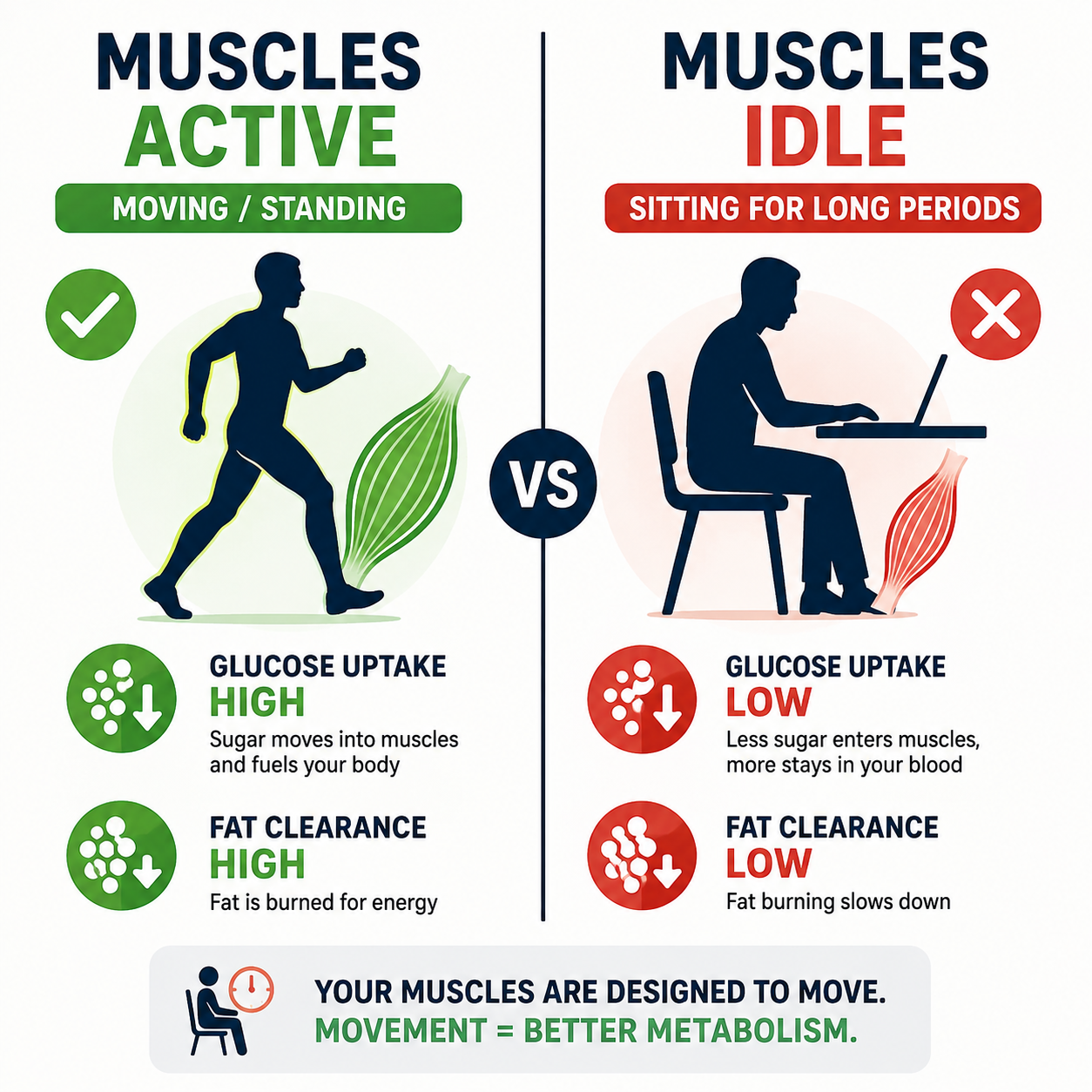
When you sit for long periods, the large muscles in your legs and glutes essentially go quiet. Those are some of the biggest muscle groups you have, and they are supposed to be pulling glucose out of your bloodstream and burning fuel all day long. When they shut off, your body stops managing insulin efficiently and blood sugar starts running higher than it should.
I tell patients to picture their leg muscles as a large furnace. Sitting does not just dim that furnace, it turns it off. Research on skeletal muscle response to inactivity has shown that reduced muscle contraction leads to decreased lipoprotein lipase activity, the enzyme responsible for clearing triglyceride-rich fat from the blood, along with declines in muscle triglyceride uptake within just 24 hours of inactivity. That is not theory. That is measurable, and it happens fast.
So you get a double hit. Less fat clearance and worse blood sugar control, happening at the same time, every single day you are parked in a chair for hours. Mayo Clinic's overview of sitting risks links extended sitting to a cluster of conditions that make up metabolic syndrome, including increased blood pressure, high blood sugar, excess body fat around the waist, and unhealthy cholesterol levels.
I see this constantly in my own practice, even in patients whose main complaint has nothing to do with weight. Someone comes in for low back pain or hip stiffness, and once I start asking about their day, I find out they are sitting nine or ten hours between a desk job and the commute. If they are doing metabolic work with us, I will often see it reflected in their labs too, borderline fasting glucose, a creeping A1C, stubborn weight around the midsection that will not budge no matter what they are eating.
I had a patient, a claims adjuster in her late 40s, who was doing everything right with her diet and still gaining weight. Once we mapped out her actual day, she was sitting almost 11 hours. We did not change her food much at first. We just got her moving in short bursts throughout the day, and her fasting glucose improved within six weeks. The chair turned out to be the bigger problem, not the plate.
One Workout Does Not Undo a Sedentary Day
This is one of the most important things I tell patients, and it surprises almost everyone. A hard workout in the morning does not erase eight or nine hours of sitting afterward. I call it the weekend warrior trap. People think if they hit the gym hard for an hour, they have earned the right to sit the rest of the day guilt free. Metabolically, it does not work that way.
A clinical trial tracking step counts and fat metabolism found that the metabolic benefit exercise provides for fat processing is abolished after a period of physical inactivity, and that taking 5,000 steps or fewer per day cancels out that benefit even when a formal workout is included, while roughly 8,500 steps or more a day preserves it. Your muscles need to be intermittently active throughout the day to keep pulling glucose and fat out of circulation, not active once and idle for the other 15 waking hours.
This is why I keep my coaching simple, because complicated plans do not survive a real workday. My rule of thumb is two to three minutes of movement every 30 minutes. Stand up, walk to get water, do a few bodyweight squats, walk to a coworker's desk instead of messaging them. It does not need to be a workout, it needs to be an interruption. A randomized trial published in Diabetes Care found that sitting interrupted with two minutes of light or moderate walking every 20 to 30 minutes significantly reduced postprandial glucose and insulin responses compared to uninterrupted sitting.
I tell patients to set a silent timer or use a smartwatch reminder because willpower alone will not do it. Your environment has to prompt you.
Where Standing Desks Actually Fit In
Standing desks help, but I think they get oversold as a complete fix. Standing burns a bit more energy than sitting, but standing frozen in place for eight hours is not dramatically different metabolically from sitting for eight hours if you are not actually moving. In a controlled crossover study on older adults, standing breaks did not improve postprandial glucose, insulin, or triglyceride outcomes at all, while light walking breaks produced clinically meaningful improvements. A separate trial comparing prolonged standing directly against prolonged sitting found that standing reduced fasting triglycerides but did not meaningfully change the postprandial glucose or insulin response the next day compared to sitting.
What matters is alternating positions and adding real movement, not trading one static posture for another. I recommend standing desks to patients who ask, but I am honest that the desk itself is not magic. The people who do best with them use the height adjustment as a cue to change position and move, not as a way to stand frozen while scrolling through email.
How This Connects Directly to Weight Loss
Calories matter, I am not going to pretend they do not. But sitting changes the environment those calories are processed in. When your muscles are inactive, insulin resistance creeps up, and insulin resistance makes it harder for your body to access stored fat for fuel. So you can be eating a reasonable amount and still struggle to lose weight if your blood sugar regulation is off.
This is part of why we built our GLP THREE online weight loss program the way we did. For a lot of people, especially those who have plateaued, the missing piece is not willpower or another diet, it is addressing the metabolic dysfunction that sedentary time creates. Movement is not just about burning calories in the moment, it is about keeping your whole system sensitive to insulin so the calories you do burn actually work the way they are supposed to.
The stakes are higher for people who already have blood sugar concerns. If you are insulin resistant or prediabetic, prolonged sitting makes a bad situation worse faster, because your body has less margin to work with. I have had patients with prediabetes see meaningful drops in fasting glucose from breaking up sitting time alone, before we changed anything else about their diet. For someone with healthy insulin sensitivity, an occasional long sitting day will not cause lasting damage, but the habit adds up over months and years for everyone.

What This Has to Do With Chiropractic Care
Some patients do not see the connection at first, but the link is direct. Prolonged sitting compresses the spine, tightens the hip flexors, and weakens the posterior chain, the glutes and hamstrings that should be doing the metabolic work I described earlier. When those muscles are inhibited by poor posture and disuse, they are even less available to help regulate blood sugar when you finally do move. Chronic sitters commonly develop tight hip flexors and decreased hip mobility, which compounds the problem.
Part of what I do with adjustments and rehab is restore normal movement patterns so those muscles can fire correctly again. I have had patients who could not properly activate their glutes during a simple movement screen because they had been sitting so long the neuromuscular connection had gotten sluggish. Getting the spine and hips moving properly again is not just about pain relief. It is about giving those large metabolic muscles their job back.
Realistic Strategies If Your Job Requires Long Hours at a Desk
The goal is not to quit your job, it is to work with the hours you have got. I have had patients set up walking meetings for calls that do not need a screen, eat lunch away from their desk and take a ten minute walk afterward, or do calf raises and seated marches while on a call. None of it looks impressive, but it adds up.
According to Mayo Clinic's guidance on breaking up sedentary time, standing, walking, or stretching for at least five minutes every sitting hour meaningfully offsets a large share of the health risks associated with prolonged sitting. Those small movements throughout the day are sometimes called nonexercise activity thermogenesis. They are not formal exercise, but they keep your metabolism engaged.
I also tell patients not to underestimate the two bookends of the day, the walk before work and the walk after dinner. Those alone can offset a meaningful amount of the metabolic cost of a sitting heavy day. Perfect is not the goal. Consistent interruption is.
Your body was built to move constantly in small ways throughout the day, not occasionally. Sitting is not dangerous in the way people picture danger, but the metabolic cost is real and it is cumulative. The good news is the fix is not complicated or expensive. You do not need a gym membership to protect your blood sugar and your weight. You need to stand up more than you think you should.

If your labs are drifting in the wrong direction, or the scale is not moving despite doing everything right with food, it is worth looking at how much of your day is spent sitting still. At Optimal Health Members in Henderson, we look at the whole picture, movement patterns, posture, blood sugar, and metabolic health, not just diet. If weight loss has been the sticking point, our GLP THREE online program is built to address the metabolic dysfunction that sedentary time creates, wherever you live. Reach out and let's find where your day is working against you.