How Sitting Affects Your Metabolism, Blood Sugar, and Weight
If you spend most of your day in a chair, you already know the back pain and the afternoon slump. What you may not know is that your metabolism is quietly changing too, and it has nothing to do with willpower.
I have been practicing chiropractic medicine for almost thirty years, and the patients I see today look different than the ones I saw when I started. Back then, sitting was something people did during the workday and stopped doing when they got home. Now it is the default. Cars, desks, couches, screens. And the body is starting to show us what it thinks about that arrangement, in ways that go well beyond a stiff low back.
This is the conversation I have with patients almost every single day, so I wanted to lay it out here the way I explain it in the office. No scare tactics, just the mechanics of what is actually happening in your body when you sit for hours at a time, and what to do about it.
Why Sitting Quietly Changes Your Blood Sugar
Here is how I explain it to patients. Your body was built to move, and when it doesn't, the systems that regulate blood sugar and burn fuel basically go quiet.
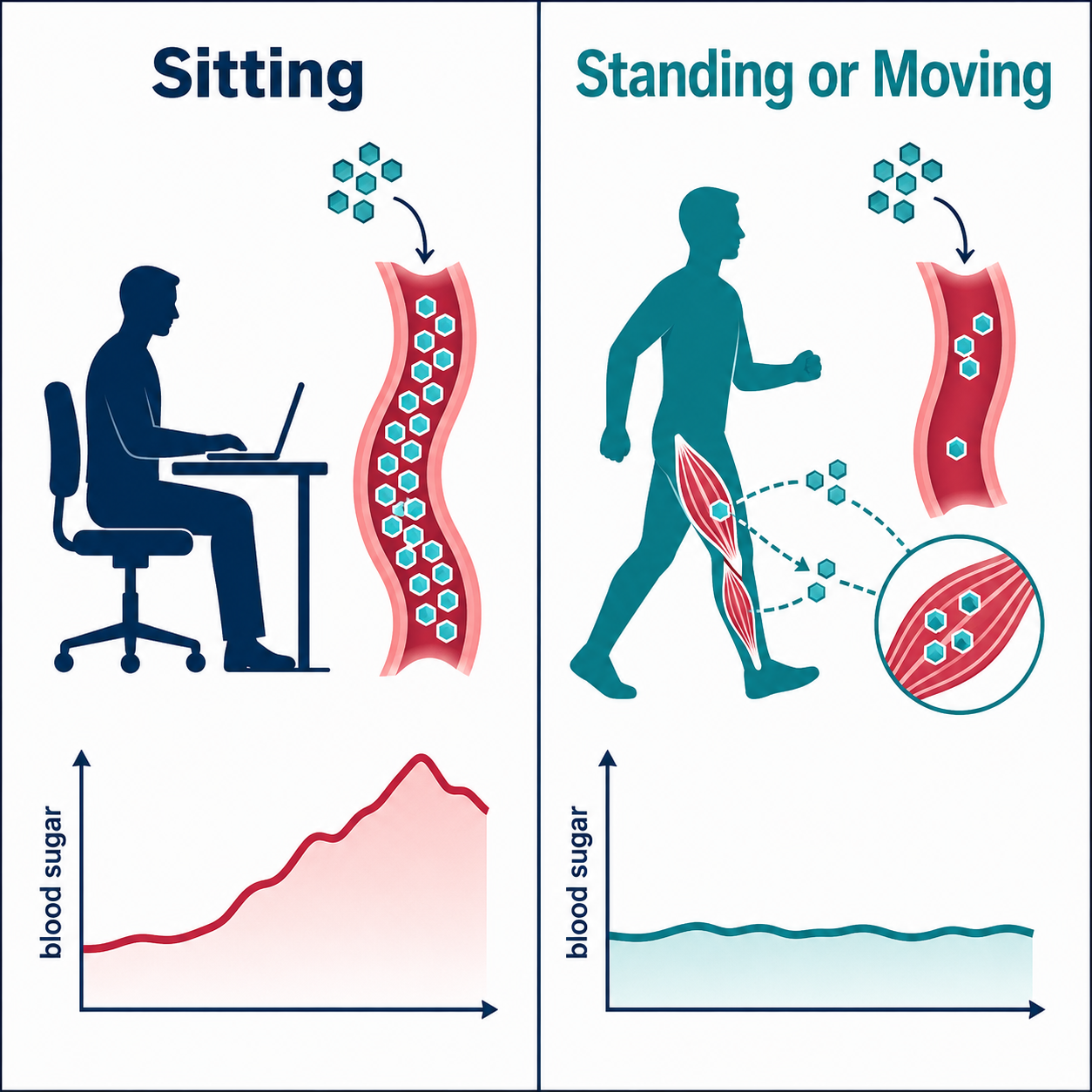
Your muscles, especially the large ones in your legs and glutes, are where a huge amount of glucose gets pulled out of your bloodstream. This happens through a mechanism separate from insulin. Muscle contraction itself signals glucose transporters called GLUT4 to move to the cell surface and pull sugar out of the blood, which is part of why skeletal muscle plays such an outsized role in regulating glucose uptake and insulin sensitivity throughout the body. When you are sitting for hours, those muscles are not asking for fuel, so sugar lingers in your bloodstream longer and insulin has to work harder to clear it.
Do that pattern day after day, and it wears down your metabolic flexibility. I put it this way to patients: it is not that sitting burns zero calories, it is that sitting turns off the machinery that keeps your metabolism responsive. This is not just a theory. A controlled trial found that interrupting sitting with short bouts of light or moderate walking meaningfully lowered after-meal glucose and insulin levels compared to sitting straight through. A separate study in women at higher risk for type 2 diabetes found that breaking up prolonged sitting with brief periods of standing or walking every thirty minutes significantly reduced the glucose and insulin spike that follows a meal. That is not a small effect. Stand up for two minutes every twenty, and you start waking that machinery back up.
What I See in My Clinic Every Week
Almost always, it is a cluster, not just one complaint. The classic desk-job patient walks in with low back pain and tight hips, and once we start talking, they will also mention afternoon energy crashes, sugar or carb cravings around three in the afternoon, and weight that has settled around the midsection no matter what they try.
I see forward head posture, rounded shoulders, and glutes that have essentially forgotten how to fire. Many of these patients are surprised when I connect their back pain to their blood work, but it is the same root cause showing up in different places. Prolonged stillness affects the spine and the metabolism at the same time. Johns Hopkins Medicine notes that working in one position without breaks, even in a well-set-up chair, is a major cause of back and neck pain, and that same stillness is what is slowing glucose clearance in the muscle tissue just below it.
If any of that sounds familiar, you are not imagining it, and you are not alone. This is one of the most consistent patterns I see in patients who work desk jobs in Henderson and Las Vegas, regardless of age or fitness background.
A Patient Who Changed the Trajectory With One Simple Habit
I had a patient, a guy in his late 40s, sales job, twelve hours a day in a chair or a car. He came in for low back pain, but he also mentioned he had been told he was pre-diabetic at his last physical and could not shake fifteen pounds no matter what he ate.
We started with adjustments and SoftWave therapy to calm down the inflammation in his spine, but the real shift happened when he committed to standing and walking for five minutes every hour, non-negotiable, phone alarm and everything. Within about six weeks his energy crashes were gone, his pants fit differently, and at his next physical his fasting glucose had actually improved.
His chiropractic care fixed the pain. The movement fixed the metabolism. He needed both, and that is the piece I want more people to understand. You cannot out-adjust a sedentary lifestyle, and you cannot out-walk a spine that is locked up and inflamed. They work together.

Is "Sitting Slows Your Metabolism" Accurate, or Oversimplified?
It is not wrong, but it is incomplete, and incomplete health information is almost as unhelpful as wrong information. Sitting itself does not slow your metabolism the way skipping meals might. What it does is reduce muscle activation, which reduces glucose uptake, which reduces insulin sensitivity over time. That is a metabolic consequence, but it is a downstream one.
When people hear "sitting slows metabolism," they picture their body simply burning fewer calories, like a dimmer switch. The real story is more like a circuit that stops getting used, and eventually the whole system gets less efficient at responding to food. Mayo Clinic has linked extended sitting not just to weight gain but to a cluster of conditions that make up metabolic syndrome, including elevated blood pressure, high blood sugar, excess abdominal fat, and unhealthy cholesterol levels. I want my patients to understand the mechanism, not just the headline, because the mechanism is what tells you the fix.
What People Get Wrong When They Blame Weight Gain on Calories Alone
They are looking at inputs and ignoring context. Calories in, calories out is real, but it assumes a body that is functioning optimally, and prolonged sitting, chronic inflammation, poor sleep, and blood sugar dysregulation all change how your body processes those calories.
I see patients who are eating correctly by every textbook standard and still gaining weight, and it is because their body is inflamed, their nervous system is stressed, and their muscles are not metabolically active enough hours a day to help regulate blood sugar. "Bad metabolism" is not some mysterious curse. It is usually a body that has been sitting still, sleeping poorly, and running on stress hormones for years. That is fixable. It is not a life sentence, and I have watched hundreds of patients prove that to themselves.
How Often to Break Up Sitting, and What Actually Works
My baseline recommendation is every 30 minutes, minimum every hour. I tell patients to set an alarm because willpower alone will not do it. Your brain gets absorbed in work and two hours disappear before you notice.
As for movement, it does not need to be complicated. I like bodyweight squats, standing calf raises, a short walk around the office or the house, or simply standing up and doing a few hip hinges and shoulder rolls. For patients with existing low back pain, I will often add a gentle extension stretch, since so much of what we undo in the office is the flexed, rounded posture that sitting locks people into.
Studies breaking up sitting time with either standing or light walking every thirty minutes have shown meaningful reductions in after-meal blood sugar and insulin spikes, and the effect holds up whether the movement is a walk down the hallway or a few minutes of stretching at your chair. The goal is not a workout. It is a signal to your muscles and your nervous system that says we are still active, even in a small dose.
Signs Sitting May Be Affecting More Than Just Your Back
Afternoon energy crashes are a big one, especially if they hit at a predictable time every day. Sugar or carb cravings that show up a couple of hours after lunch. Weight that concentrates around the midsection even when your overall weight has not changed much. Feeling tired but wired in the evening. Waking up groggy even after enough sleep.
Any one of those on its own could be a lot of things. But when I see them stacked together in someone with a sedentary job, I start asking about their blood sugar and their movement patterns, not just their posture. The body tends to tell you what is going on if you know what you are listening for.
The Chain Reaction Behind Insulin Resistance and Inflammation
I walk patients through this like a chain reaction, because that is exactly what it is. Sitting reduces muscle contraction, and muscle contraction is one of the main non-insulin ways your body clears glucose from the blood. Less movement means glucose lingers, and insulin has to work harder to do the same job.
Do that day after day and your cells start needing more insulin to get the same response. That is insulin resistance forming. On top of that, sitting compresses blood flow in the legs and pelvis, which slows circulation and encourages inflammatory markers to build up in tissue that is not getting flushed properly. Chronic low-grade inflammation itself worsens insulin sensitivity, so it becomes a loop. Less movement, worse circulation, more inflammation, worse blood sugar control, and that loop feeds weight gain and fatigue right along with it.
There is even data suggesting the risk climbs with total sitting time regardless of whether someone exercises separately. A Mayo Clinic study found a 35 to 40 percent increased health risk for people who sit six or more hours a day even when they maintain a regular exercise routine. Exercise matters, but it does not cancel out ten hours in a chair.
Why This Requires a Coordinated Plan, Not a Single Fix
Each piece of care has a job. Chiropractic adjustments restore proper motion and nervous system function to a spine that has been locked into a seated posture for years. That is foundational. You cannot ask someone to move more comfortably if their joints are restricted.
SoftWave and Class 4 laser therapy address the tissue-level inflammation and pain that keep people from wanting to move in the first place, healing damaged tissue faster so exercise does not feel like punishment. Red light therapy supports cellular energy production and recovery, which matters when someone has been running on empty for months. And on the metabolic side, that is where nutrition and structured support like ChiroThin or GLP THREE come in, because you can fix someone's spine and calm their inflammation, but if their blood sugar and eating patterns are still working against them, they will plateau.
I do not see these as separate lanes. I see them as one coordinated plan to get a person out of pain and back into a body that can move and regulate itself the way it is supposed to. Whether that starts in the office in Henderson or through the online program, the goal is the same.
What I Want You to Remember
You do not need an hour at the gym to protect your metabolism. You need to stop sitting still for hours at a time. That is the whole message.
Standing up for two or three minutes every half hour, taking the stairs, parking farther away, these are not consolation prizes for people who cannot make it to a workout. They are legitimate metabolic interventions backed by real physiology. I would rather my patients build five small movement breaks into a workday than promise themselves a workout they will skip out of exhaustion.
Your body is listening to everything you do, or do not do, all day long, not just the 45 minutes you spend at the gym three times a week. Start there, and the rest gets a lot easier.

If you are dealing with back pain, energy crashes, or blood sugar concerns that you suspect are tied to a desk-bound lifestyle, I would like to help you get to the root of it. In the office in Henderson, we combine chiropractic care, SoftWave therapy, and laser treatment to address the pain and inflammation that keep people from moving comfortably. For the metabolic side of the equation, whether that is structured weight loss support through ChiroThin or the GLP THREE program, we work with patients locally and online, nationwide. You can learn more or schedule a visit at optimalhealthmembers.com or call us directly at 702-541-9060.