
How Many Calories Should I Cut Daily to Lose Weight?
If you have ever done the math, cut your calories, added cardio, and then watched the scale refuse to move, this one is for you. You are not imagining it, and you are not lazy. You did what every diet article told you to do. You ate less. You moved more. And somehow your body dug in its heels. After almost thirty years of sitting across from patients with that exact frustration, I can tell you the problem is rarely the number of calories. The problem is that we have all been trained to treat weight loss like arithmetic when the body actually runs on biology. So let me walk you through what I really say when someone asks me how many calories they should cut.
Why the Calorie Question Is Almost Never the Real Question
I will be honest about my first reaction. There is a small internal sigh, and then a lot of compassion, because I know exactly why the question is being asked. Most people have been trained by decades of diet culture to believe weight loss is a simple equation. Eat less, weigh less. I understand the logic. But after nearly three decades in practice, I have learned that the calorie question is almost never the real question. Underneath it is usually something more honest and more vulnerable, which is "Why isn't my body cooperating anymore?" So I do not roll my eyes and I do not lecture. I meet people where they are, and then I gently move the conversation off the calculator and onto their metabolism, because that is where the real answer lives.
Why I Don't Hand Out a One-Size Number
People want me to say 250, 500, or 750 calories a day, and I understand why. The textbook answer is a moderate deficit, somewhere around 500 calories a day, because Mayo Clinic notes that trimming roughly 500 calories daily tends to produce about half a pound to a pound of loss per week. That is not wrong. But if I hand a five-foot-two woman who has been chronically under-eating for a decade the same number I would give a 220-pound man who has barely tracked a day in his life, I have done both of them a disservice. So I would rather first establish what your body actually runs on, protect your muscle, and then build a deficit your metabolism can tolerate. A number you cannot sustain is not really a deficit. It is a setup for the rebound.
What Happens When You Cut Too Hard, Too Fast
The most common mistake I see is people slashing intake so hard and so fast that their body fights back. When you cut aggressively, your body does not interpret it as fat loss. It interprets it as famine. The research is clear that prolonged restriction triggers adaptive thermogenesis, where energy expenditure drops beyond what your smaller body size alone would predict. Metabolism slows, hunger hormones climb, energy tanks, and you start losing muscle right alongside fat, which is the worst possible trade. Then willpower runs out, because willpower always runs out, and one weekend of bingeing undoes three weeks of effort. People blame themselves and call it a lack of discipline. It was never discipline. It was a starvation response doing exactly what it is wired to do. Aggressive almost always loses to consistent.
Eating Less Is Subtraction. A Real Plan Is a System.
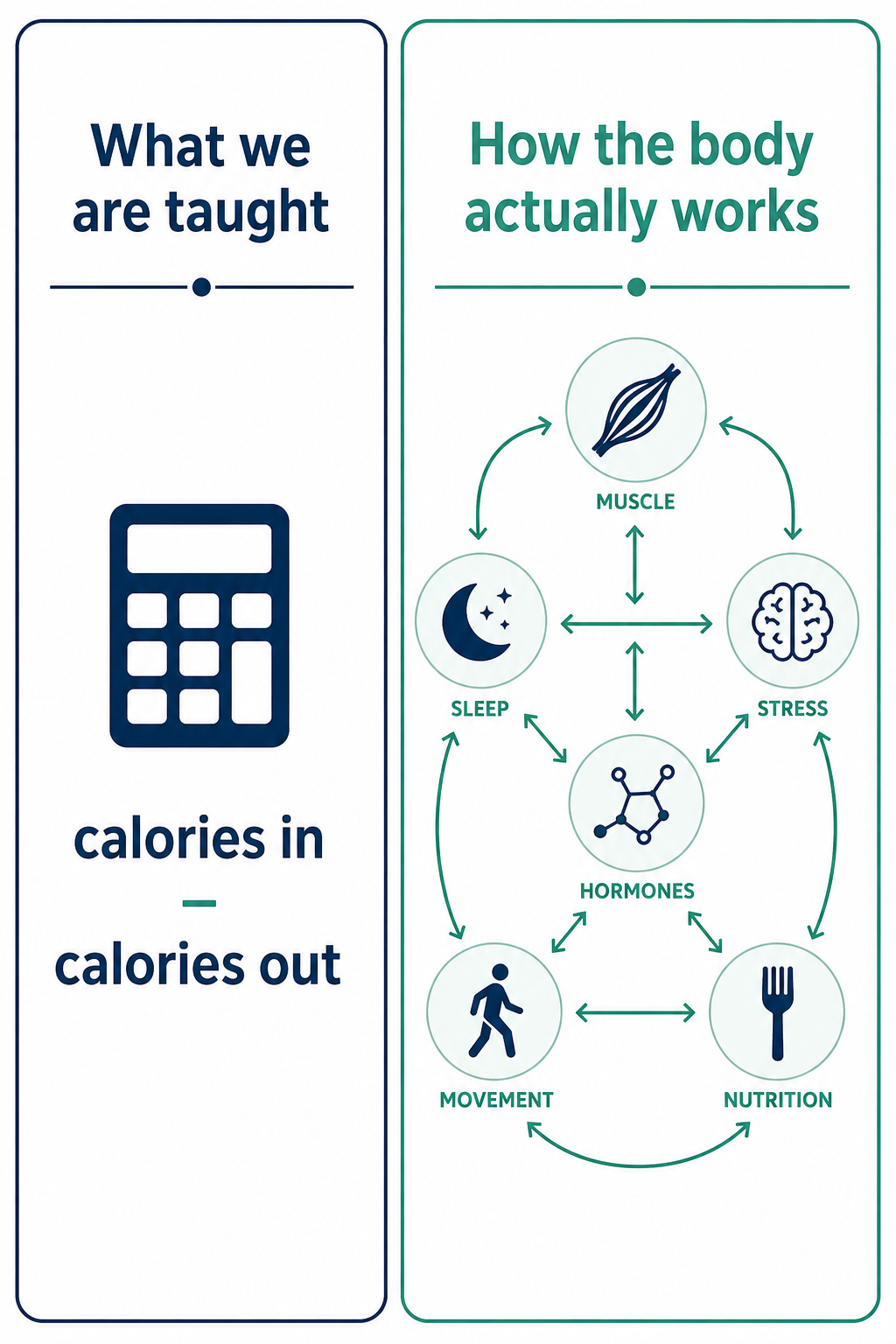
I tell people that eating less is subtraction, and a real plan is a system. Anybody can eat less for a week. You can white-knuckle it, skip meals, and survive on coffee and resentment. But you cannot build a body on subtraction alone. A sustainable plan asks better questions. Are you getting enough protein to hold onto muscle? Are you sleeping? Is your stress through the roof? Are you moving in a way you will actually keep up? Eating less treats your body like a calculator. A real plan treats it like a living system with hormones, recovery, and a nervous system that all have a vote. One is a punishment you endure. The other is a structure you can actually live inside.
The Whole Scorecard Your Body Keeps
Here is what I watch happen over and over when someone focuses only on calories. They lose a little weight at first, so they double down, but they are shedding muscle along with fat, so they end up smaller and softer instead of leaner and stronger. They are exhausted because they are under-fed and under-slept. Then the scale stops moving and they cannot understand why, because on paper they are doing everything right. The truth is they were doing one thing right and ignoring five others.
This is where the science gets practical. Higher protein intake has been shown to preserve lean mass and improve satiety during weight loss, which is exactly why I protect protein before I ever cut calories. Sleep matters just as much, because losing sleep is associated with lower leptin and higher ghrelin, the two hormones that govern fullness and hunger. And chronic stress is not just a feeling. Elevated cortisol from ongoing stress is linked to fat storage in the abdomen specifically. The body keeps the whole scorecard, not just the calorie column. Ignore the rest and you will plateau, and then you will suffer.

The Woman Who Was Eating Too Little of the Right Things
I see this case so often that I can give you the composite without naming anyone. A woman in her forties comes in frustrated. She is eating around 1,100 calories a day, doing cardio five times a week, and the scale has not moved in months. On paper she is a model patient. But when we dig in, she is barely sleeping, she is under enormous stress, she is getting maybe 50 grams of protein, and she has been dieting on and off since her twenties. Her body is not broken. It is protecting her.
So we did the counterintuitive thing. We actually raised her food, leaned hard into protein, fixed her sleep, and pulled back the frantic cardio. Within weeks her energy came back and the weight started moving again. She was not eating too much. She was eating too little of the right things, for far too long. That is one of the most common and most fixable patterns I see.
Building a Plan Around a Real Life
When someone is already stretched thin between work, kids, and exhaustion, the last thing they need is a second full-time job. That is the mistake most programs make. They hand an overwhelmed person a complicated meal plan and a spreadsheet, and that plan is abandoned by Thursday. What that person actually needs is two or three anchors they can keep. So we start with protein at every meal, because it kills cravings and protects muscle. We get sleep moving in the right direction. We simplify instead of adding.
And if someone has a history of yo-yo dieting, I get extra gentle with the deficit, because that person's metabolism has been burned before and so has their trust. My job there is as much about rebuilding belief as it is about cutting calories. Small wins they can repeat will always beat a perfect plan they cannot sustain.
Where ChiroThin, GLP-1 Support, and Supervised Programs Fit
People ask where the programs fit into all of this, and I am always upfront. They fit in as structure and support, not as magic. ChiroThin and our doctor-supervised programs work because they give people accountability, a clear framework, and real clinical oversight instead of guessing alone at home. GLP-1 medications can be a genuinely useful bridge for the right person, because these medications appear to curb hunger and slow how fast food leaves the stomach. But I never let anyone treat a medication as the destination.
This is also where our natural metabolic approach through GLP THREE comes in, designed to support the body's own metabolism rather than override it. My whole philosophy is that weight loss is the side effect of fixing your metabolism, not the goal you chase directly. Whatever tool we use is in service of that. If the underlying metabolism, habits, and lifestyle do not change, no program and no shot will hold. The tool buys you a window. What you do inside that window is what lasts.
Tracking Apps: Training Wheels or a Tyrant in Your Pocket?
People ask whether they should track calories with an app, and my answer is that it depends entirely on the person. For some, tracking for a few weeks is the best education they will ever get, because they finally see that the healthy smoothie was 600 calories, or that they were eating half the protein they assumed. Those are training wheels, and they are great. But for others, especially anyone with a history of disordered eating or anxiety, that app becomes a tyrant in their pocket, and the obsession does far more damage than the extra calories ever would. So I use it the way I would use any tool. Short-term, for awareness, and then we take the training wheels off. The goal was never to track food forever. The goal was to understand it well enough that you do not have to.
If counting calories or food has ever fed into anxiety or disordered eating for you, please loop in a qualified professional before you start tracking, and know that I can help you find the right support.

What to Do Before You Cut a Single Calorie
Before you cut a single calorie, get a baseline and fix the foundation. If something feels off, whether it is hormones, thyroid, or fatigue that does not add up, get the labs, because you cannot out-diet a problem you have not identified. Then, before any restriction, do the three things that move the needle for almost everyone. Anchor your protein. Pull back the ultra-processed foods that drive cravings and inflammation, since an NIH controlled trial found people ate roughly 500 more calories a day on an ultra-processed diet than on a whole-food diet with the same calories and macronutrients available. And start moving more in a way you will actually keep doing.
Most people are stunned by how much changes from those three alone, before they ever count anything. And if you have been stuck, fighting your body and doing all the right things with nothing to show for it, that is exactly when a real consultation earns its keep. Not to sell you a quick fix, but to find the actual reason your metabolism stopped listening. Start with the foundation. The calories sort themselves out later.
Let's Find the Real Reason Your Body Stopped Listening
If you are tired of guessing, I would be glad to help you build a plan around your actual life and your actual metabolism. We work with patients in person here in Henderson and the greater Las Vegas area, and we work with patients across the country online, and both options give you the same clinical oversight and the same personalized approach. You can learn more about our doctor-supervised weight loss programs and ChiroThin at optimalhealthmembers.com, or explore our natural metabolic program at GLP THREE. Wherever you are, the goal is the same. We fix the metabolism, and the weight follows.