Herniated Disc Non-Surgical Treatment Options: Why I Want Surgery to Be the Last Conversation, Not the First
Most disc patients I meet can tell me exactly how many seconds they sit on the edge of the bed before they trust their back to stand. They plan errands around how long they can sit in the car. And by the time they get to my office, nearly all of them have already asked a friend, a search engine, or a surgeon the same question: am I going to need an operation?
I have been treating disc patients since 1996. The fear in that question is often more disabling than the disc itself. So here is the same conversation I have across the table from a scared disc patient, including the research that changed how I practice and the treatment I stopped using.
Quick Answer: Can a Herniated Disc Heal Without Surgery?
Yes, most herniated discs can be managed without surgery. Research shows many herniations shrink on their own, and the bigger ones often shrink most. After nearly 30 years treating disc patients, the first sign I look for is leg pain pulling back toward the low back. New bladder or bowel changes need an ER today.
Key Takeaways
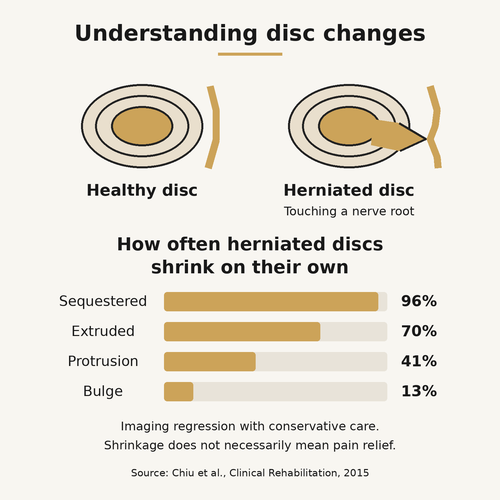
In one systematic review, disc material shrank over time in 96% of sequestered discs and 70% of extruded discs, which is why the word “extrusion” on a report doesn’t alarm me.
Disc bulges show up in 30% of pain-free 20-year-olds and 84% of pain-free 80-year-olds, so I never treat the MRI alone. I treat what your nerves are doing on exam.
Mayo Clinic reports that without nerve damage, surgical and non-surgical outcomes look similar at two years. That’s why I want surgery to be the last conversation, not the first.
If your bladder, bowels, or groin sensation change, I don’t want you calling my office. I want you in an emergency room.
In my experience, the first sign care is working is pain pulling back from the leg toward the low back.
What a Herniated Disc Actually Is, the Way I Explain It in the Room
When a patient asks me what is going on in their spine, I start with an analogy. Almost every chiropractor in America uses the jelly donut, and I use it too because it works: each disc has a tough outer ring and a softer center, and over years of sitting, lifting with the back instead of the legs, or one bad twist, some of that center pushes out. The part most people never hear is what comes next. Mayo Clinic notes that most herniations come from gradual wear rather than a single event, which matches what I hear when I take a history. People remember the moment it hurt, but the disc had usually been getting weaker for years.
When that material irritates a nerve, patients describe it to me in surprisingly specific ways: a toothache in the calf, a cold patch on the shin, a foot that feels like it belongs to someone else. Here is the part I want every patient to hear: a big share of the pain comes from inflammation around the nerve, not only the pressure. That inflammation is the part I can actually work with, and it usually settles faster than the disc itself. Your body also has its own way of cleaning up loose disc material. Researchers have found that the larger, more dramatic herniations are actually the ones most likely to regress. When I share that with patients, I can watch their shoulders drop. I’ve watched the body clean up disc material that patients were sure would be there forever. My job is to stop getting in its way and start giving it what it needs.
Why Your MRI Is Not Your Verdict
Most of my disc patients walk in holding an MRI report, and most of them have already pictured themselves in a surgical gown. The first thing I do is ask them to set the report down and talk to me.
I’m not against imaging. I read every disc patient’s MRI myself. I just refuse to let it do my thinking for me. A large review in the American Journal of Neuroradiology found disc degeneration, bulges, and protrusions are common in people with no back pain at all, and the researchers concluded these findings have to be read in the context of the patient’s actual symptoms. That fits what I have seen for decades. The person with the most alarming MRI is not always the person in the most pain, and the person with a “minor” bulge can be the one who cannot sit through dinner. Imaging and pain do not line up nearly as neatly as people assume.
So I put more weight on what your nerves are doing. Can you walk on your heels? Is one reflex quieter than the other? Does the numbness follow one nerve’s path or wander all over? Those answers tell me where we stand. I also watch how you get out of a chair. That exam tells me far more about how you are going to heal than the picture does. Fear makes muscles guard, guarding makes pain worse, and calming that fear is honestly the first thing I treat.
Who Should Try Non-Surgical Care First, and Who Needs a Surgeon Today
Here’s the line I draw in my own exam room: if your pain is bad but your strength is holding and your bladder and bowels are normal, you’ve earned a real trial of conservative care before anyone operates. That is consistent with Mayo Clinic’s own approach, which starts with nonoperative treatment and notes that few people with herniated discs ever require surgery.
Now, part of being a good chiropractor is knowing when something is not mine to handle. If you have new loss of bladder or bowel control, numbness in the groin or inner thighs, or a foot or leg that is getting weaker week by week, go to an emergency room today. Those can be signs of cauda equina syndrome, and that is one of the few times I will tell you not to wait a single day. I have sent patients straight to the ER from my exam room, and I will keep doing it.
I respect my surgeon colleagues. My problem has never been with surgery itself. It is with surgery being the first conversation instead of the last.
How I Treat a Herniated Disc Without Surgery: The Tissue Around the Nerve Comes First
Every disc patient at Optimal Health Members starts with an exam, and the exam decides the plan. I don’t sell packages to disc patients, because I don’t know on day one how fast your body will respond. The goals stay the same: calm the inflamed tissue around the nerve, and restore motion without provoking the disc.
On an acute disc, my adjustments are small and deliberate, and some visits I don’t adjust the painful level at all. Nothing forceful on an angry disc. Then we use our Class 4 laser directly over the irritated area, because the tissue around the nerve is the part I want to reach. Laser research in disc patients is still growing, but a 2025 randomized controlled trial found high-intensity laser combined with exercise reduced resting pain more than low-intensity laser in people with lumbar disc herniation. SoftWave is what I reach for when a disc patient’s progress stalls and the tissue needs a stronger signal to keep repairing. As patients improve, we add targeted movement and core work, plus guidance on sleep, sitting, and nutrition, because inflammation does not only live in the spine.
Disc patients always ask me what they can do on the days they aren’t on my table. Hands-on care gets the healing started, but most of your repair happens in the days between visits. For the right patients, I recommend RECOVER™, a peptide and antioxidant complex with BPC-157, GHK-Cu, and Carnosine that supports the body’s natural tissue repair processes and helps maintain a healthy inflammatory response. It is not a replacement for care in the office. I think of it as support for the work your body is already doing between treatments, and it pairs especially well with laser, SoftWave, and chiropractic care. If you take a blood thinner or are pregnant, check with your provider before starting it.
I would rather you graduate from my office than keep coming back. A disc patient who understands why their back hurts is the one I see least often a year later.
Why I Retired Spinal Decompression in My Practice
For years, robotic spinal decompression was part of how I treated discs, and I do not regret the patients it helped. But I kept seeing the same pattern. We could take pressure off the disc on the table, and then the patient would drive home, sit at a desk for eight hours, and we were right back where we started.
Mechanical pressure was only part of the problem. The inflamed, under-supplied tissue around the nerve was the part we were not reaching well enough. When I brought Class 4 laser and SoftWave into the practice, I started working on the biology of healing, not just the mechanics. I stopped asking, “How do I take pressure off this disc?” and started asking, “How do I help this tissue actually repair?” In my experience, that second question leads to better long-term results, and it is the reason I retired decompression and replaced it with Class 4 laser.
The Two Mistakes I See Disc Patients Make Most
The two biggest mistakes I see are complete opposites.
The first is total bed rest. People get scared, lie on the couch for two weeks, and come in stiffer, weaker, and in more pain. Mayo Clinic advises keeping rest to roughly a day or a day and a half, because longer bed rest has not been shown to help. The couch feels safe, but the patients who come in after two weeks lying on it are almost always stiffer and more scared than the ones who kept walking to the mailbox.
The second is the person who pushes through it. They keep lifting at the gym, keep golfing, keep hauling bags of mulch, because they believe pain is weakness leaving the body. With a disc, that can turn a manageable problem into a nerve that stays irritated for months.
And then there is the person who bounces between a heating pad, a massage gun, and stretches from a video that were never meant for their disc. Some of the most popular stretches online, like aggressive toe-touches, can make a disc worse. Generic advice for a specific problem is how people stay stuck.

Where I Part Ways With Common Disc Advice
I disagree with letting the MRI drive the decision. Too many people get imaged early, read frightening words, and get steered toward injections or surgery before their body has had a fair chance to heal. The research showing discs can shrink on their own has been around for years, and I still meet patients who were never told about it before someone offered them an injection.
I also disagree with some people in my own profession. Not every disc should be adjusted the same way, and forceful manipulation on an acutely inflamed disc is not something I would do. Some chiropractors treat every back alike. I do not.
And I think pain medication as a long-term plan is a trap. A few days of relief so you can sleep is one thing. But masking a disc problem for months does not fix it, and I have watched people lose a year of their lives that way.
What to Do at Home Between Visits
Here is what I tell my disc patients to do, and to stop doing, between appointments:
Walk, even if it’s only to the end of the driveway. I’d rather you take five short walks than one long one you pay for later.
Break up sitting. If you work at a desk, stand up and move about every 30 minutes. For most disc patients, sitting is the enemy.
Fix your sleep position first. Side-lying with a pillow between your knees, or on your back with a pillow under them. When a disc patient tells me nights are the worst part, this is usually the first change I make, and it’s free.
Stop bending and twisting while you lift, and skip the toe-touch stretches until we have cleared you for them.
Get off the soft couch. Hours in a sinking cushion load the disc in exactly the wrong position.
Watch what you’re eating. I’ve helped patients with nutrition since 2012, and I see the same thing every time: the ones living on sugar and drive-through food are the slowest to settle down.
How Long Recovery Takes and How You Know It Is Working
I will not give you a timeline, because every disc and every person is different. Anyone who guarantees you a number is selling something. What I can tell you is what I watch for.
The first sign that care is working is usually centralization: the pain that was shooting down your leg starts pulling back toward your low back. That is a good sign, even if your back still aches. After that, sleep usually improves. Then you can sit a little longer and walk a little farther.
I tell patients to measure progress in what they can do, not only in pain scores. Can you pick up your grandchild? Can you sit through a church service without shifting in your seat? Can you get back on the golf course? Those are the wins my patients tell me about first, and they almost never mention a pain score when they do.

If You Are Sitting With an MRI Report Right Now
If you have been told you have a herniated disc and you are not sure what to do next, have someone put their hands on you, test your nerves, and explain what they find in plain English before you decide anything. If you are in the Henderson or Las Vegas area, bring your MRI to Optimal Health Members and I’ll go through it with you line by line. If you are farther away, look for a provider who examines you thoroughly, respects the research on non-surgical care, and knows when to refer you out.