Golfer's Elbow Treatment: Combining Chiropractic Care and Shockwave Therapy
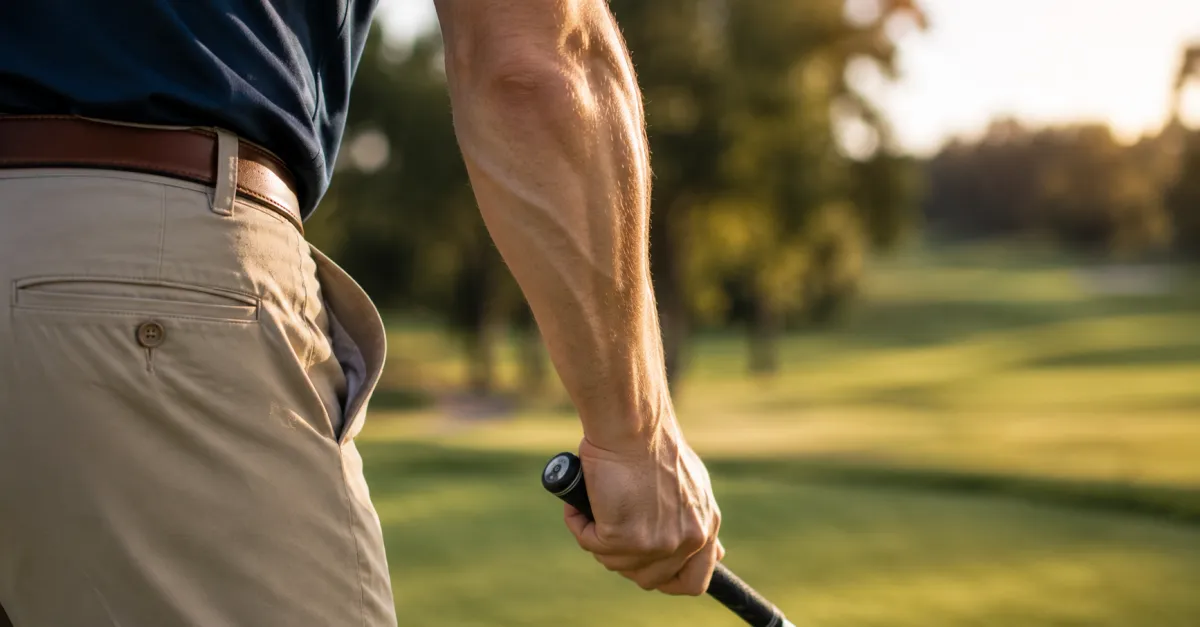
The name "golfer's elbow" is a little misleading. In my nearly 30 years of practice, the patients who come into my Henderson, Nevada office with this condition are far more often painters, plumbers, carpenters, desk workers, and weekend tennis players than they are golfers. The golf connection refers to the anatomy, not the activity. What these patients share is the same problem: a tendon attachment on the inner elbow that has broken down faster than the body can repair it.
What they also share is a common experience before they find my office. They rested it. They iced it. They wore a brace. Some tried a cortisone shot. The pain quieted for a while and then came back, sometimes worse than before. If that pattern sounds familiar, I want to explain exactly why that happens and what a more complete treatment approach actually looks like.
What Is Actually Happening Inside the Tendon
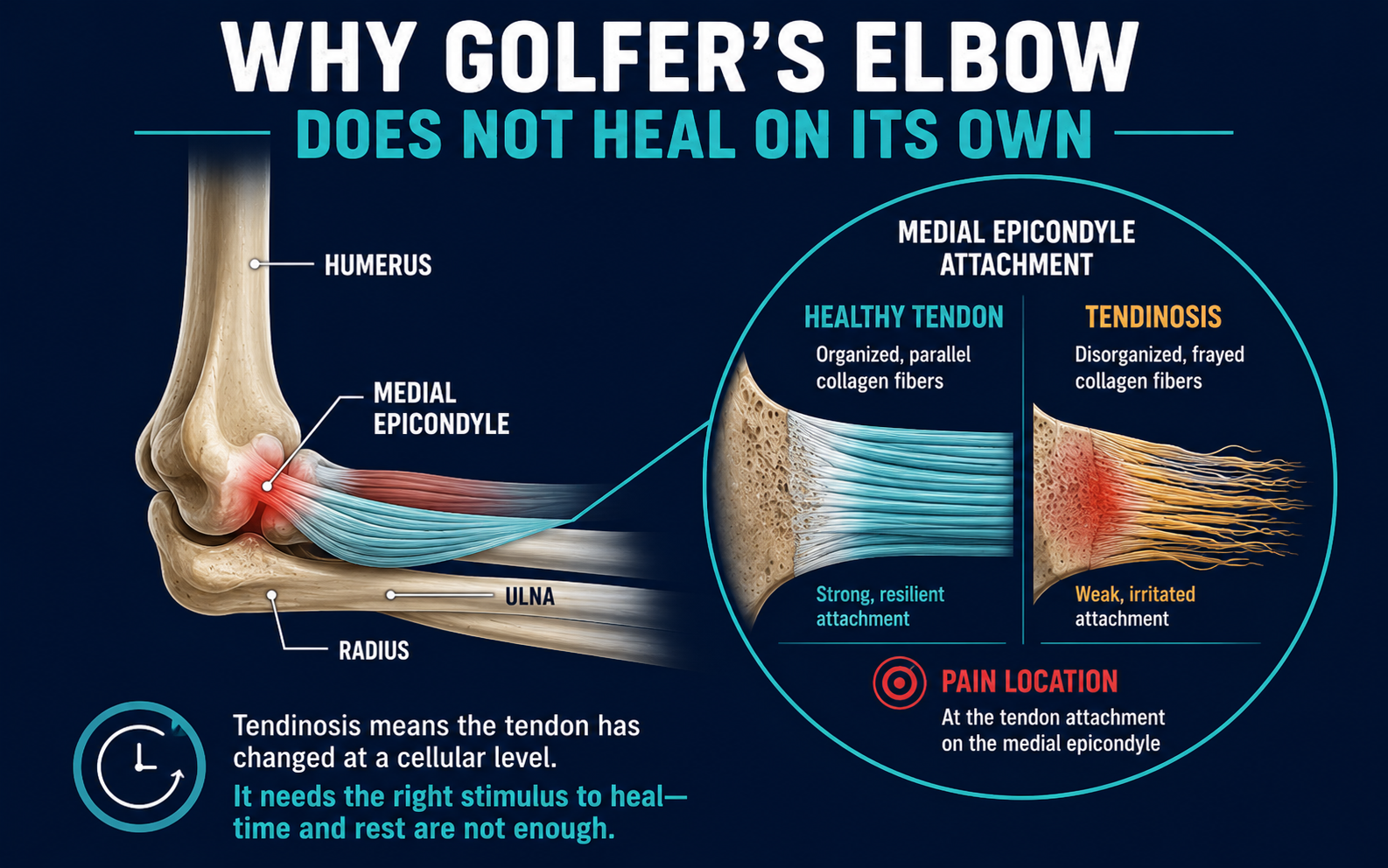
Golfer's elbow, known clinically as medial epicondylitis, is a condition in which the flexor-pronator tendons that attach to the medial epicondyle on the inner aspect of the elbow become irritated and structurally degraded. The pain shows up during gripping, lifting, or any wrist movement that loads those tendons under resistance.
The word "itis" at the end of the clinical name suggests inflammation, and inflammation is part of the early picture. But in chronic cases, the more accurate term is tendinosis, a condition defined not primarily by inflammation but by collagen disorganization, micro-tearing, and failed healing attempts within the tendon tissue itself. Research consistently demonstrates that chronic tendinopathy involves degenerative changes at the cellular and structural level rather than the active inflammatory process that responds to ice and rest.
This distinction is clinically important because it explains why passive treatments so often fall short. Rest reduces load, which is useful. But tendons have a relatively poor blood supply compared to muscle tissue. Without a stimulus that actively promotes cellular regeneration and new collagen formation, the tendon does not rebuild its structural integrity. It simply waits, slightly less irritated, until the next demand on it reopens the cycle.
Medial epicondylitis affects approximately 0.4 percent of adults annually, with the highest prevalence in adults between 40 and 60 who perform repetitive occupational or recreational tasks. In my practice, those numbers translate to real people whose grip strength, sleep quality, and ability to do their work are being quietly eroded by something they assume they just have to manage.
Why the Problem Is Rarely Just the Elbow
One of the first things I explain to patients with medial epicondylitis is that the elbow is usually where the pain lives, but not always where the problem originates.
The elbow sits in the middle of a kinetic chain that runs from the shoulder through the forearm to the wrist and hand. When any link in that chain is not functioning optimally, the load redistributes. A shoulder with restricted internal rotation, a wrist that lacks proper mobility, or a thoracic spine that limits how freely the upper extremity moves under load, all of these can place amplified mechanical stress on the medial elbow structures.
I see this regularly. A patient presents with inner elbow pain from repetitive work, and when I assess their shoulder mechanics, I find limited mobility and muscle imbalance that has been quietly transferring excess stress distally for months. Treating only the elbow in that scenario is treating the symptom while leaving the cause untouched.
A thorough chiropractic evaluation of golfer's elbow looks at the entire upper extremity kinetic chain. We assess shoulder range of motion, scapular stability, wrist and forearm mechanics, and how force travels through the system during the specific movements that provoke your symptoms. This context is what separates a treatment plan that addresses the source from one that only manages the complaint.
What Chiropractic Extremity Care Provides at the Elbow
Chiropractic extremity care for the elbow focuses on two primary objectives: restoring joint alignment and improving neuromuscular coordination around the affected structures.
Gentle, precise adjustments to the elbow, wrist, and shoulder complex reduce abnormal loading patterns across the medial structures. When joints move through their intended range of motion without restriction, the tendons attached to those joints experience less compensatory strain during everyday activities. The adjustment does not fix the tendon directly. It removes the mechanical environment that keeps the tendon under excessive, repetitive stress.
Soft tissue techniques work alongside adjustments to address the musculature of the forearm flexors that share the workload with the tendon. Improving circulation and pliability in these tissues supports the environment the tendon needs to begin rebuilding its structural integrity.
Evidence supports manual therapy as an effective component of conservative care for lateral and medial epicondylitis, and in my clinical experience the results are most durable when the entire kinetic chain is addressed rather than only the symptomatic site.
How Shockwave Therapy Restarts the Healing Process
This is where I want to tell you about a patient I will call David.
David came into my office after about seven months of dealing with inner elbow pain that had started during a home renovation project. He had rested it, iced it daily, worn a counterforce brace for most of those months, and received one cortisone injection from his primary care physician. The injection helped for about three weeks and then the pain returned to its previous level. His grip strength had noticeably declined. He was a recreational golfer but at that point had not played in months. More frustrating to him was that he could not do basic tasks at work without discomfort.
What I explained to David was that his tendon was not failing to heal because of insufficient rest. It was failing to heal because tendons in a state of chronic degeneration often lack the cellular signaling needed to initiate a proper repair response. The tendon had essentially plateaued in a state of organized dysfunction. To restart the healing cycle, we needed to provide a regenerative stimulus that rest alone could not supply.
That is precisely what extracorporeal shockwave therapy does. Shockwave delivers focused acoustic energy waves into the degenerated tendon tissue. These waves stimulate increased local blood flow, trigger fibroblast activity, promote the formation of new collagen, and reduce the pain-generating substance P within the tissue. A randomized controlled trial published in BMC Musculoskeletal Disorders found that shockwave therapy significantly reduced pain and improved function in patients with medial epicondylitis, supporting its role as an evidence-based intervention for this condition.
For David, the combination of extremity chiropractic care to address his kinetic chain and a structured shockwave protocol to stimulate tendon regeneration produced steady, measurable progress over six weeks. He returned to golf at week eight. More importantly, he returned to his daily work without bracing or managing pain. That is the outcome we aim for.

Preventing Recurrence Through Smarter Daily Habits
Getting the tendon to heal is one part of the process. Changing the conditions that broke it down in the first place is the other part.
Most patients with chronic medial epicondylitis have habitual movement patterns, occupational postures, or training approaches that created the problem. Without addressing those contributing factors, the tendon is at significant risk of a relapse once it is loaded again.
The prevention habits I consistently recommend to my patients include:
A proper warm-up before any repetitive grip or forearm activity. Cold tendons under load are more vulnerable to micro-tearing. Dynamic warm-ups that include wrist circles, forearm stretches, and shoulder mobilization prepare the entire chain.
Forearm flexibility work as a daily habit, not just a pre-activity step. Consistent stretching of the wrist flexors and pronator muscles reduces resting tension on the medial epicondyle attachment.
Shoulder and wrist strengthening. Addressing the strength deficits that transfer excess load to the elbow is one of the most effective long-term prevention strategies. Targeted exercises for the rotator cuff and wrist stabilizers distribute mechanical demands more evenly across the kinetic chain.
Scheduled rest during repetitive work. Cumulative tendon fatigue is a real phenomenon, and strategic rest periods within a work session are more effective than resting only when pain forces you to stop.
Equipment adjustments. Grip size matters more than most patients realize. A grip that is too small requires excessive forearm flexor engagement to maintain control. For golfers specifically, racquet or club grip size adjustments sometimes produce immediate symptomatic improvement.
Maintenance Care and Why It Protects the Investment You Made in Recovery
Once a patient has achieved meaningful pain relief and functional restoration, I have a direct conversation with them about maintenance. This is not a sales pitch for more visits. It is a clinical recommendation grounded in how tendons behave over time.
Tendons adapt to load slowly. They also respond to neglect slowly. The gains made through shockwave therapy and chiropractic care need time to fully consolidate into structurally resilient tissue, and during that consolidation period, the habits and load progressions we establish matter considerably.
Periodic extremity evaluations catch subtle joint restrictions before they become symptomatic again. Nutrition plays a supporting role here as well. Adequate vitamin C, protein, and hydration are all required for collagen synthesis and tendon tissue repair, and many patients with chronic tendinopathy are not consistently meeting those nutritional requirements.
Maintenance is about protecting the results of the work you already did. For most patients, that means periodic check-ins rather than ongoing frequent treatment, combined with a consistent home program.

You Do Not Have to Keep Managing This
Golfer's elbow that has become chronic is not simply a matter of needing more time. It is a tendon that has lost its ability to complete a proper repair cycle without clinical support. Rest reduces the load but does not restart the healing. Bracing compensates but does not resolve. Cortisone may quiet the pain temporarily but does not address the structural deficit that the degeneration created.
Chiropractic extremity care restores the mechanical environment that the tendon operates in. Shockwave therapy provides the regenerative stimulus the tendon needs to rebuild. Together, they address both the contributing causes and the tissue itself in a way that neither approach can accomplish alone.
If you are in the Henderson or Las Vegas area and dealing with inner elbow pain that has not responded to rest or conventional care, I would welcome the opportunity to evaluate what is actually happening and build a treatment plan around your specific presentation. Schedule a consultation at Optimal Health Members and let us get you back to the activities and the function that this condition has been limiting.