Meet DynaROM: How We Help Personal Injury Patients Prove What They Feel
You were rear-ended. Maybe it didn't even seem that bad. The car barely had a scratch, the ER took an X-ray, and you were sent home with a note that said "neck strain." But three weeks later you still can't sleep through the night, turning your head to check a blind spot hurts, and the insurance adjuster is already asking whether a low-speed collision could really cause all of this.
If that sounds familiar, I want you to know two things. First, your pain is real. Second, it can be measured. In nearly 30 years of practice, I have watched too many honest people get their care cut short because nothing on paper backed up what they were living with. That is why I want to introduce you to DynaROM, the motion test we use with our personal injury patients at Optimal Health Members in Henderson, Nevada. It turns the pain you feel when you move into objective data that you, your doctor, and everyone involved in your case can actually see. Here is what it is, how it works, and why I believe in it.
Quick Answer: What Is DynaROM?
DynaROM is a noninvasive motion test that measures muscle guarding and spinal range of motion at the same time while a patient moves. After a car accident, injured muscles and ligaments cause protective guarding that X-rays and MRIs often miss. DynaROM records that guarding on a graph, giving objective documentation of soft tissue injury.
Key Takeaways
Soft tissue injuries like whiplash frequently do not show up on X-rays or MRI, even when the patient is clearly hurting.
DynaROM measures muscle activity and range of motion simultaneously during six movements, which takes about 15 to 20 minutes and is completely painless.
Research shows that healthy back muscles normally relax at full forward bend, while injured or painful backs often keep firing, which surface EMG can detect.
An early baseline test, followed by retesting during care, shows whether a patient is truly improving and when they have reached maximum improvement.
DynaROM is one part of a complete exam, not a replacement for a doctor's history, hands-on findings, or imaging when imaging is needed.
What DynaROM Is and Why I Brought It Into My Practice
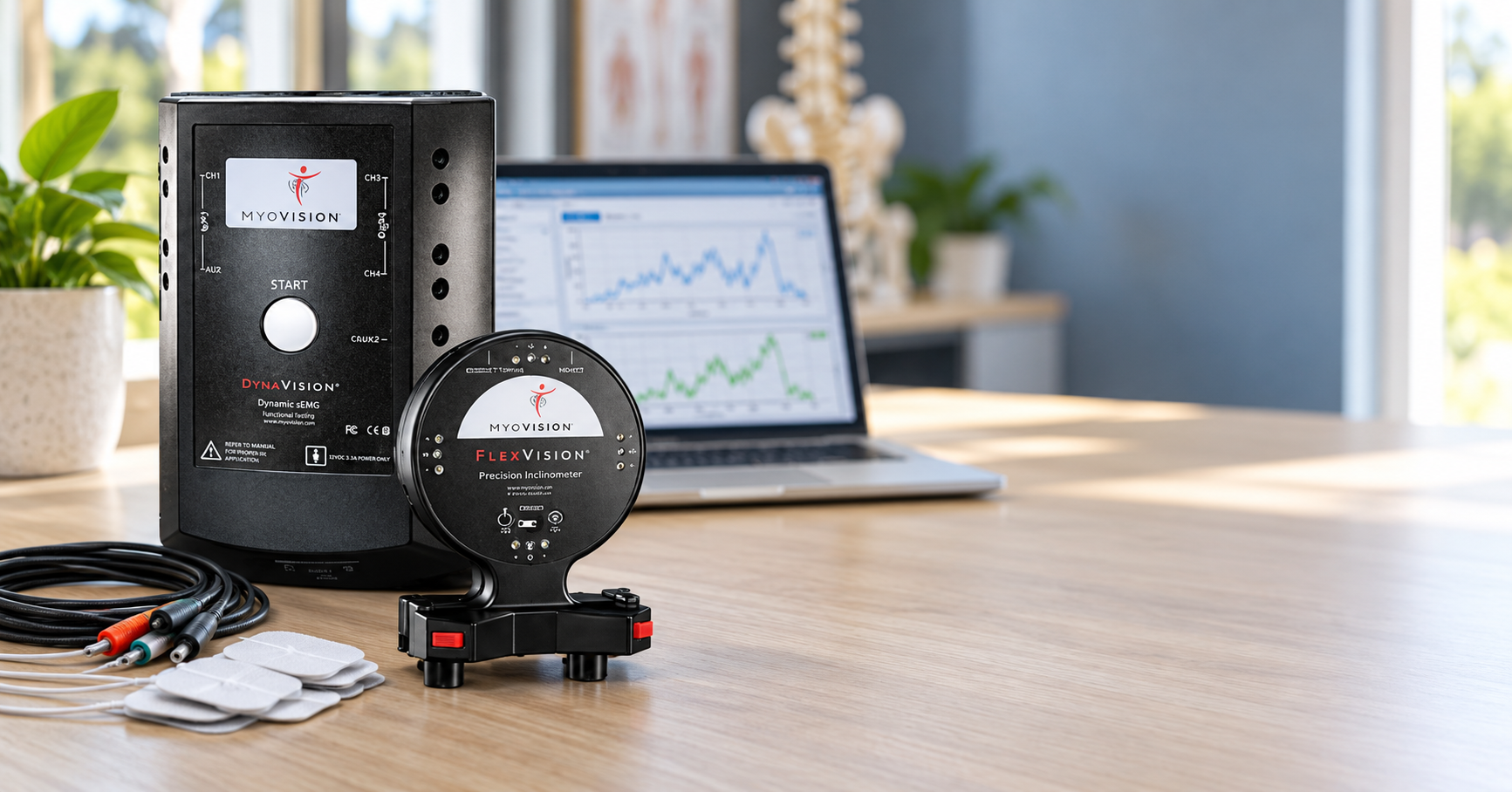
In plain language, DynaROM measures two things at once while you move: how far your spine moves, and how hard the muscles around it are working to protect it. Small surface sensors sit on the skin over the muscles along your spine, and motion sensors track your movement. Then I guide you through bending forward, backward, side to side, and twisting. The system is made by MyoVision, and it is designed specifically to evaluate soft tissue injury in motion.
I brought it in because I got tired of my patients' pain being treated like an opinion. After nearly three decades of putting my hands on injured spines, I know what a soft tissue injury looks and feels like. But "the doctor says so" isn't enough for an insurance adjuster, and honestly, it shouldn't have to be. My patients deserve objective evidence. DynaROM gives us that.
Why Personal Injury Patients Need an Objective Test
Here is the problem nobody tells you about after an accident. Soft tissue injuries usually don't show up on X-rays, and often not clearly on MRI either. Mayo Clinic notes that whiplash itself typically won't appear on imaging tests, which are mainly used to rule out other problems like fractures. A prospective study of 178 whiplash patients who received cervical MRI found that trauma-related findings were rare, even though many of those patients were still in pain.
So the patient is hurting, and the paperwork says nothing is wrong. That gap does real damage. I have seen good people get their care cut off after a handful of visits because nothing in their chart backed them up. Some stopped treatment too early and ended up with a chronic problem they are still dealing with years later. That is what pushed me to look for something better.
What a DynaROM Exam Feels Like, Step by Step
The test is simple and painless. Nothing goes into the body. We place small surface sensors on the skin over the muscles of your neck or low back, along with motion sensors that track how you move. Then you perform six short movements: bending forward, bending backward, side bending to the left and right, and rotating to the left and right. Each movement takes about 30 seconds and includes three repetitions.
Most patients are surprised by how easy it is. The whole process takes about 15 to 20 minutes. I talk people through every step, because many of the patients I see after a car accident are already tense and a little scared. The goal is to measure how you actually move, not to push you into pain.
What DynaROM Shows That X-Rays, MRI, and a Standard Exam Miss
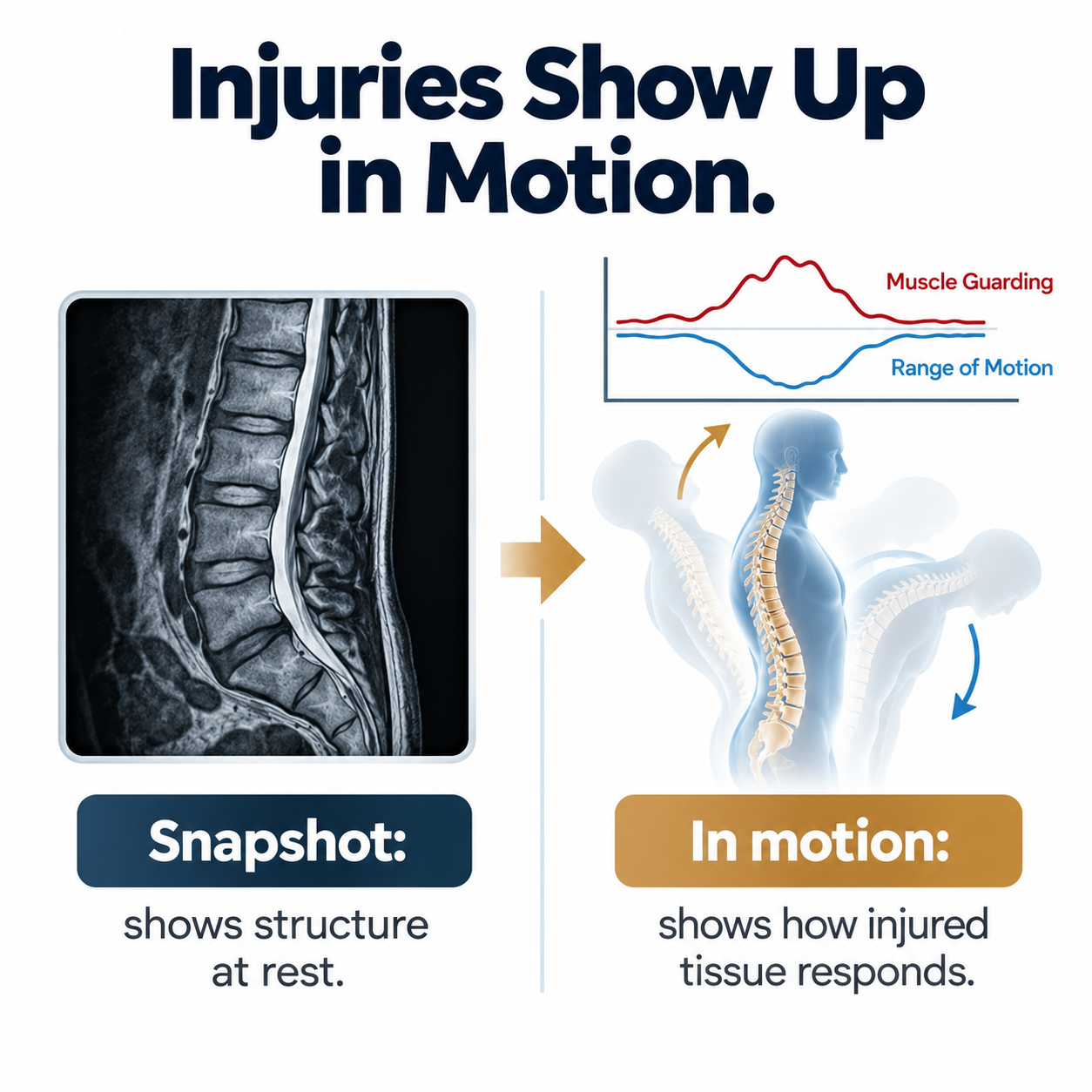
X-rays, MRIs, and a standard range of motion check are all snapshots. They capture a still moment or a single endpoint. Injuries show up in motion.
When a ligament or muscle is injured, your body protects it by guarding. The muscles around the injury fire harder than they should, sometimes even when you are standing still and relaxed. DynaROM graphs that guarding on the left side and right side in real time. It also shows how you reached the end of a movement. If you stop and start, or ratchet your way through a motion because it hurts, the graph shows it.
This isn't guesswork. Researchers have studied a pattern called flexion relaxation for decades. In a healthy back, the spinal muscles go nearly quiet at full forward bend. A study of 218 chronic low back pain patients published in the Clinical Journal of Pain found that surface EMG measures of this pattern correctly classified roughly 79 to 82 percent of patients, and that combining muscle activity with range of motion performed slightly better than range of motion alone. Another study following people through a back pain episode found that this relaxation response is often disrupted when pain is present.
I have had patients with nearly normal range of motion whose muscles were still firing hard at rest. That tells me the injury is real, even though a basic exam might have missed it.
A Patient Story: When the Data Finally Matched the Pain
One patient stays with me. She was a schoolteacher in her forties who was rear-ended at a stoplight. It was a low-speed collision with minor damage to her car, and the ER sent her home with a neck strain diagnosis. Three weeks later she still couldn't sleep through the night, and turning to check on her classroom gave her headaches. The adjuster was already questioning whether a collision that small could cause that much trouble.
Her DynaROM showed clear guarding on the right side of her neck and a choppy, protective pattern every time she rotated. When I walked her through the graphs, she cried. She told me it was the first time since the accident that she felt believed.
That data supported her treatment plan, and she completed her care. When we retested near the end, those guarding patterns had calmed down significantly. Honestly, that second test meant as much to her as the first one did. It showed her, in black and white, that she was healing.

How We Use DynaROM Results to Build Your Treatment Plan
Your first test becomes our baseline. It shows me which areas are guarding, how much, and on which side, so I am not guessing where to focus. That shapes your chiropractic adjustments, your soft tissue work, and whether therapies like SoftWave or Class 4 laser therapy make sense for you.
Then we retest during care. If the numbers are improving, we know we are on the right track. If they aren't, I change something. Near the end of care, retesting helps show whether you have reached maximum improvement or still need more treatment. I like that it holds me accountable, too. The data tells the truth about how you are doing, whether that's good news or not.
Healing soft tissue takes more than a few good visits. Injured ligaments and muscles keep doing repair work every hour between appointments, and that is where support for the body's own recovery can make a difference. For many of my injury patients, I recommend RECOVER™ by AgeRecode, a regenerative peptide and antioxidant complex that combines BPC-157, GHK-Cu, and carnosine in a multi-phase release capsule designed to protect the peptides from stomach breakdown. It isn't a replacement for hands-on care. SoftWave, Class 4 laser, and chiropractic care help start the healing process, and RECOVER™ helps the body sustain that repair between visits. Patients on blood thinners should check with their provider first, and it is not recommended during pregnancy unless a provider approves it.
How DynaROM Helps With Documentation, and What It Can't Do
Documentation is where DynaROM really earns its place. Instead of a note that says "patient reports pain with rotation," I can show a graph with measured guarding and measured motion. Attorneys and adjusters respond to that because it is data, not just a doctor's word. It also holds up well when an independent medical exam claims nothing is wrong.
I want to be honest about what it is, though. DynaROM is one piece of a complete exam. It doesn't replace my history, my hands-on findings, or imaging when imaging is needed. And it cuts both ways. If someone isn't truly injured, the data will show normal muscle function, and I think that's a good thing. My job is to tell the truth about your condition. I am not here to help anyone win a case. I am here to make sure injured people get the care they actually need.
If You're Worried People Think You're Exaggerating
I tell every patient the same thing: I believe you, and your body will speak for itself. That fear is incredibly common. People feel judged by the insurance company, sometimes by their employer, and sometimes even by their own family. "But you look fine" is one of the hardest things to hear when you are hurting.
So I show patients their graphs and explain what their muscles are doing. Something shifts when a person sees their pain on paper. They stop defending themselves and start focusing on getting better. That shift matters more than people realize. Stress and feeling dismissed keep the nervous system on high alert, and that can slow recovery.
What to Do in the First Days and Weeks After a Car Accident
Get evaluated, even if you feel okay. Adrenaline after a crash can mask pain for hours or even days. Mayo Clinic explains that whiplash symptoms often develop within days of the injury rather than right away. Some of the worst whiplash cases I have treated were people who felt fine at the scene and woke up two days later unable to turn their head.
A few simple steps protect both your health and your case:
Write down how you feel each day, including sleep, headaches, and what movements hurt.
Keep your appointments. Gaps in care can hurt your recovery and raise questions later.
Don't wait months hoping it goes away on its own.
Get a baseline. An early DynaROM test documents your condition close to the date of injury, which is far more useful than trying to piece things together six months later.
Who Is a Good Candidate, and What Makes Our Approach Different
Anyone with neck or back pain after a car accident, a work injury, or any trauma where soft tissue injury is likely is a good candidate for DynaROM. It is especially valuable when imaging comes back "normal" but the person clearly isn't.
What makes our approach different is that we combine objective testing with real hands-on care and a genuine relationship. I have been treating patients since 1996, and I still believe healing happens best when someone feels seen. We measure, we treat with chiropractic care, SoftWave, and Class 4 laser therapy when appropriate, and then we measure again. Every patient gets the truth, a clear plan, and a doctor who is on their side for their recovery. That's how I would want my own family treated.

Ready to See What Your Body Has Been Telling You?
If you were hurt in a car accident and you are still living with neck pain, back pain, headaches, or stiffness, you don't have to keep wondering whether anyone will take it seriously. A DynaROM evaluation can show what is happening when you move and give us a clear starting point for your care.
I would be glad to help you get answers. You can learn more or schedule a visit at Optimal Health Members in Henderson, Nevada. Come in, let us measure what's going on, and let's build a plan that gets you back to your life.