How Advanced Chiropractic Techniques Enhance Recovery
If you train CrossFit with any regularity, you already know this feeling. It is the shoulder that catches every time the barbell goes overhead. It is the lower back that stiffens on the drive home after a heavy deadlift session. It is the knee that started as a minor annoyance three months ago and has quietly become something you manage every single day.
You keep showing up because that is what CrossFit athletes do. But somewhere in the back of your mind, you are starting to wonder how long you can keep pushing before something stops you for good.
I have been in clinical practice for nearly 30 years. I see CrossFit athletes in my Henderson, Nevada office every week. What I notice most is not the injury itself. It is the frustration that comes from not understanding why it keeps happening, or what to actually do about it beyond rest and ibuprofen.
This post is for you. We are going to cover what is really driving CrossFit pain, what the research shows about advanced recovery strategies, and how we approach this at Optimal Health Members so you can train hard without constantly managing the fallout.
Why CrossFit Athletes Get Hurt More Often Than They Realize
CrossFit is a genuinely demanding training system. The combination of high loads, complex Olympic lifting patterns, and the competitive intensity that this community breeds creates cumulative stress on the musculoskeletal system that builds faster than most athletes appreciate.
According to research published in the Orthopaedic Journal of Sports Medicine, injury rates among CrossFit participants vary widely across studies but shoulder, lumbar spine, and knee injuries consistently rank as the most affected regions. In my clinical experience, what those numbers do not capture is how many of those injuries were preventable with earlier intervention.
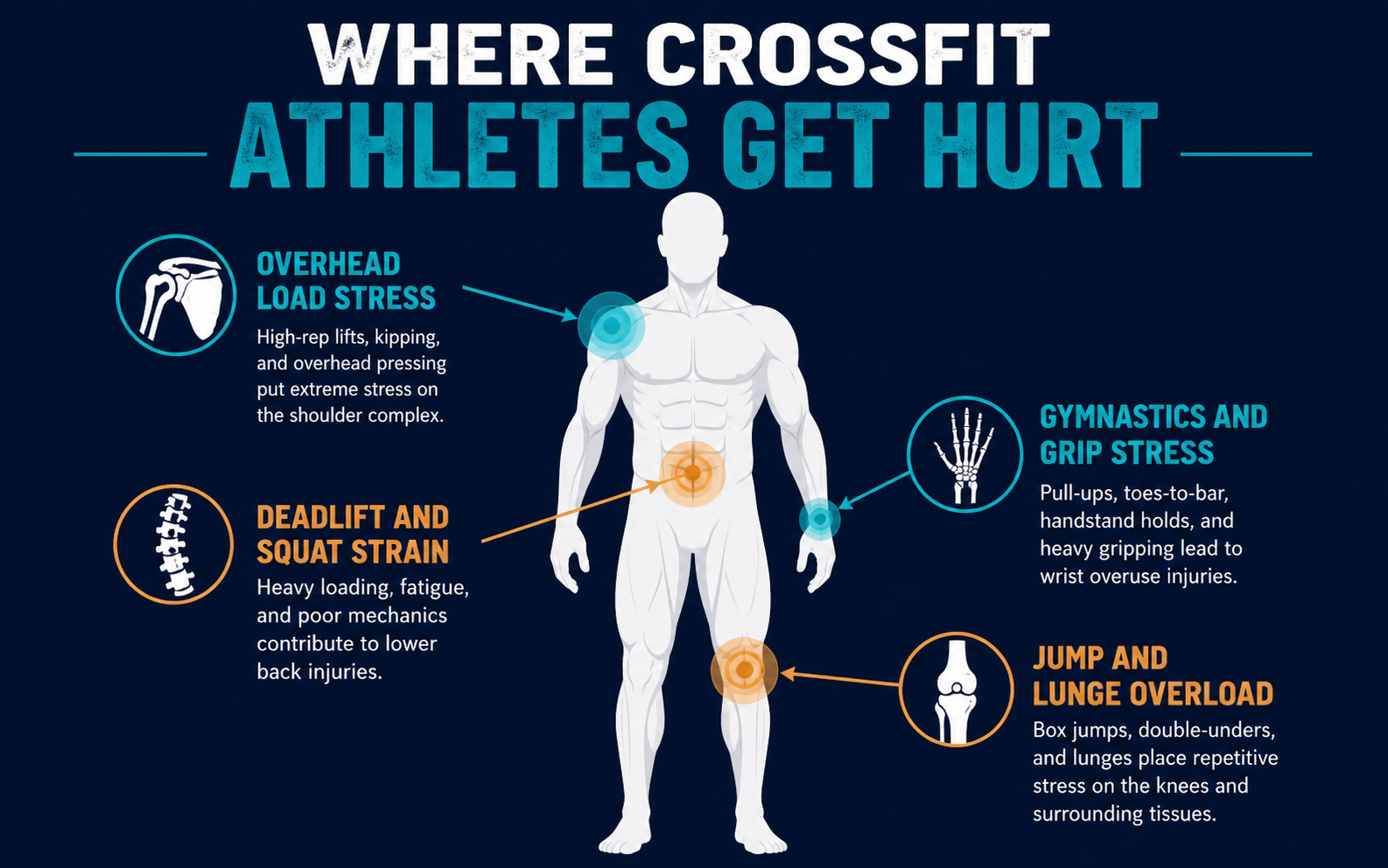
The injuries I see most often in my office include:
Shoulder impingement and rotator cuff irritation from repeated overhead pressing, kipping pull-ups, and snatch work
Lumbar strain from high-volume deadlifting and barbell squat cycles
Knee pain linked to repetitive box jumps, wall balls, and lunge sequences
Wrist stress from gymnastics movements, ring work, and high-impact hand placements
Ankle and foot discomfort from rope climbs, box jumps, and running volume
Most of these injuries do not arrive suddenly. They build over weeks of compensated movement. A joint loses mobility, the body finds a workaround, the workaround becomes the new normal, and eventually a small inefficiency becomes a structural problem. That is what chiropractic assessment is designed to catch early, while there is still time to correct the pattern before it becomes a significant setback.
What Chiropractic Assessment Actually Finds in a CrossFit Athlete
Chiropractic care for athletes is not simply about relieving pain after something goes wrong. The more useful application is identifying the functional restrictions that set pain in motion before it ever becomes acute.
When a CrossFit athlete walks into my office, I am not only asking where it hurts. I am evaluating joint alignment throughout the spine and extremities. I am watching how force distributes across the shoulder complex during overhead loading. I am identifying compensatory movement patterns that are silently increasing mechanical strain on vulnerable structures.
The shoulder is a useful example. An athlete presenting with shoulder pain from overhead work almost always has an underlying restriction in thoracic spine mobility or a deficiency in scapular control that is forcing the glenohumeral joint to work beyond its intended range. The shoulder hurts because the thoracic spine is not doing its job. Treating only the shoulder without addressing the thoracic restriction is like fixing a symptom without touching its cause.
Corrective chiropractic adjustments restore proper joint mechanics. When joints move the way they are designed to move, neuromuscular communication improves, compensatory patterns reduce, and pain often resolves without passive rest. Research supports spinal manipulation as an effective intervention for musculoskeletal pain and dysfunction, and in my practice I see that principle confirmed regularly with athletes who assumed they simply needed more time off.
Extremity-focused care matters just as much. Precise adjustments to shoulder, hip, knee, and ankle joints optimize how force distributes through the complex movement chains that CrossFit demands. When every link in that chain is moving correctly, mechanical strain decreases across the entire system.
How SoftWave and Shockwave Therapy Change the Tissue Healing Equation
Even when joint mechanics are restored, injured soft tissue still needs to heal. This is where SoftWave technology and extracorporeal shockwave therapy have become some of the most clinically significant tools in my practice.
Both modalities work by delivering focused acoustic energy waves into damaged musculotendinous tissue. That energy stimulates increased local blood flow, triggers cellular regeneration, promotes collagen remodeling, and reduces chronic inflammation at the site of injury. For an athlete dealing with persistent rotator cuff irritation, a stubborn tendinopathy, or lumbar musculature that has not fully recovered despite time off, these are meaningful biological changes, not minor symptomatic relief.
A systematic review published in the American Journal of Sports Medicine found that extracorporeal shockwave therapy significantly reduced pain and improved function in patients with chronic tendinopathy, often outperforming conservative treatment alone. I have observed exactly that pattern in my office with athletes who spent months trying rest, ice, and over-the-counter anti-inflammatories with limited progress. SoftWave and shockwave treatments regularly produce measurable improvement within a series of sessions.

One thing athletes consistently appreciate about these therapies is the complete absence of downtime. There is no surgical risk, no recovery period, and no dependency on medication. You come in, we deliver focused energy to the injured tissue, and you leave with better circulation to that area than when you arrived. For someone who cannot afford to stop training entirely, that matters enormously.
The benefits I consistently observe with SoftWave and shockwave therapy include:
Enhanced local circulation that accelerates soft tissue repair at the cellular level
Stimulated collagen regeneration that reduces chronic inflammation and tissue adhesion
Improved tissue pliability that supports flexibility following hard training sessions
Measurable progress in tendinopathy cases that have not responded to passive rest
A fully non-invasive approach that requires no downtime and carries no surgical risk
Building a Recovery Protocol That Fits How You Actually Train
Recovery for a CrossFit athlete is not a generic process, and a protocol that ignores your specific training demands will not hold long-term.
At Optimal Health Members, we start every athlete with a thorough movement analysis to identify the muscle imbalances and functional restrictions contributing to pain or limiting performance. From there, we build corrective exercise progressions that target those specific weak links before they trigger another injury cycle. This is not a general core-strengthening program. It is a targeted intervention based on what your body is actually doing.
Training modifications are often part of the conversation. Reducing volume temporarily while keeping relative intensity controlled preserves fitness while allowing injured tissue to complete its healing cycle. I want to be clear about what this is and is not. It is not telling an athlete to stop training. It is intelligent periodization that respects the physiological difference between productive stress and damaging overload.
Soft tissue treatment and mobility work are integrated into every phase of care. We are not only chasing pain. We are restoring the functional foundation that allows you to train consistently without recurring setbacks.
The Lifestyle Habits That Either Support or Undermine Your Recovery
Clinical care addresses structure and tissue. What you do outside my office determines how quickly that work takes hold.
Sleep is the most undervalued recovery tool in any athlete's toolkit. The National Institutes of Health identifies sleep as essential to musculoskeletal repair, hormone regulation, and nervous system recovery. When I am working with a CrossFit athlete whose progress is slower than expected, sleep quality is one of the first variables I revisit. Chronic sleep deprivation creates a physiological environment where injuries become far more likely and healing becomes significantly slower.
Hydration matters more than most athletes account for. Joints depend on adequate hydration for lubrication and nutrient transport. Athletes who arrive chronically dehydrated present with more joint stiffness, more audible crepitus, and slower recovery curves than those who prioritize fluid intake.
Your warm-up is not optional and it is not a casual jog followed by some arm circles. A dynamic mobility sequence that mirrors the specific demands of your planned workout prepares muscles and connective tissue for load without the shock of sudden stress. Post-training cool-downs with targeted stretching preserve the range of motion that chiropractic care works hard to restore.
Scaling workouts when you are fatigued is not a compromise. It is one of the most intelligent decisions an experienced athlete can make. Form breakdown under fatigue is one of the primary mechanisms I see producing repetitive strain injuries in CrossFit athletes, and it is almost entirely preventable.
Why Nutrition Is Not an Optional Part of Your Recovery Plan
You cannot out-train poor nutrition, and you cannot out-adjust it either. This is something I tell patients directly and without apology.
Research published in the British Journal of Sports Medicine confirms that adequate dietary protein is essential for muscle protein synthesis and repair following high-intensity training. I recommend lean protein at every meal to CrossFit athletes in active recovery, not as a performance optimization strategy but as a fundamental requirement for cellular repair. Without it, the tissue healing we initiate clinically has less raw material to work with.
Anti-inflammatory fats found in fatty fish, avocado, and quality olive oil reduce the oxidative stress that accumulates from repeated high-intensity training sessions. Antioxidant-rich foods, particularly colorful vegetables and berries, support immune function and the cellular recovery processes that happen hours after you have left the gym.
Electrolyte balance supports proper muscle contraction and nerve function. Athletes who train hard and sweat heavily need more than plain water to maintain optimal cellular function, and the fatigue and cramping that often show up late in hard training weeks frequently have a hydration and electrolyte component, not just a volume problem.
When nutrition, hydration, sleep, and clinical care work together, the results compound. Structural improvements hold longer. Tissue heals faster. Athletes make consistent progress without the constant interruption of recurring pain.

You Can Train Hard Without Constantly Managing Injury
CrossFit is not inherently dangerous. But training hard without addressing underlying movement restrictions, unresolved tissue damage, and inadequate recovery creates a cumulative burden on the body that will eventually win.
The athletes who train pain-free over the long term are not the ones with the best genetics or the fewest injuries. They are the ones who take recovery as seriously as they take performance. Advanced chiropractic care, SoftWave therapy, shockwave treatment, and deliberate lifestyle habits are not luxuries reserved for elite competitors. They are the investment that keeps you in the gym, training the way you want to train, without constant interruption.
If you are a CrossFit athlete in the Henderson or Las Vegas area dealing with pain that is not resolving on its own, I would welcome the opportunity to assess what is actually happening and build a plan that fits your training demands. You can schedule a consultation directly at Optimal Health Members or contact my office. Let us find out what is keeping you from training the way you are capable of training.