Class 4 Laser for Hip Pain: What the Research Says
You can’t lie on that side anymore. Getting out of the car takes a second longer than it used to, and you’ve started taking the elevator instead of the stairs without really deciding to. Somewhere along the way you read that laser therapy might help, and now you want to know if it’s real or just another expensive gadget.
I’ve been treating hip pain since 1996, and I’m going to give you the honest version. Class 4 laser has real research behind it. It also has real limits, and the hip is one of the places where those limits matter most. Here’s what the studies show, where they fall short, and how I actually use laser in my office.
Quick Answer
Class 4 laser uses near-infrared light to support tissue repair and reduce pain signaling, and controlled trials show it can reduce joint pain when the dose is correct. Hip-specific research is smaller than knee research. In my practice, laser works best on the hip only after an exam confirms where the pain is actually coming from.
Key Takeaways
Laser therapy, also called photobiomodulation, works through light absorbed by the mitochondria in your cells, which affects energy production and inflammatory signaling.
A 2019 meta-analysis of 22 placebo-controlled trials found laser reduced knee arthritis pain, but mainly at the recommended doses. Underdosing is a big reason laser studies disagree.
Hip-specific studies are fewer and smaller, and the strongest results come when laser is combined with exercise and other care.
Pain on the outside of the hip, near the gluteal tendons, tends to respond better than advanced bone-on-bone arthritis.
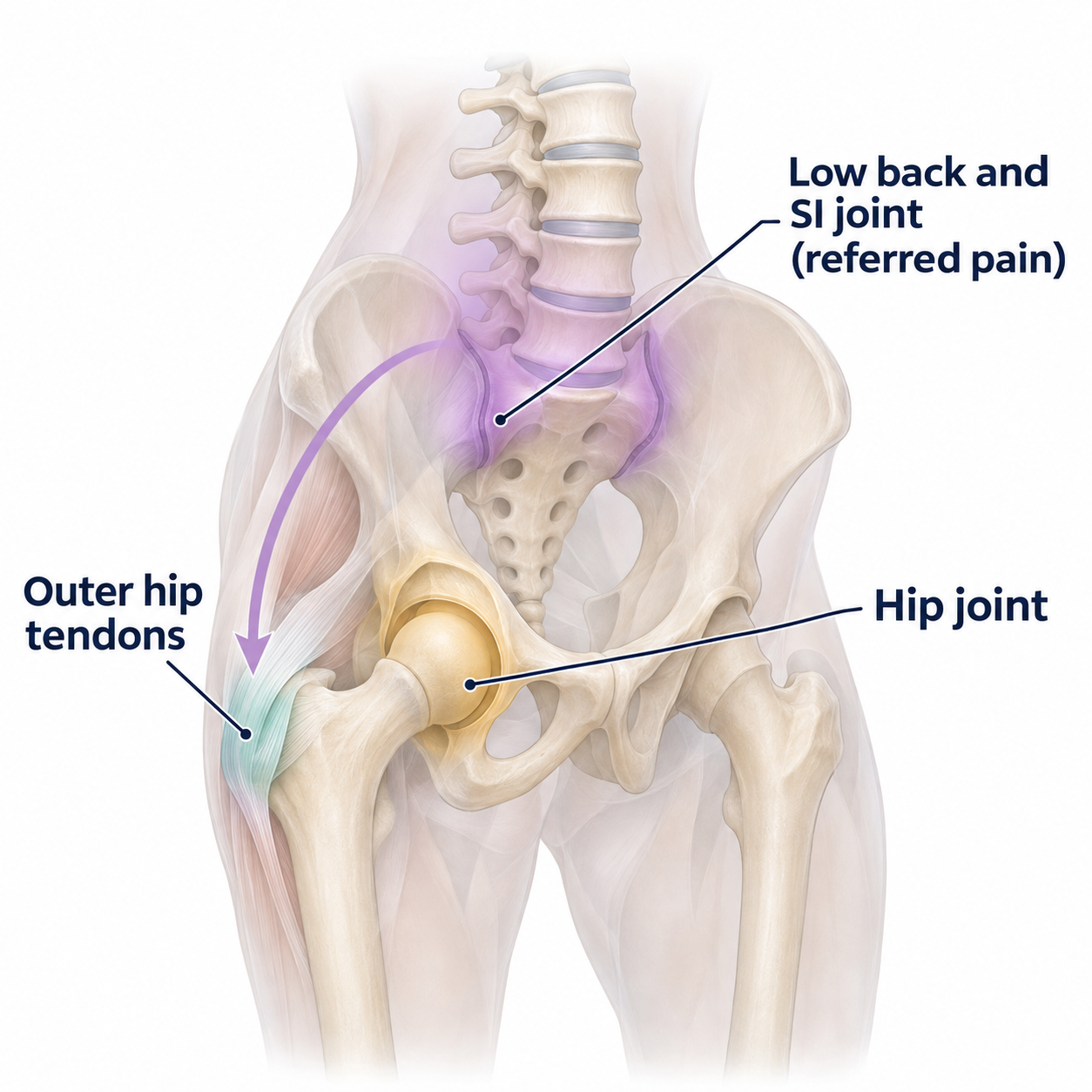
A large share of “hip pain” originates in the low back or sacroiliac joint, so the exam has to come before the laser.
Why I Ask Where Your Hip Pain Is Coming From Before I Talk About Laser
Most people who ask me about laser are hoping for a light switch. Lie down, get treated, walk out new. I understand that. When your hip has kept you up for three months, you want it gone.
The first thing I tell them is that laser is not a diagnosis. It’s a tool that helps tissue do its repair work more efficiently, and it only helps if we aim it at the tissue that’s actually causing the problem. In nearly 30 years of practice, I’ve learned that a big share of the hip pain that walks through my door isn’t coming from the hip joint at all. Hip pain has a long list of possible causes, from tendon irritation to arthritis to problems in the low back that send pain down into the hip.
If I laser the wrong spot, I’ve wasted your time and your money. I won’t do that. So before we talk about light, we talk about where the pain lives, what makes it worse, and what your low back and pelvis are doing.
What Class 4 Laser Is Actually Doing Inside the Tissue
The research term is photobiomodulation. Light at specific wavelengths is absorbed by your mitochondria, the small structures inside cells that produce energy. A review from the Wellman Center for Photomedicine at Massachusetts General Hospital describes how that light interacts with an enzyme in the mitochondria called cytochrome c oxidase, which affects cellular energy production and redox signaling. In plain language, tissue that’s been stuck in a slow, irritated state gets a nudge toward repair.
The “Class 4” part is about power. The unit in our office is a LightForce that runs up to 10 watts at 810 and 980 nanometers. More power lets us deliver a meaningful dose in a reasonable amount of time and reach deeper than a handheld low-level device can. That matters with the hip more than almost anywhere else. The hip is one of the most deeply buried joints in the body, with thick layers of glute muscle between the skin and the joint. With a deep structure like that, power and technique both count, and so does knowing exactly where you’re aiming.
What the Research Honestly Shows, and Where It Is Still Thin
I’m going to be straight with you here, because I don’t think every clinic is.
The strongest laser research for joint pain is on the knee, not the hip. A 2019 systematic review and meta-analysis in BMJ Open pooled 22 randomized, placebo-controlled trials with over 1,000 people who had knee osteoarthritis. Laser reduced pain and disability compared to placebo, and the clearest benefit came when the dose matched recommended guidelines. That’s the detail I want you to remember. Studies that underdosed tended to show little, and I believe that’s a big part of why laser got a mixed reputation. It’s also why I pay attention to wavelength: the effective range in that review included the 810 nanometer wavelength our unit uses.
Hip-specific research is smaller. A 2024 systematic review on hip and knee arthritis found that laser added to exercise may improve short-term pain and function, though the authors rated the certainty of that evidence as very low. A 2026 randomized controlled trial on hip osteoarthritis combined high-power laser with physiotherapy and injections and found added benefit in walking performance and quality of life, while the researchers themselves said more evidence is needed. There’s also a small placebo-controlled trial after total hip replacement where laser reduced pain and certain inflammatory markers in the hours after surgery.
So when someone asks me if the research proves laser works for hips, here’s my answer. The research supports how laser affects tissue. The joint pain data, especially for the knee, is encouraging when the dose is right. The hip-specific evidence is promising but not as deep as I’d like. I’d rather tell you that than oversell it.
Which Kinds of Hip Pain Tend to Respond Best
The cases I’m most optimistic about are on the outside of the hip. People usually call it hip bursitis. In my exam room, it’s often irritation of the gluteal tendons where they attach to the side of the hip bone. Those tissues sit closer to the surface than the joint itself, and in my experience they tend to respond better than deep joint problems.
Early to moderate hip arthritis can respond too, especially when I pair laser with adjustments and movement work that take pressure off the joint.
Where I’m cautious: advanced arthritis where the joint is bone-on-bone, pain that’s really coming from the low back, and anything that looks like a fracture, a labral tear that needs a surgical opinion, or something systemic. Laser may help with comfort in some of those cases, but I’ll tell you plainly it isn’t the main answer, and I’ll refer you out when that’s what you need.
The Pattern I See Over and Over in My Office
The side-sleeper with the “bad hip” who actually has a back problem. I see it constantly. They point to the hip, they can’t lie on that side at night, and they’ve been icing the hip for months. Then I check the low back and the sacroiliac joint, and that’s where the story is. The hip hurts because it’s on the receiving end.
The second pattern is just as common. Someone changes how they walk to protect a sore knee or foot, and six months later the hip on the opposite side is angry. The body compensates well until it can’t. When I see that, treating only the hip is like mopping the floor while the sink is still overflowing.
The Biggest Mistake People Make Before They Come In
They wait, and they rest. Both sound reasonable, and that’s what makes them a trap.
Hip pain makes you move less. Moving less weakens the glutes. Weak glutes put more load on the tendons and the joint. More load means more pain, and around it goes. By the time some people reach my office, the original problem is the smaller part of what we’re dealing with. The bigger part is a year of deconditioning.
The second mistake is chasing the pain with only a pill or only a passive treatment, and I include laser in that. If someone wants laser alone with no change to how they move, sit, sleep, and load that hip, I tell them they’re likely leaving most of the benefit on the table. The research backs this up. The best hip results in the studies above came when laser was paired with exercise and active care, not used by itself.

What Changed My Mind About Laser
I’ll be honest: I was skeptical of lasers for years. I’d seen low-powered devices that, in my opinion, didn’t deliver enough energy to matter, and I’d seen them marketed like miracle wands. That made me suspicious of the whole category.
What changed my thinking was the dose research and what I saw once the dose was right. When I started using a unit with enough power to reach deep tissue, aiming it at the tissue the exam pointed to, and pairing it with hands-on care and movement, the results looked very different from what I’d seen with the weaker devices. That taught me something I still tell patients. It’s never the device alone. It’s the exam, the dose, the aim, and what you do between visits.
Where I Disagree With How Laser Is Marketed
I disagree in two places, and some of my colleagues won’t love this.
First, I don’t like seeing laser sold as a standalone cure-all on a 20-visit package before anyone has figured out where the pain is coming from. That’s not care. That’s a sales funnel. Laser is a strong tool, but it isn’t a diagnosis.
Second, I disagree with treatment that’s rushed or underdosed to keep the schedule moving. The research is clear that dose matters, and with a deep joint like the hip, a quick pass over the skin isn’t going to cut it. Many chiropractors do excellent work, and I’m proud to serve them as President-Elect of the Nevada Chiropractic Association. But I believe our profession earns trust by being more honest about what laser can and can’t do, not less.
What a Realistic Plan of Care Looks Like
Every case is different, so I don’t hand out a fixed number of visits or promise a timeline. Laser works cumulatively, so a plan usually involves a series of sessions over several weeks, and we reassess as we go. If we’re not seeing meaningful change, we adjust or rethink. We don’t just add more sessions.
At Optimal Health Members, laser is almost always paired with chiropractic adjustments for the low back, pelvis, and sacroiliac joint, plus specific exercises to rebuild the glutes and hip stabilizers. For some tendon cases, SoftWave is part of the plan too. Between visits, I want you moving in ways that are appropriate for your hip, sleeping with a pillow between your knees if you’re a side-sleeper, and getting up more often if you sit for long stretches.
Tendon and soft tissue repair doesn’t stop when you leave the table, and that in-between time is where a lot of recovery happens or stalls. For patients working through hip tendon or soft tissue problems, I often talk about RECOVER™, a regenerative peptide and antioxidant formula with BPC-157, GHK-Cu, and carnosine in a multi-phase release capsule. It’s designed to support the body’s normal tissue repair processes and help maintain healthy recovery between visits. It isn’t a replacement for hands-on care. Laser, SoftWave, and adjustments get the repair process moving, and RECOVER™ helps support that work at home. If you take a blood thinner or are pregnant, talk with your provider before starting it.
Who Should Be Cautious, and My Honest Advice
Laser isn’t for everyone. We don’t treat over the abdomen or low back during pregnancy, over areas with known or suspected cancer, or near the eyes, and everyone in the room wears protective eyewear. If you take medications that increase light sensitivity, we need to talk first. And if you have hip pain with fever, unexplained weight loss, a recent fall, or pain that’s worse at night no matter how you lie, I want that properly evaluated before we do anything else.
My honest advice is this: don’t start with the device. Start with the exam. Find someone who will tell you what’s actually causing your hip pain, who will tell you if laser isn’t a good fit, and who has a plan for getting you moving again, not just a plan for getting you back on the table. When that’s the conversation you’re having, laser can be a valuable part of the answer.

Let’s Find Out Where Your Hip Pain Is Really Coming From
If your hip has been changing how you sleep, walk, or live, I’d be glad to take a look. At Optimal Health Members in Henderson and Las Vegas, every hip case starts with a real exam, and if Class 4 laser is a good fit, I’ll explain exactly why and what to expect. If it isn’t, I’ll tell you that too. You can reach our office at (702) 541-9060.