Always Cold? What I Check Before I Recommend Circulation Support
You wear socks to bed in a Las Vegas summer. Your hands are cold enough that your family flinches when you touch them. You keep a sweater at the office while everyone else is comfortable, and you’ve been told more than once that you’re “just a cold person.” Maybe you’ve already bought a circulation supplement or two, hoping one of them finally makes the difference.
I’ve been listening to patients describe this since I started practicing in 1996, and I want to give you the honest answer I give in the room. Circulation support can help, but only when circulation is actually the bottleneck. In my experience, it usually isn’t the first place to look.
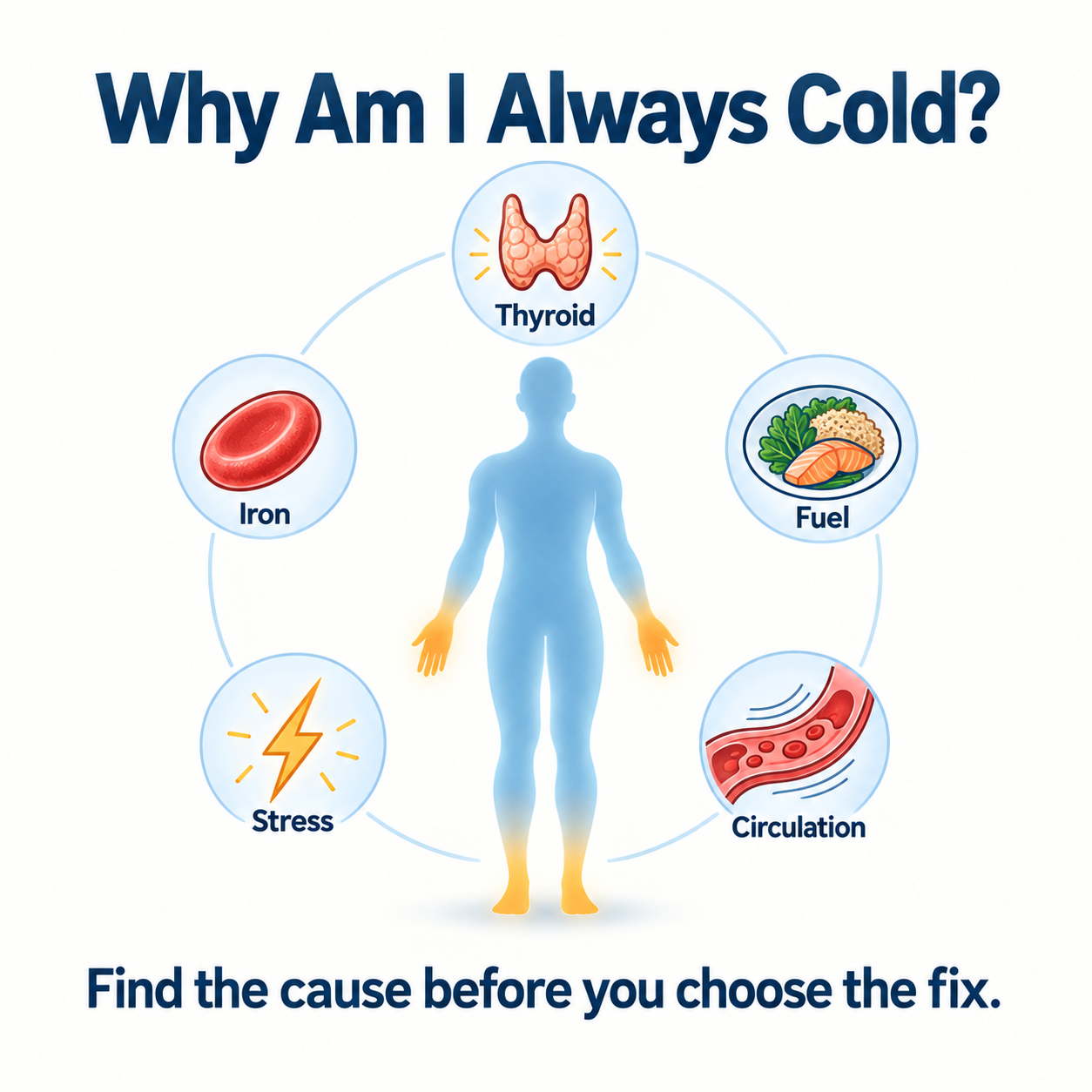
Quick Answer: Circulation support can help with cold intolerance when blood flow is the real limitation, but often it isn’t. In my practice, the most common drivers are low thyroid function, low iron, eating too little, and a stressed nervous system. I find the cause with questions and labs first, then decide whether circulation support fits.
Key Takeaways
Feeling cold all the time is a symptom, not a diagnosis, and it has several possible causes beyond circulation.
An underactive thyroid and iron deficiency anemia are both well-documented causes of cold intolerance and are confirmed with simple bloodwork.
Long-term calorie restriction has been shown to lower core body temperature in humans, which is why dieters often feel cold.
Fingers that turn white or blue, slow-healing foot sores, or leg pain when walking need a medical evaluation before any self-care plan.
Dietary nitrates from foods like beets and leafy greens help the body make nitric oxide, which supports healthy blood vessel function.
What I’m Listening For When You Tell Me You’re Always Cold
When a patient sits down and says “I’m always cold,” I don’t reach for a product. I start sorting through a short list in my head: thyroid, iron, blood sugar, how much they’re eating, what medications they take, and how wound up their nervous system is.
Then I ask three questions. Is it your whole body, or mostly your hands and feet? Is it both sides, or one? Did it start recently, or have you always been this way? Those three answers tell me more than any supplement label ever will.
MedlinePlus lists cold intolerance as a symptom with a range of possible causes, which matches what I see in the office. After nearly 30 years, I can tell you the patients who do best are the ones where we figured out why they were cold before we tried to warm them up.
Is Cold Intolerance Really a Circulation Problem?
Less often than most people assume. True circulation problems are real and worth taking seriously: Raynaud’s, peripheral artery disease, nerve damage from diabetes, and nicotine tightening the blood vessels.
But in my office, the most common drivers are different. An underactive thyroid slows the body’s heat production. Iron deficiency anemia means less oxygen-carrying capacity, and cold hands and feet are a classic sign. Very low body fat, not eating enough, and a nervous system stuck in stress mode round out the list. Some medications, including beta blockers, can leave hands and feet cold too.
So when someone asks me if circulation support will help, here’s what I say: it can, if circulation is the actual bottleneck. If it isn’t, you’re putting a better heater in a house with the windows open.
Warning Signs That Mean You Need a Workup First
Some cold symptoms should not be handled with a home routine. I want you seen promptly if:
Your fingers or toes turn white or blue, then red, when you’re cold or stressed
You have sores on your feet that heal slowly
One leg aches when you walk and eases when you rest
Numbness or tingling is getting worse
The cold came on alongside fatigue, weight change, thinning hair, or constipation
That last cluster makes me think thyroid every time. And if you’re diabetic or you smoke and your feet are always cold, please don’t self-treat. Get checked.
I’ll always order or recommend labs before I build a plan. Natural solutions first has never meant ignoring the bloodwork. It means using what the bloodwork tells us to choose the least invasive path that actually addresses the cause.
The Pattern I See in People Who Are Losing Weight
Here’s the connection most people never make: dieting. I’ve been helping patients with weight management since 2012, and one of the most consistent things I hear a few weeks into an aggressive calorie cut is, “Doc, I’m freezing.”
When you eat far less than your body needs, it turns down the thermostat to protect itself. This isn’t just something I’ve noticed. A study of people practicing long-term calorie restriction found their core body temperature ran lower than that of endurance athletes, even though both groups were similarly lean. The difference was how much fuel was coming in.
People come to me thinking they’ve developed a circulation problem, when really their metabolism is conserving energy. This is a big reason I care so much about protein, real food, and never crash dieting. It’s also something I watch for in anyone using appetite-suppressing approaches. If you’re losing weight and suddenly always cold, that’s information, not a badge of honor. When patients ask me about natural metabolic support, I point them to the approach I use at GLP THREE, where fueling the body well is part of the plan, not an afterthought.
The Mistake I See Most When People Try to Warm Up on Their Own
They go straight to the supplement aisle and skip the basics. I’ve had patients bring a bag into my office with cayenne capsules, ginkgo, and a “circulation blend,” while they’re drinking four coffees a day, sitting nine hours without standing, and still vaping.
Nicotine tightens blood vessels. Long sitting stalls your calf muscles, and those calves are basically your second heart for pushing blood back up from your feet. No capsule outworks that.
The second mistake is assuming every cold person needs the same plan. A 28-year-old marathoner with very low body fat and a 62-year-old with diabetes might both have cold feet, but I would never hand them the same advice.
How Your Nervous System Decides Where Your Blood Goes
Your blood vessels don’t decide on their own how open to be. Your sympathetic nervous system, the fight-or-flight side, tightens the vessels in your hands and feet when it senses stress. It’s a survival reflex: protect the core, let the hands and feet go cold. People living in constant tension often have cold hands for exactly this reason.
I want to be clear: chiropractic care isn’t a circulation cure, and I’d never tell anyone it is. What I see in practice is that when we reduce pain, restore movement, and help someone stop living in a braced, guarded state, they often tell me they feel more relaxed overall.
One specific pattern I always look for is a cold or tingly hand on only one side, especially when it gets worse with the arms overhead. That can point to compression around the neck, collarbone, and first rib, a condition called thoracic outlet syndrome. One-sided cold is a different conversation than whole-body cold, and it’s something we evaluate carefully in the office.

What Class 4 Laser and Red Light Can and Can’t Do for Circulation
We use Class 4 laser and red light therapy at Optimal Health Members, and the research behind light therapy and blood flow is interesting. In animal research on red light therapy, a short session of red light produced vasodilation, and blood flow remained elevated 30 minutes after the light was turned off, with the effect tied to nitric oxide. That’s a real, useful mechanism, especially when cold is tied to a specific stiff or injured area, like an old ankle sprain or arthritic hands.
But it’s local. Laser on your feet won’t fix low thyroid or low iron. I tell patients that plainly, because I’d rather lose a session than have someone believe a machine is addressing a root cause it can’t reach.
When a cold, achy area traces back to an old injury that never fully finished healing, I think about what happens between visits. Laser and chiropractic care get the repair process moving, and then the body has to carry that work forward on its own for days at a time. That’s where I sometimes recommend RECOVER™, a peptide and antioxidant complex with BPC-157, GHK-Cu, and carnosine, designed to support the body’s natural tissue repair processes between visits. It isn’t a replacement for hands-on care. It helps support the work the body is already doing. If you take a blood thinner or are pregnant, talk with your provider before starting it.
Nutrients and Supplements: What Helps and What’s Overhyped
The foundations matter most: enough protein, enough iron and B12 if labs show you’re low, omega-3 fats, and plenty of water.
Dietary nitrates from beets and leafy greens help your body make nitric oxide, which supports healthy blood vessel function. A review of human intervention studies found dietary nitrate acutely lowers blood pressure in healthy people and showed promising effects on endothelial function, the health of the lining of your blood vessels. That’s food I’m happy to recommend.
Ginger and warming spices are fine and pleasant. I just don’t think they move the needle the way the labels suggest. What I consider overhyped is the “circulation formula” with fifteen ingredients at doses too small to matter. I’d rather correct one real deficiency than take a handful of maybes.
Iron is the one I won’t let people guess on. Too much iron causes its own problems, so get tested before you supplement.
Why I Don’t Accept “You’re Just a Cold Person”
This is where I part ways with a lot of people in my field. I think circulation support is one of the most oversold categories in wellness. It’s easy to hear “cold hands,” reach for a product, and send the patient out the door with something in their hand. It feels helpful. It often isn’t.
My view, after watching this pattern for decades, is that most cold intolerance is a fuel, thyroid, iron, or stress problem, and circulation sits downstream of those.
I also don’t accept “you’re just a cold person” or “it’s your age” as an answer. Some people do naturally run cooler. But a change in how cold you feel deserves an explanation, whether you’re 30 or 70.
What I Tell Patients on Day One
I tell them, “We’re going to find out why before we decide what.” Then we start with the things that cost nothing:
Stand up and walk for a few minutes every hour, and do calf raises. Moving your calves pushes blood back up from your feet.
Eat a real breakfast with protein instead of running on coffee.
Cut back on nicotine and go easier on caffeine.
Keep your core warm. When your trunk is cold, your body pulls blood away from your hands and feet first.
Breathe slowly through your nose for a few minutes before bed to bring that stress response down.
Get labs.
Most people are surprised how much those basics change things before we ever talk about a supplement. As a man of faith, I also remind patients that their body is doing its job by protecting them. Our job is to give it a reason to stop.

If You’re Tired of Being the Cold One
If you’re always cold and you’ve already tried the sweaters, the socks, and the supplements, it might be time to look at the reason instead of the symptom. At Optimal Health Members in Henderson, we start with the right questions and the right labs, then build a plan around what we actually find. If your cold intolerance started alongside dieting or weight changes, you can also learn how I approach natural metabolic support at glpthreevegas.com.
No pressure, no product pushed across the counter on day one. Just a clear answer about why you’re cold and what makes sense next.