Circulation and Aging: What Really Changes in Your Blood Vessels Over Time
My guess is your cold feet, a calf cramp at 2 a.m., or a sore shoulder that's still hanging on in month three didn't make you think about your blood vessels. Most people put all of that under "getting older" and move on. After nearly 30 years in practice, I think that habit is one of the most expensive mistakes people make about their health. The calendar does change your circulation. But a lot of what we blame on age was done by sitting, sugar, and stress, and that part can be changed.
Quick Answer: With age, arteries stiffen, the blood vessel lining makes less nitric oxide, and unused capillaries in muscle thin out. The lining matters most because it decides whether vessels open when tissue needs blood. In my practice, two people of the same age often have very different circulation. Movement, blood sugar, and sleep explain the gap far more often than birth year.
Key Takeaways
Aging stiffens arteries, but the bigger issue is the endothelium, the vessel lining that signals vessels to open.
About three hours of uninterrupted sitting measurably reduces blood flow and vessel function in the legs, even in young, healthy adults.
Light walking after sitting lowers post-meal blood sugar better than standing alone.
Muscle that isn't used loses capillaries, and lower capillary density is linked to weaker muscles in older adults.
High blood sugar damages the vessel lining quietly for years before most standard exams flag anything.
What Actually Changes in Your Blood Vessels as You Age
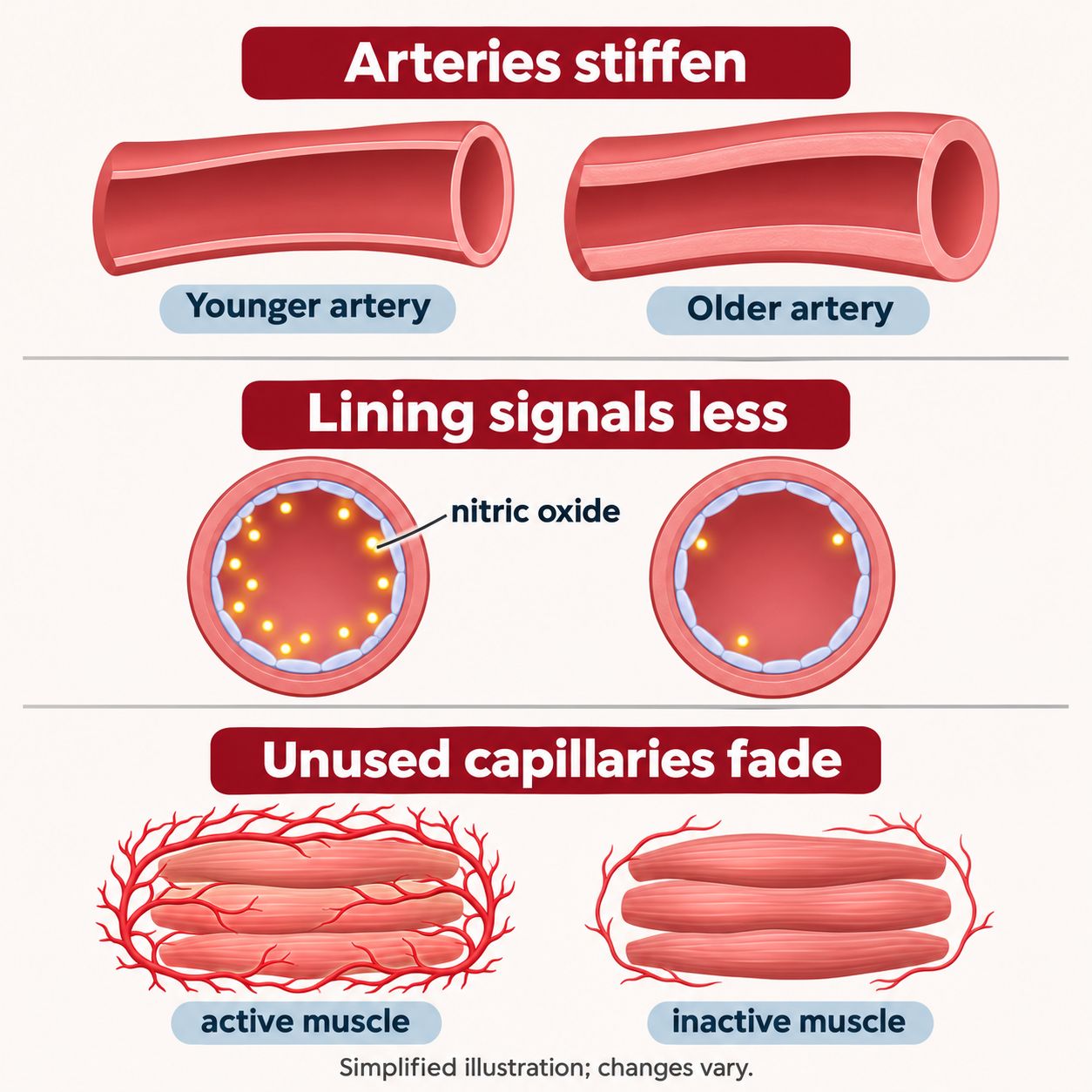
Three things change. Your arteries gradually stiffen and the heart works harder to push blood through them. The endothelium, the thin lining inside every blood vessel, starts making less nitric oxide, the signal that tells a vessel to relax and widen. And the tiny capillaries that feed your muscles, nerves, and skin start disappearing in areas that don't get used.
If you made me choose one, I'd pick the endothelium. Researchers now treat it as one of the largest organs in the body, the one that balances whether vessels tighten or open. When the lining stops responding well, everything downstream gets shortchanged: your feet, your brain, your spinal discs, your skin.
Most people picture circulation as plumbing, with pipes that clog. I think of it as a signaling system. Aging, more than anything, is that signal getting quieter.
How Much Is Really Aging, and How Much Is Lifestyle
Less is pure aging than most people assume. Arteries do stiffen over time, and I won't pretend you can stop that completely. But over the years, I've had two people of the same age sit across from me with completely different circulation. The difference almost never came from their age. It came from how much they moved, what they ate, how they slept, and where their blood sugar sat.
Capillaries follow the "use it or lose it" rule. In one study of middle-aged and older adults, people with age-related muscle loss had about 20% fewer capillaries per muscle fiber than matched peers without it. Those capillaries didn't vanish because of a birthday. Tissue that stops asking for blood eventually stops getting it.
When people tell me their circulation is just their age, I gently push back. In my experience, the calendar gets blamed for damage that sitting, sugar, and stress did.
The Early Signs People Brush Off
These are the signals I hear about all the time that almost nobody connects to blood flow:
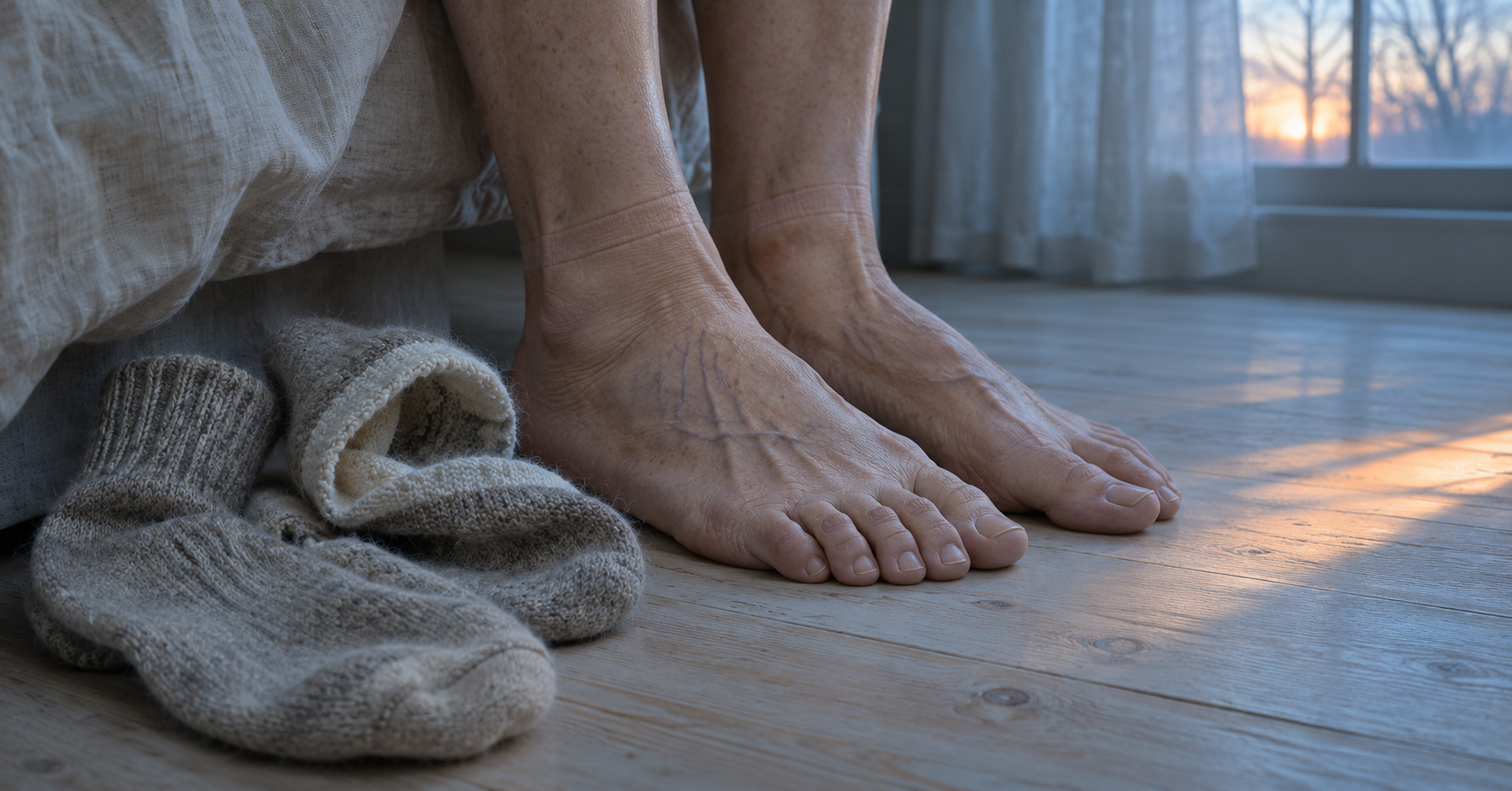
Hands and feet that run cold when they used to be warm
Cuts and bruises that take longer to heal
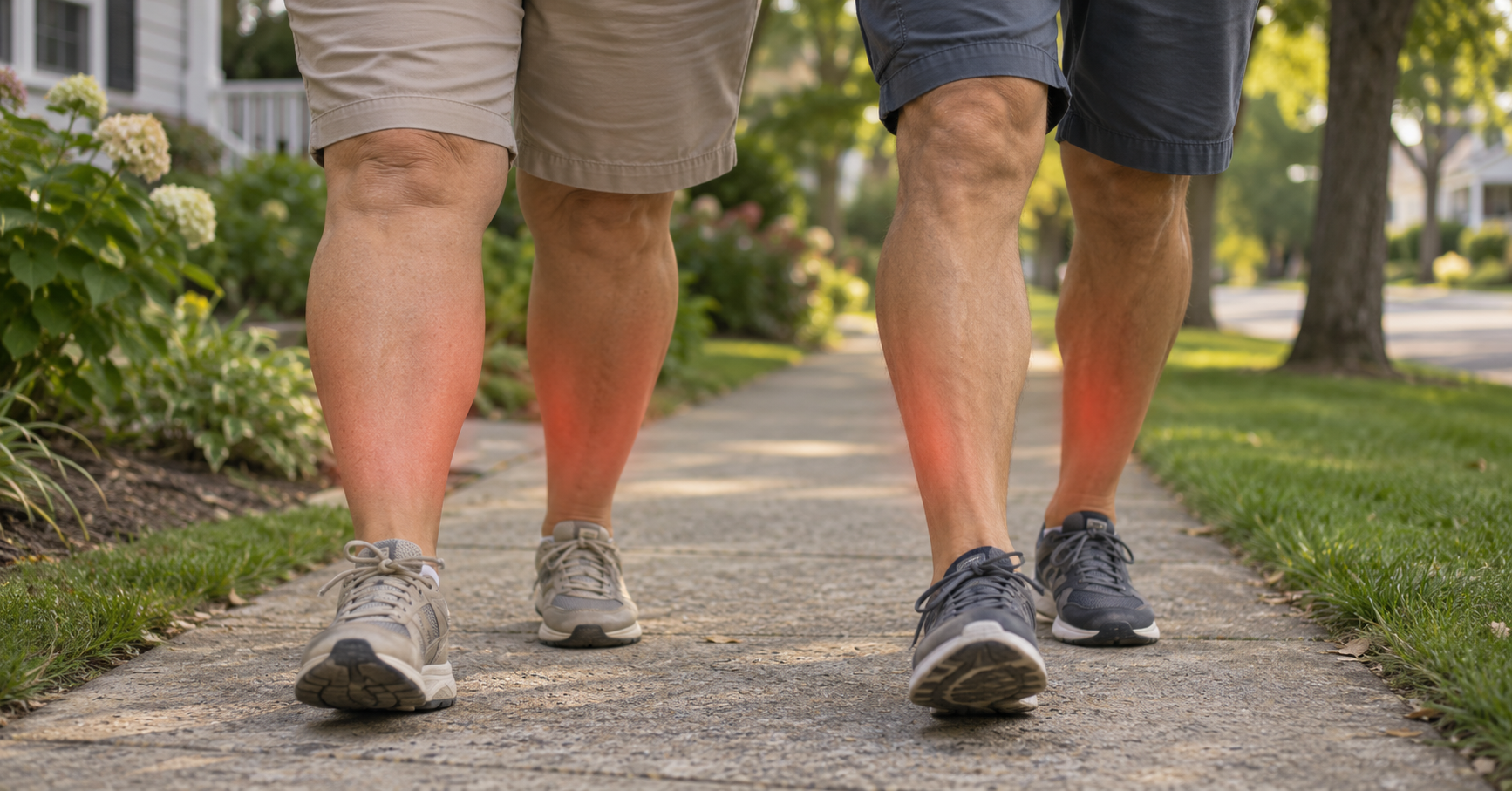
Calves that cramp at night or feel heavy by evening
Sock marks that stay pressed into the ankles
Brain fog after a few hours in a chair
A strained muscle or tendon that lingers for months when it used to clear up in weeks
People file each of these separately: getting older, bad shoes, too much coffee. I connect them because they so often show up together. One of them alone might mean nothing. Three of them together tell me to look at circulation before I look anywhere else.
The Mistake I See Most: Buying Something Instead of Doing Something
When people decide to "fix their circulation," most of them shop. They buy compression gadgets, foot massagers, or whatever supplement social media showed them that week. Not all of it is useless, but every one of those purchases treats circulation as something done to you.
The main engine for moving blood out of your legs and back to your heart is your calf. Each step squeezes the deep veins, and the calf muscle pump is the force that returns venous blood from the lower legs. It only runs when you walk.
Sitting shuts that engine off. In a study of young, healthy adults, about three hours of uninterrupted sitting cut resting blood flow to the leg and blunted the artery's ability to dilate. Those were healthy 22-year-olds. Now picture 55 years old and nine hours a day at a desk. What I tell people in my office is simple: no pill out-pumps a calf.
Where the Nervous System and Spine Fit In
This is where my chiropractic background shapes how I see circulation. Your sympathetic nervous system, the fight-or-flight side, helps control how open or tight your blood vessels are. When someone lives in a constant stress state, vessels in the hands and feet tend to stay tighter, and blood gets routed toward survival priorities.
I want to be careful here. An adjustment does not unclog arteries, and I lose respect for any doctor who says it does. What I will say is that a body stuck in guarding mode, with tight muscles, shallow breathing, and limited movement, circulates poorly. Restoring movement and calming that guarding is part of the picture. It's not the whole picture, and I won't sell it that way.
Blood Sugar: The Circulation Problem Nobody Calls a Circulation Problem
This is the part most people never hear, and I think it's the most important section of this article. Chronically elevated blood sugar is one of the major drivers of endothelial dysfunction. It damages the vessel lining slowly and quietly, often for years before anything shows up on a routine exam.
It's a big reason I got serious about metabolic health and why I've helped people with weight management since 2012. When someone tells me their circulation is getting worse, my first question isn't about their legs. It's about their fasting glucose and their waistline.
Supporting healthy blood sugar and metabolism is circulation work, even though almost nobody calls it that. Along with nutrition and movement, some people I work with use GLP THREE, a natural, non-synthetic supplement designed to help support healthy metabolic function. It's not a shortcut around the walking. It's support for the person who's already doing the work.
What I Tell People to Start This Week
I give the same list in my office almost every day. It's not exciting, and that's why it works. People actually do it.
Walk after meals, even 10 minutes. A review of randomized trials found that light walking breaks lowered post-meal glucose and insulin more than sitting, and more than standing breaks. Walking also restarts the calf pump right when blood sugar peaks.
Get up every 30 to 45 minutes if you sit for work. Set a timer if you have to.
Do calf raises while you brush your teeth. Two minutes a day, and nobody has to see you.
Stop smoking if you smoke. Nothing else on this list can undo it.
Eat more nitrate-rich vegetables like beets, arugula, and spinach. To be honest about the research, a meta-analysis found dietary nitrate modestly lowered systolic blood pressure in healthy people but not in people who already had hypertension. Think of these foods as good daily fuel, not as treatment.
Get your blood pressure and glucose checked. Stop guessing.
Where In-Office Therapies Fit: Class 4 Laser, Red Light, and SoftWave
At my practice, we use Class 4 laser therapy, in-office red light therapy, and SoftWave tissue regeneration. I'm careful to describe them as supporting players. Laser and red light work through photobiomodulation, where specific wavelengths of light interact with cells in the treated tissue. SoftWave uses acoustic waves, and shockwave research has documented effects on tissue regeneration and new small blood vessel formation.
Where I find them most valuable is with older adults whose soft tissue injuries have stalled because the area just isn't getting enough blood flow. They help the local tissue. They don't replace walking, and when someone expects otherwise, I tell them they're expecting too much.
Slow healing in an older body often means the repair work starts in the treatment room and then runs out of support at home. For people going through SoftWave, laser, or chiropractic care, I sometimes recommend RECOVER™, a peptide and antioxidant complex with BPC-157, GHK-Cu, and carnosine. It's designed to help support the body's natural tissue repair processes between visits. It doesn't replace hands-on care. It helps the body keep doing the work those therapies started. If you take a blood thinner, or if you're pregnant, check with your provider first.
An Opinion Not Everyone in My Field Shares
I think the wellness industry has turned circulation into a product category, and people are worse off for it. Walk any health expo and every other booth is selling a vibration plate or a capsule that promises "better blood flow." Most of it pulls attention away from the fundamentals that actually move the needle.
I also think my own profession often undersells how much metabolic health drives musculoskeletal outcomes. A chiropractor who adjusts a slow-healing shoulder without ever asking about blood sugar is missing half the reason it's slow. That isn't a popular thing to say at a chiropractic conference, but I believe it, and it's how I practice.
The Realization That Changed How I Practice
Early in my career, I thought healing time was mostly about the injury itself: how bad the sprain was, how old the tear was. Over the years, I kept noticing the same injury healing on completely different timelines in different people. The pattern underneath it was blood flow and metabolism.
That changed how I work. Now, when something isn't healing on schedule, I stop looking only at the injured area and start looking at the whole system that's supposed to feed it. Tissue can only repair as fast as blood can reach it. Once you understand that, circulation stops being a vague wellness topic and becomes the foundation under everything else.

If any of the early signs in this article sound familiar, I'd rather you hear about them from a doctor who will look at the whole picture than from a gadget ad. You can learn more about how we approach recovery and whole-body health at Optimal Health Members. If blood sugar and metabolism seem to be part of your story, you can explore the natural metabolic support approach I use at glpthreevegas.com. Start with a walk after dinner tonight. Your calves will know what to do.