ChiroThin vs Prescription Weight Loss Drugs: Which Is Right for You?
Every week someone sits across from me and says some version of the same thing: "Should I just go on Ozempic, or is there something else that actually works?" It's one of the most common questions in my office now, and I don't think that's a bad thing. For years, patients apologized for their weight like it was a personal failing. The rise of GLP-1 medications has done something valuable just by pushing the conversation past willpower and shame and toward biology. But biology isn't the whole story, and the path that's right for your neighbor isn't automatically right for you.
Quick Answer: ChiroThin is a drug free, structured weight loss protocol that supports fat loss through nutrition and portion control, while prescription GLP-1 drugs like Ozempic and Wegovy work by mimicking a gut hormone that slows digestion and reduces appetite. ChiroThin tends to fit patients who are 15 to 50 pounds from goal without major metabolic disease, while GLP-1 medications are often more appropriate for higher BMI, diabetes, or significant insulin resistance. The right choice depends on labs, health history, and goals, not on what's popular.
Key Takeaways
ChiroThin uses a structured low-calorie protocol with homeopathic support drops, while GLP-1 drugs work by mimicking the hormone GLP-1, which slows gastric emptying and signals fullness directly to the brain.
Patients who stop GLP-1 medications without other lifestyle changes in place often see significant weight regain, with one major trial extension finding participants regained roughly two-thirds of their prior weight loss within a year of stopping semaglutide.
Without insurance, GLP-1 list prices commonly run close to $1,000 to $1,350 a month, compared to a defined, one-time program cost for ChiroThin.
Patients with type 2 diabetes, significant insulin resistance, or a BMI in the severely obese range are often better served starting the GLP-1 conversation with their prescribing physician.
Neither option is the easy path. Both require real commitment from the patient to succeed long term.
Why This Conversation Keeps Coming Up In My Office
I'll be honest, my first reaction when a patient brings up Ozempic or Wegovy is relief. Not because I think everyone should be on one, but because it means we've moved past the old assumption that weight is purely a matter of discipline. Appetite and metabolism are biological. GLP-1 drugs have made that point in the public consciousness in a way that decades of clinical explanation never quite managed on its own.
But my very next thought is always the same. What's the plan for after? I've watched too many patients lose weight on a medication only to have no strategy in place for keeping it off once the prescription ends. That question, more than any brand name, is where this whole conversation actually starts.
How ChiroThin And GLP-1 Drugs Actually Work In The Body
These two approaches don't just look different on paper, they work through completely different mechanisms.
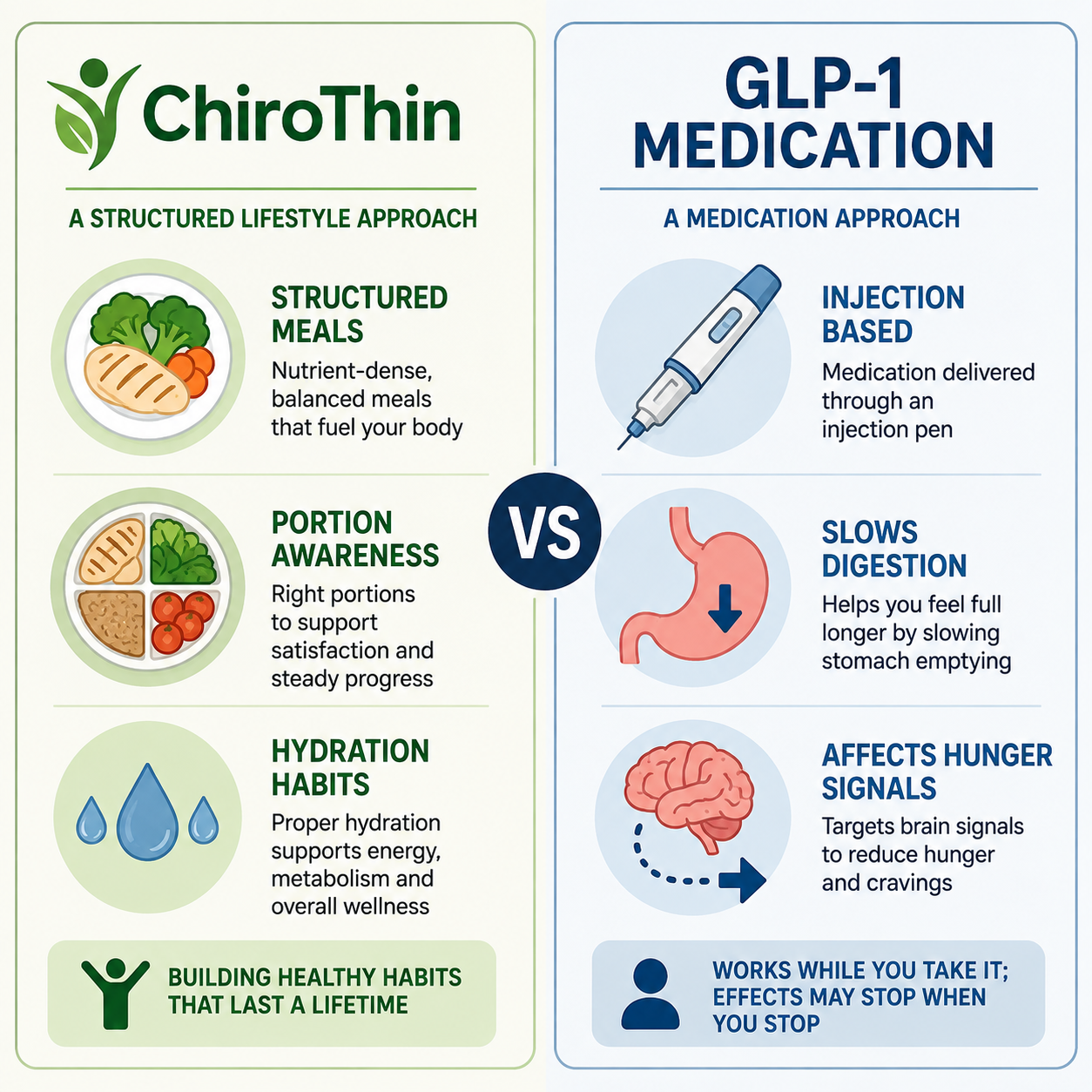
ChiroThin pairs a structured low-calorie eating plan with homeopathic support drops, designed to help your body pull energy from stored fat rather than muscle while you retrain your portions and habits. There's no hormone pathway involved. It's structure, support, and consistency.
GLP-1 medications like Ozempic and Wegovy work by mimicking a naturally occurring gut hormone. That hormone slows digestion, enhances insulin secretion, and sends fullness signals directly to appetite centers in the brain, which is why patients on these drugs report eating less because they're genuinely less hungry. It's a direct biochemical intervention, not a behavioral one.
Neither approach is magic. ChiroThin asks you to build the habit yourself. A GLP-1 drug changes your biology so the habit feels easier to build, at least while you're taking it.
Weighing The Real Pros And Cons Of Each Path
I lay this out plainly for every patient, because they deserve the full picture before they decide anything.
Prescription GLP-1 drugs can produce significant weight loss, and for patients carrying real disease risk from their weight, that can change the trajectory of their health. But they come with real tradeoffs: cost, especially without insurance, ongoing injections, gastrointestinal side effects for some patients, and the honest reality that weight often returns once the medication stops if nothing else has changed.
ChiroThin is lower cost, drug free, and it teaches portion and food habits that stay with you long after the 42 day protocol ends. But it demands more personal discipline during that window, and it isn't going to produce the same results for someone dealing with severe insulin resistance or significant metabolic disease. I'm not going to pretend one option is right for everybody, because it isn't.
When A GLP-1 Medication Is Genuinely The Better Choice
I say this to patients directly, because I think they deserve a chiropractor who tells them the truth instead of protecting a program. If someone has a BMI in the severely obese range, a type 2 diabetes diagnosis, or labs showing significant insulin resistance, they deserve to have that conversation with their prescribing physician. I'm not a prescriber, and I'm not going to let ego or business interest stand between a patient and the care that actually fits their medical picture. Sometimes that means telling someone honestly that ChiroThin alone probably won't move the needle far enough for what their body is dealing with.
Who ChiroThin Tends To Serve Best
On the other side, ChiroThin tends to be the stronger fit for someone who's roughly 15 to 50 pounds from their goal, doesn't have major metabolic disease driving their weight, and wants to actually relearn how to eat rather than outsource the process to a medication. I also see it work particularly well for patients who tried a GLP-1 drug, lost weight, then stopped and gained it back because nothing about their daily habits had actually changed underneath the medication. Done right, ChiroThin rebuilds those habits at the same time the weight comes off.
A Patient Who Taught Me These Paths Aren't Always Competitors
I had a woman in her fifties, pre-diabetic, who came to me already on Ozempic through her primary doctor. She'd lost 30 pounds but was miserable with nausea, and honestly scared of the idea of being on an injection indefinitely. We talked it through. She stayed on her medication under her physician's care, and we layered in nutrition coaching and strength work alongside it to build real meal structure. When she and her doctor eventually stepped her down off the medication, she didn't rebound, because we'd used that window to actually change her relationship with food.
That case is the reason I don't frame this as an either-or fight. Sometimes ChiroThin and GLP-1 medications work best in sequence, not in competition.

The Myths I Hear Most Often About Both Paths
The biggest myth I hear is that GLP-1 drugs are an easy way out, and that's not fair or accurate. Patients on these medications still have to manage nutrition, protect muscle mass, and deal with real side effects along the way.
On the other side, people assume ChiroThin is some kind of gimmick because part of the protocol is homeopathic, but I've watched it produce real, measurable results in patients who actually follow it. Neither path is the lazy path. Both take genuine commitment.
What Cost And Access Really Mean For This Decision
This factor is real and I don't dance around it with patients. Without insurance, GLP-1 medications commonly carry list prices in the range of roughly $1,000 to $1,350 a month, and coverage for weight loss specifically remains inconsistent and often restricted by insurers. On top of that, research following patients after they stop GLP-1 treatment has found substantial weight regain in the first year without continued medication or lifestyle support, which means the cost conversation often isn't a one-time decision, it's an ongoing one.
ChiroThin is a defined program cost for the full protocol, with no recurring monthly prescription expense after it ends. For a lot of my patients, that difference matters just as much as the mechanism does. I never want someone choosing a path purely on cost without understanding the tradeoff, but I also won't pretend cost doesn't matter to real families managing a real budget.
Where GLP THREE Fits Into This Conversation
For patients who go through this whole conversation and land on the GLP-1 side of the fork, GLP THREE gives them a legitimate, physician-overseen way to explore that path online rather than starting from scratch at a specialty weight loss clinic. I see it as another tool in the toolbox, not a replacement for the ChiroThin conversation, but a real option for patients whose bodies and labs point that direction.

What I Want You To Do Next
Don't choose based on what's trending on social media. Get real data first, your labs, your BMI, your health history, and have an honest conversation, either with me about ChiroThin or with a physician about medical weight loss options. The right choice depends on your body, not on what worked for your coworker.
If you want to talk through where you stand, visit optimalhealthmembers.com to schedule a consultation, or if you're already leaning toward exploring a physician-overseen GLP-1 path, take a look at GLP THREE. That's the conversation I have in my office every single week, and it's the one I want you to have before you spend a dollar on either path.