Can I See a Chiropractor If I'm Pregnant? A Prenatal Care Guide
Somewhere around the second trimester, a lot of my pregnant patients hit the same wall. The back pain starts, or the hips ache when they roll over at night, or sciatica shoots down one leg and won't let up. They've heard chiropractic might help, but nobody has told them whether it's actually safe, so they just live with it because they're scared to ask. I want to answer that question plainly, because you shouldn't have to spend nine months in pain out of caution that isn't necessary.
Quick Answer: Yes, chiropractic care is safe during pregnancy when performed by a provider trained in prenatal techniques. Adjustments are modified for a pregnant body, avoid pressure on the abdomen, and are recognized by organizations like the American Pregnancy Association as a safe, drug-free way to manage the back, hip, and pelvic pain that comes with pregnancy.
Key Takeaways
Chiropractic care is considered safe throughout pregnancy when the provider uses prenatal-specific techniques.
Pain develops largely because the hormone relaxin loosens ligaments to prepare the pelvis for delivery, which reduces joint stability.
The Webster Technique is a specific protocol used to balance the pelvis and reduce uterine constraint in the third trimester.
Certain conditions, including placenta previa or a high-risk pregnancy, require OB clearance before starting care.
Regular prenatal adjustments are associated with better sleep, easier movement, and shorter, more comfortable labor for many patients.
Is Chiropractic Care Actually Safe During Pregnancy?
Yes, and I say that after almost 30 years of treating pregnant patients in this office. Chiropractic care is hands-on and drug-free, and when it's performed by someone trained in prenatal adjusting, it's one of the safer things a pregnant woman can do for her body. I've adjusted women in their first trimester and women who came in the week before delivery. The technique changes, not the commitment to getting it right. This isn't a fringe idea either. The American Pregnancy Association recognizes chiropractic as a safe option throughout pregnancy, and I've built a large part of my practice around treating expecting mothers well.
Why Do So Many Women Develop Back and Pelvic Pain During Pregnancy?
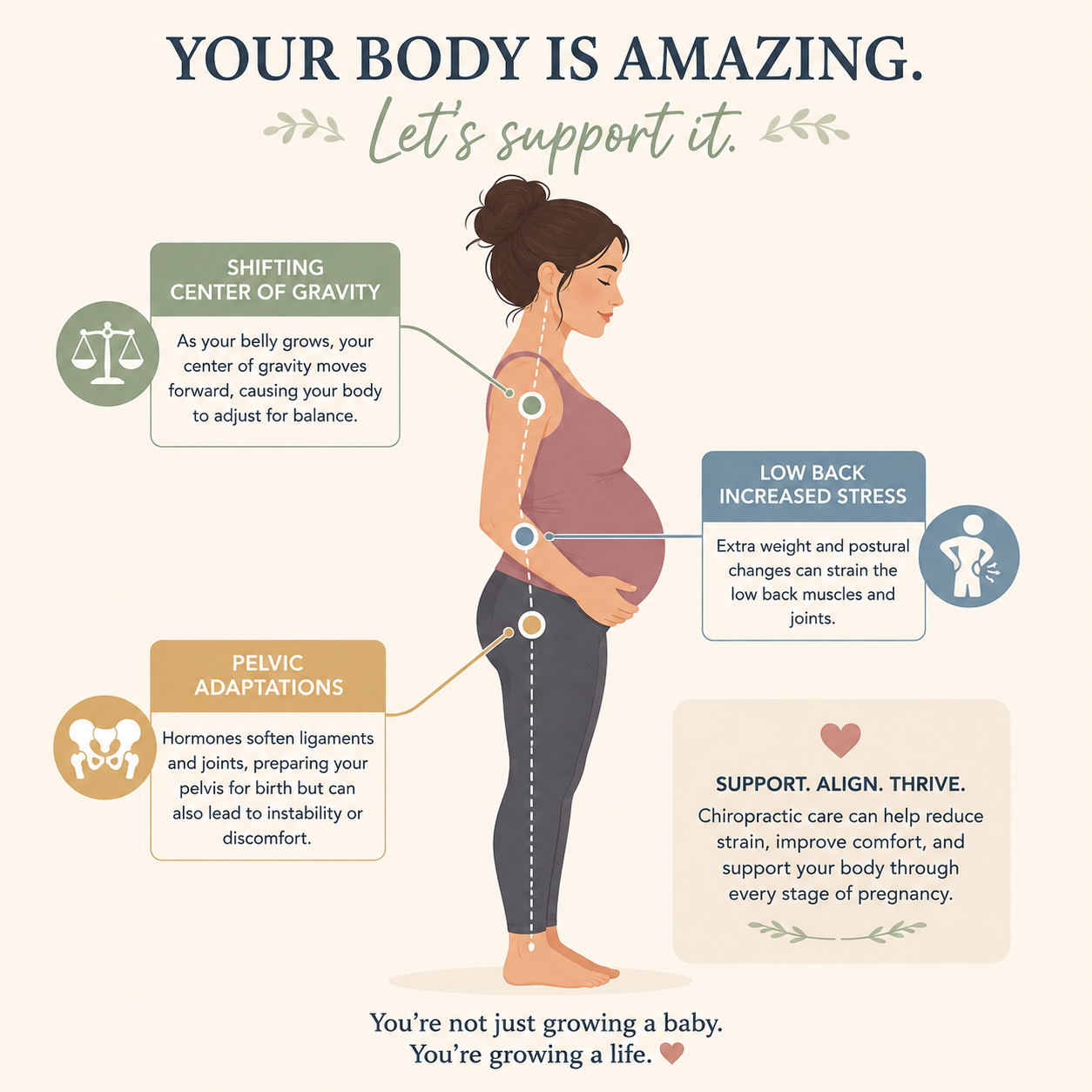
Your body goes through a rapid structural shift. The baby's weight pulls your center of gravity forward, your posture changes to compensate, and a hormone called relaxin loosens your ligaments to prepare your pelvis for delivery. That's necessary for birth, but it also means your joints are less stable than normal, so your spine and pelvis absorb more stress than they're built to handle for months at a time. I see this constantly in my office. Low back pain, sciatica, pubic bone pain, hip pain that flares up the second you try to roll over in bed. None of that is something you're supposed to just white-knuckle through for nine months.
What Does a Prenatal Adjustment Actually Look Like?
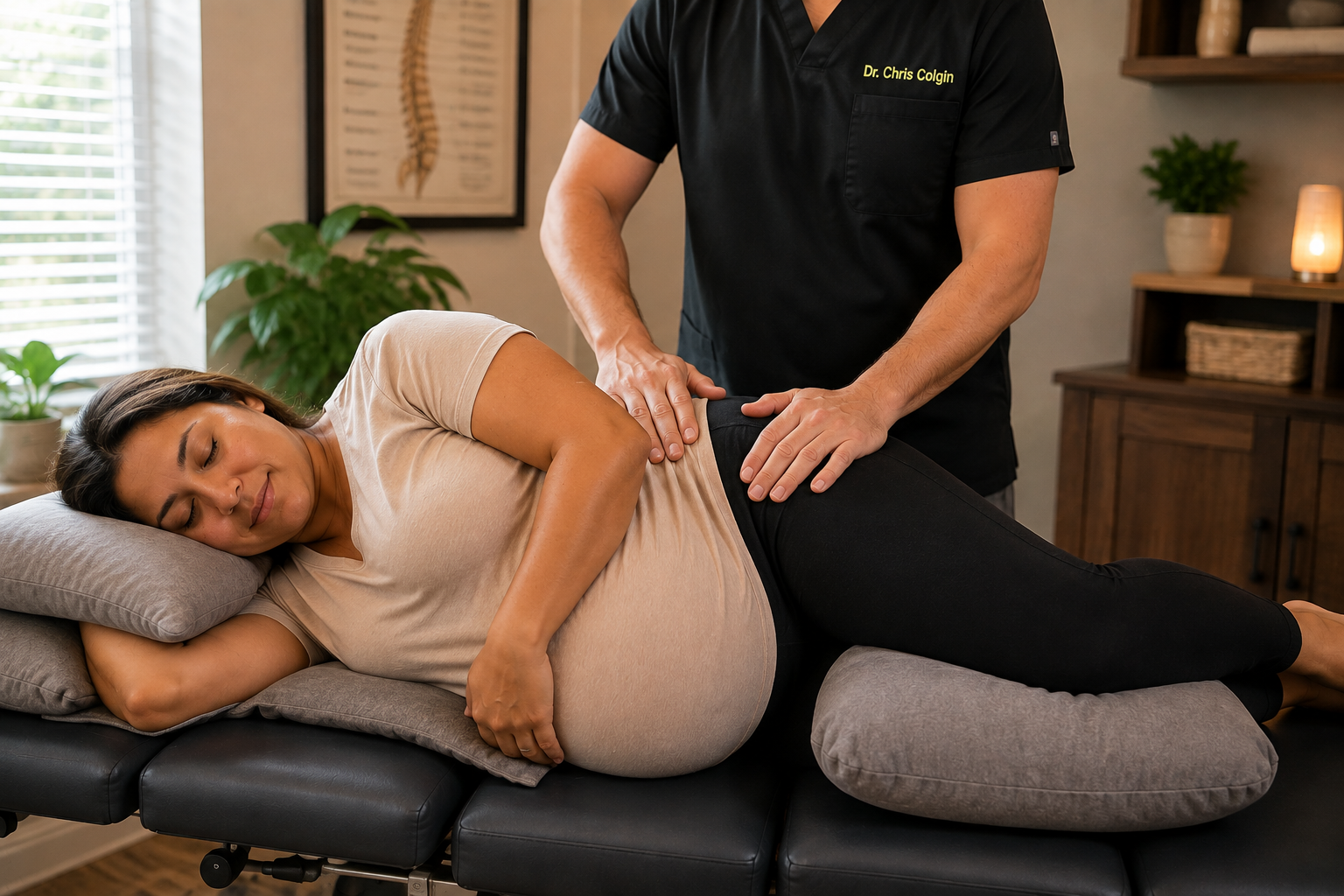
We never have a pregnant patient lie flat on her stomach on a regular table, obviously. I use a pregnancy pillow system with a cutout for the belly, or I'll adjust side-lying, which is comfortable for most women in their second and third trimester. The adjustments themselves are gentler than what I'd use on a general patient. I'm also checking pelvic alignment specifically, because a misaligned pelvis can restrict the space available for the baby, which is part of why I lean on a specific protocol called the Webster Technique as pregnancy progresses.
What Is the Webster Technique and Why Do I Use It?
It's a specific chiropractic protocol designed to reduce the effects of sacral misalignment and pelvic tension, which can in turn reduce constraint on the uterus. Some practitioners associate it with babies presenting breech, though I'm always careful not to overpromise here. I don't tell a patient that chiropractic will turn a breech baby. What I tell them honestly is that balancing the pelvis creates the best possible environment for the baby to get into position on its own. I'm certified in this technique through the International Chiropractic Pediatric Association and I use it regularly with my third trimester patients.
A Patient Story: Twenty Weeks Sleepless to a Shorter Labor
I had a patient, second pregnancy, who came in around 32 weeks with pain radiating down her leg so badly she wasn't sleeping. She'd had a rough labor with her first and was genuinely afraid of a repeat. We started twice a week with gentle pelvic and lumbar adjustments. Within about three weeks the leg pain was gone and she was sleeping through the night again. She delivered at 39 weeks and told me afterward that labor was noticeably shorter and easier than her first. I can't promise every patient that exact outcome. Every pregnancy is different. But I've seen that pattern often enough to know it's not a fluke.

Are There Situations Where Chiropractic Isn't Right During Pregnancy?
Yes, and I take this seriously. If a woman has vaginal bleeding, placenta previa, a high-risk pregnancy flagged by her OB, or certain other complications, I want clearance from her doctor before I touch her, and sometimes the answer is we wait. I always ask how the pregnancy is going and keep an open line with the patient's OB or midwife when needed. This isn't a field where you wing it, and any provider worth seeing will tell you the same.
When Should You Start, and Does Timing Matter?
Honestly, all three trimesters bring women in for different reasons. First trimester is usually nausea or just wanting to start care early. Second trimester is when belly growth really starts changing posture and people start feeling it in the low back and hips. Third trimester is when we lean heavily on Webster and pelvic balance heading into labor. There's no wrong time to start. I've had women come to me for the first time at 38 weeks and still get real relief.
What Are the Benefits Beyond Pain Relief?
The pain relief is the obvious one, but I also see better sleep, easier movement, and in some cases less swelling, since nerve and joint restriction can affect circulation. Women often report feeling more capable in their bodies heading into labor. Pelvic balance can also support optimal fetal positioning. And there's a mental piece too. When you're not in constant pain, you carry the emotional weight of pregnancy differently. I've had patients tell me the adjustments were what got them from week 30 to 40 without falling apart.
What Should You Look for in a Prenatal Chiropractor?
I'd tell any nervous or skeptical patient the same thing I tell everyone. Ask questions, and expect real answers. Find a chiropractor specifically trained in prenatal care, not just someone willing to see you. Ask what technique they use, how many pregnant patients they treat, and what the adjustment actually involves. A good provider welcomes those questions. And trust your gut. If something feels too aggressive or just doesn't feel right, speak up or find someone else. This should always feel safe and gentle, never forceful.

How to Get Started
If you're pregnant and dealing with back pain, hip pain, sciatica, or you simply want your body as balanced as possible heading into labor, you don't have to wait until it's unbearable. The first visit at our office is mostly conversation and a thorough history, your current pregnancy, past pregnancies, current symptoms, and anything flagged by your OB. Then a gentle exam to find where the restrictions are, in the pelvis, low back, or hips. We build a plan from there together. If you're in Henderson or the greater Las Vegas area, reach out through Optimal Health Members and we'll usually get you in within a few days.