Should I See a Chiropractor While Losing Weight?
Most weight loss conversations start and end the same way: calories, macros, exercise, willpower. And look — those things matter. But after nearly 30 years as a chiropractic physician, I can tell you with confidence that there is a massive piece of the puzzle almost nobody in the weight loss world is talking about.
Your spine. More specifically, your nervous system.
If your spine is compromised — if there's interference in the communication between your brain and your body — you can eat clean, train hard, and still feel like you're pushing a car uphill in the mud. This post is about why that happens, what to do about it, and why chiropractic care belongs in every serious weight loss plan.
The Piece Nobody Talks About: Your Nervous System Controls Everything
The nervous system is the master control system of the human body. Every organ, every muscle, every metabolic process runs through it. And the spine is the switchboard.
When there's a vertebral subluxation — interference in the communication pathway between your brain and your body — your metabolism isn't getting clean signals. Your hormonal regulation isn't getting clean signals. Your gut function isn't getting clean signals.
I've sat across from patients for nearly three decades who were doing everything right and still struggling. Once we cleared the interference in their spine, things started moving again. Energy improved. Sleep improved. Digestion improved. Weight started responding.
That's the argument most people never hear, because nobody in the weight loss world is asking about the spine. They're counting calories and tracking macros. Both matter. But if the hardware is compromised, the software can't run properly.
What Excess Weight Actually Does to Your Spine and Joints
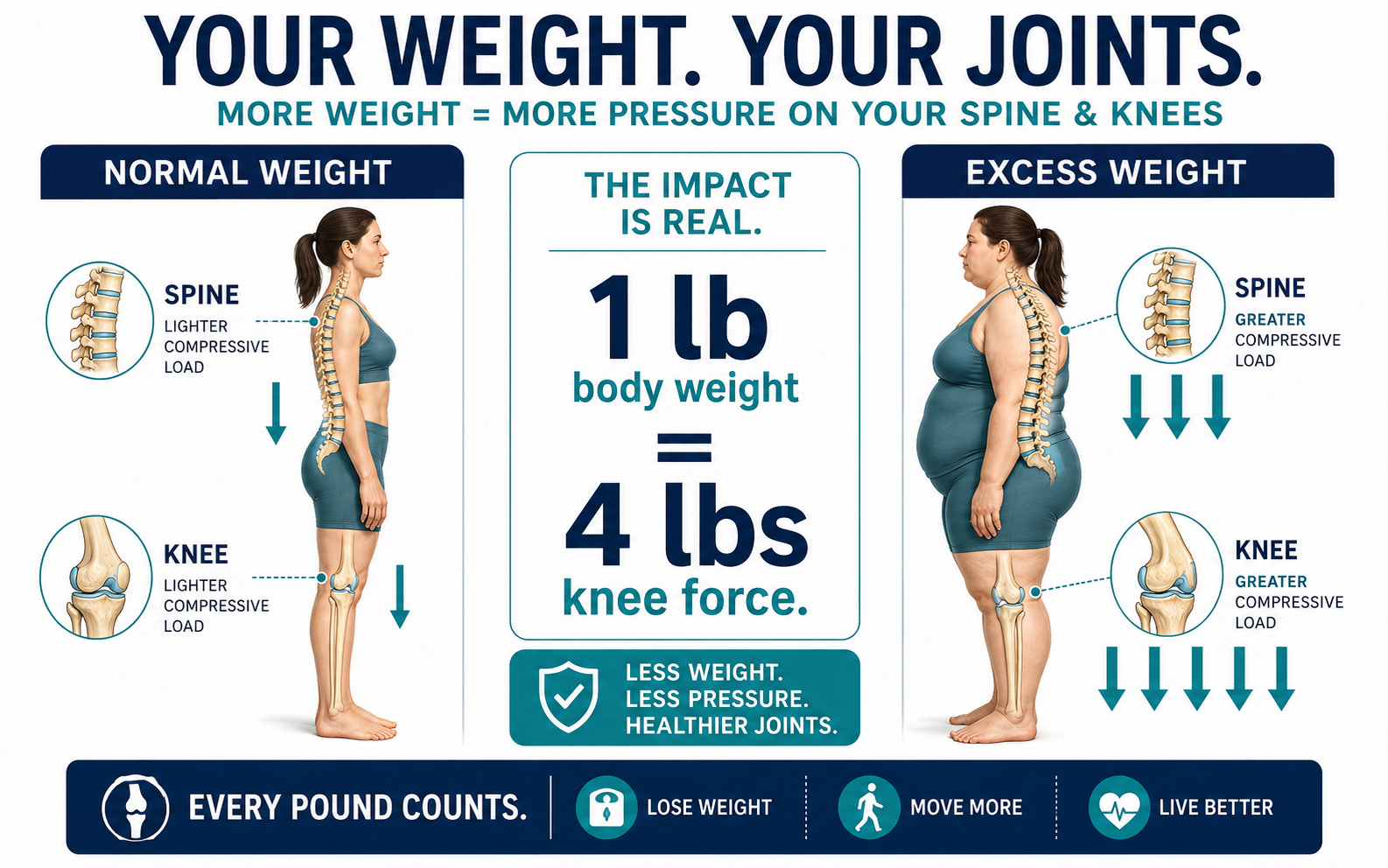
Here is a number that changes how people think about this: every extra pound of body weight puts roughly four pounds of additional compressive force on your knees. On the lumbar spine, the multiplier is even higher depending on posture and movement patterns.
Someone carrying 50 extra pounds is not dealing with 50 pounds of excess load. They are dealing with 150 to 200 pounds of additional force through their joints with every single step.
Over years, that creates predictable patterns: disc compression and degeneration, altered gait mechanics, and compensatory postural shifts that ripple up and down the kinetic chain. The hips shift. The pelvis tilts. The lumbar curve exaggerates. The thoracic spine rounds forward to counterbalance. And then that person wonders why they have chronic low back pain, hip pain, knee pain, and shoulder problems. They assume it is just aging. It is not just aging. It is physics.
Here is what surprises most people: when the weight comes off, the structural adaptations do not automatically reverse. The spine does not reset. The muscles that learned to compensate keep firing in those patterns. The joints that were compressed do not magically spring back into alignment. That is exactly where chiropractic becomes critical — not just before weight loss, but during and after it.
When Pain Is the Invisible Wall: A Patient Story
I will call her Maria. She came in about six years ago — mid-forties, about 80 pounds overweight, and had been in chronic low back and hip pain for close to a decade. She had tried several diets. She had a gym membership she was not using. And she was frustrated in a way I recognized immediately.
She was not lazy. She was stuck.
The pain had become a barrier she had unconsciously built her whole life around. She had stopped walking for exercise because it hurt. She was sitting more, which made the metabolic picture worse. She was not sleeping well because she could not get comfortable, which disrupted her cortisol and appetite hormones. It was a full loop of dysfunction feeding itself.
We focused heavily on her sacroiliac joints and lumbar spine, added soft tissue work, and within six weeks she told me she had walked 30 minutes four days in a row — something she had not done in years. That was the turning point. Movement became possible again, which made consistency possible, which made results possible. She lost 55 pounds over the following year. She still checks in. She calls it the year her life came back.
That story is not unique. I have versions of it from nearly every year of my career. The common thread is always the same: pain was the invisible wall, and chiropractic took the wall down.
The GLP-1 Era: What Rapid Weight Loss Does to Your Structure
This topic matters to me right now because it is directly relevant to what I am seeing in practice and what I am building around natural GLP-1 alternatives like GLP THREE™.
Rapid weight loss — whether from a synthetic GLP-1 injection or a natural metabolic support product — creates a structural transition the body was not designed to handle in a compressed timeline. When someone loses significant weight quickly, the load on their joints changes faster than their supporting muscles, tendons, and spinal alignment can adapt. The result is a real window of vulnerability: new joint instability, new pain patterns showing up in places that never hurt before, and in some cases, accelerated disc issues in people with underlying degeneration they did not know about.
There is also the muscle mass question. Fast weight loss without adequate protein and resistance training can pull lean tissue along with fat. The deep stabilizing muscles of the lumbar spine — the multifidus and transverse abdominis — are not aesthetic muscles. They are structural support. When they atrophy, the spine is exposed.
What I tell those patients: the weight loss is a tremendous win. Do not let anyone take that away from you. But you need a structural partner during that transition. Someone monitoring your alignment, making sure your nervous system is keeping pace with your body's transformation, and catching compensatory patterns before they become injuries. That conversation is not happening nearly enough.
The Vagus Nerve: The Neurological Argument Most People Miss
This is where it gets interesting — and where the gap between what the science supports and what the public knows is widest.
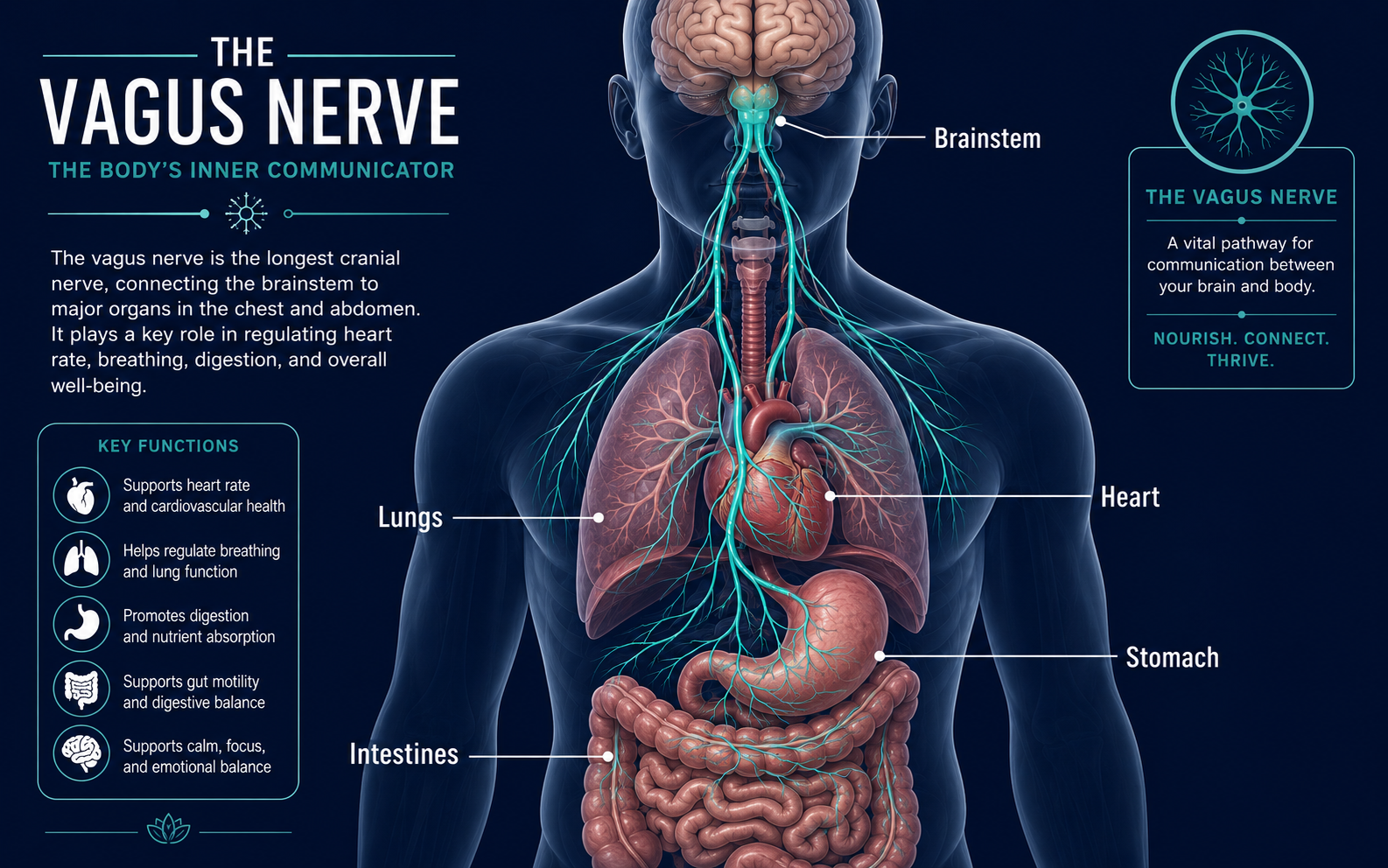
The vagus nerve is the longest cranial nerve in the body. It runs from the brainstem through the thoracic cavity down into the abdomen, regulating digestion, hunger signaling, inflammatory response, heart rate, and a significant portion of your metabolic function. It is the primary pathway for gut-brain communication — the channel through which your intestinal environment talks to your brain about satiety, energy availability, and mood.
Spinal subluxations — particularly in the cervical and upper thoracic regions — can directly impair vagal tone. When vagal tone is compromised, gut motility slows, hunger and fullness signals are disrupted, systemic inflammation rises, and the nervous system gets stuck in sympathetic overdrive — the fight-or-flight state.
And a body stuck in chronic sympathetic dominance hoards fat. It is a survival mechanism that becomes a metabolic trap.
Chiropractic adjustments have been shown to improve vagal tone and shift the nervous system toward parasympathetic activity — the rest-and-digest state where healing, digestion, and healthy metabolic function actually happen. That is not a marketing claim. That is neurophysiology.
Most weight loss programs never touch this. They hand you a meal plan and a workout schedule and wonder why your body is not cooperating. The nervous system has veto power over everything else. If you are not addressing it, you are leaving results on the table.
When Should You Start? The Timing Question
Before. Without question.
Starting chiropractic care before you begin the active weight loss phase removes structural barriers to movement before you try to exercise. It begins optimizing nervous system function so your metabolism, digestion, and hormonal signaling are working for you instead of against you. And it establishes a baseline — so your chiropractor knows what your spine looks like before the weight comes off and can track structural changes as they happen.
That said, I never turn someone away because they already started. If you are mid-journey, get in now. If you have already hit your goal weight and still feel stuck or still hurt, get in now. The best time to start is always the time you are actually willing to do it.
But ideally? Before. Set the foundation before you start building.
Who Needs It Most
Everyone doing serious weight loss work benefits from chiropractic care. But if I had to identify the people for whom it is not optional, this is that group.
People who have been significantly overweight for years have spines that have been under chronic mechanical stress long enough that structural adaptation has already occurred. The body does not just undo that on its own. Obesity-related spinal changes are well documented in the clinical literature and do not reverse automatically with weight loss.
Anyone over 40 faces different stakes. Disc hydration, joint elasticity, and nervous system adaptive capacity all decline with age. They need more structural support through the transition, not less.
Anyone with a history of injury — car accidents, falls, old sports injuries, prior surgeries — should expect that old compensation patterns get reactivated under load change. I have seen patients who thought an old injury was fully resolved suddenly have it resurface when their body mechanics shifted during weight loss.
Anyone returning to exercise after a long sedentary period is asking their spine to perform under load again without first clearing whether it is ready to do so. Jumping into workouts with a compromised spine is how people get hurt and quit. And anyone using a GLP-1 or natural metabolic support product for rapid weight loss carries the same structural risk — the faster the change, the more the body needs guidance through it.
The Real Reason People Quit Their Workout Routines
Consistency is the single most important variable in any weight loss program. Not the perfect workout — the one you can actually show up to repeatedly over months and years.
And the number one killer of exercise consistency is not motivation. It is pain.
I have had patients come in who had tried and failed to start an exercise routine three, four, five times. They would get two weeks in, something would flare up — a knee, a hip, their low back — and they would stop. They would blame themselves. And the real issue was structural. The foundation was not ready to support what they were asking it to do.
When the spine is aligned, when the nervous system is out of stress mode, when the joints are moving the way they are designed to move — the body handles physical demand in a completely different way. I have watched people go from barely able to walk a block to running 5Ks. Not because they suddenly found willpower. Because we removed the barriers that were making movement painful and unsustainable.
What I Tell Skeptics
I love the patient who thinks chiropractic is only for back pain. That conversation is one of my favorites.
I usually say: "I get it. That is what most people think — and honestly, that is partially our profession's fault for not communicating better. But let me ask you something: do you think your spine is only connected to your back?"
And then I let that land.
Your spine houses and protects your spinal cord. Your spinal cord is the primary communication highway between your brain and every system in your body — your heart, your lungs, your digestive tract, your immune system, your endocrine system. When there is interference in that highway, you do not just get back pain. You get a body that is not communicating cleanly with itself.
Chiropractic is not back pain care. Chiropractic is nervous system care. The back pain is often just the symptom that finally gets someone through the door.
For someone trying to lose weight, that matters in specific, measurable ways. Better nerve supply to the gut means better digestion and nutrient absorption. Better vagal tone means better hunger and satiety signaling. Less systemic inflammation means better hormonal function. A spine that moves correctly means you can actually exercise without breaking down.
I have never had that conversation with a skeptic who did not at least reconsider.
What Optimal Health Actually Looks Like

I lost family members to chronic disease. People I loved who were not old, who died because the medical system treated their symptoms and never addressed the root. That is personal for me. It is why I do this work, and why I am not content just adjusting spines and sending people home.
Optimal health is not the absence of disease. It is the full expression of what your body is capable of.
Weight loss and chiropractic care belong in the same conversation because they are both working toward the same thing: a body that functions the way it was designed to function. When someone is losing weight, they are in the middle of one of the most significant biological transitions a human body can go through. The load on their structure is changing. Their hormone levels are shifting. Their gut microbiome is rebalancing. Their relationship with movement and energy is being rewritten.
That transition deserves support from every angle — nutrition, movement, metabolic health, and structural integrity. A chiropractor who understands metabolic health is not a bonus. They are a missing piece.
What does it actually look like when both are working together? It looks like someone who woke up one day and realized they are not just lighter. They are different. They move differently. They think more clearly. They sleep better. They hurt less. They have energy they forgot they were capable of having.
That is what I am working toward with every patient. Not a number on a scale. A life that actually feels like living.
Ready to Add This Missing Piece to Your Weight Loss Journey?
If you are in the Henderson or Las Vegas area and you are serious about making your weight loss stick — not just the number on the scale, but how you actually feel and function — I would like to talk.
Optimal Health Members Henderson, NV. Visit https://optimalhealthmembers.com/