Can You Lose Weight Just From a More Active Job?
You are on your feet ten hours a day. Your watch says you hit twelve thousand steps before lunch. You come home sore, tired, and convinced your job is basically your workout. So why will the scale not move?
I hear this every week in my office. People with genuinely active jobs, nurses, warehouse crews, servers, construction guys, who are working harder than most gym members ever will, and still fighting their weight. They are not lazy and they are not imagining it. The truth about active jobs and weight loss is more interesting than a simple yes or no, and once you understand it, you finally know which lever to pull.
Quick Answer: A more active job can help, but rarely on its own. Moving from a desk to a job on your feet may take off a few pounds, and mostly it helps you avoid gaining. Real, lasting fat loss still comes from nutrition, strength training, good sleep, and, when the metabolism needs it, medical support.
Key Takeaways
An active job raises your daily background calorie burn, known as non-exercise activity thermogenesis or NEAT, which is a real advantage over sitting all day.
Your body quietly compensates for extra movement, so total daily energy burn rises far less than simple math predicts.
There is a documented physical activity paradox, where hard occupational activity does not deliver the same health payoff as intentional exercise.
You cannot out-move a poor diet, and poor sleep drives up appetite and cravings no matter how many steps you take.
Strength training builds muscle and improves insulin sensitivity in a way an active job never will.
Can a More Active Job Actually Move the Scale?
Honestly, both things are true. A more active job can tip the scale in your favor, and I have watched people drop ten or fifteen pounds after leaving a desk role for something on their feet all day. But meaningful, lasting weight loss from job activity alone is rare. I have seen far more people stay exactly the same, or even gain, while logging serious steps every shift.
Movement is a piece of the puzzle. It is almost never the whole puzzle. When someone tells me their job is their exercise, my very next question is about what they eat and how they sleep, because that is usually where the real story lives.
What NEAT Is and Why Your Job Raises It
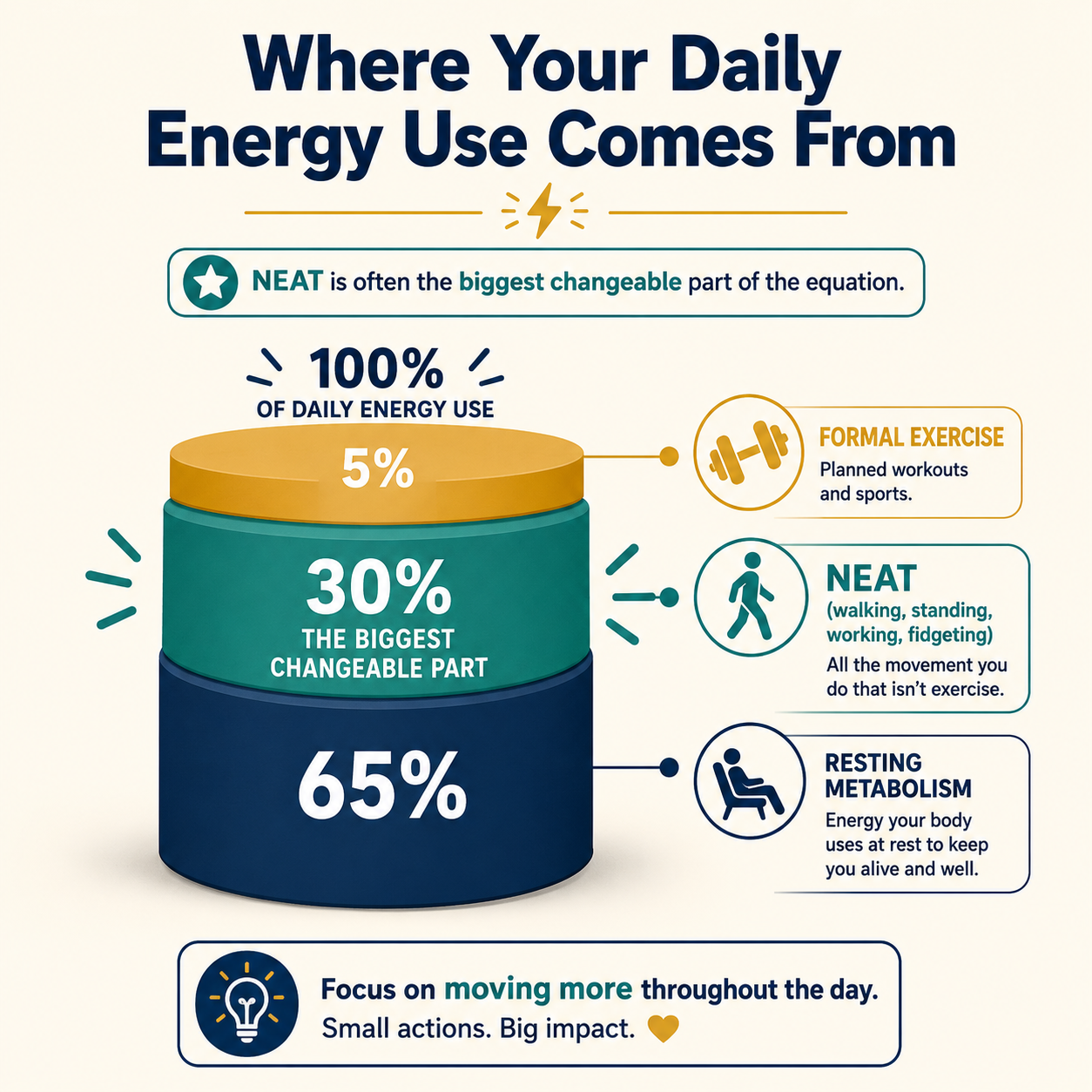
NEAT stands for non-exercise activity thermogenesis, which is a technical way of saying all the calories you burn just living your life that are not formal exercise. Walking to your car, carrying groceries, fidgeting, standing, taking the stairs, and yes, doing a physical job.
NEAT is real, and it matters. For some people it accounts for a few hundred extra calories a day, and over time that adds up. An active job raises your NEAT floor, so you start each day burning more than someone sitting at a desk. That is a genuine advantage and worth protecting. The catch is that the body is very good at quietly clawing those calories back, and most people never realize it is happening.
Why Nurses, Warehouse Crews, and Servers Still Struggle
This is the part that frustrates people, and I understand it. They are exhausted, sore, on their feet all day, and the scale will not budge. A few things are going on at once.
First, the body adapts. When you move a lot at work, you often move less off the clock without deciding to. You come home, you sit, you are wiped out, and your total daily movement is lower than you think. Second, hard physical jobs are stressful, and chronic stress tends to push appetite up and drive cravings for quick, calorie-dense food while wrecking sleep, which makes weight harder to manage. Third, and this is the big one, a tough shift makes you hungry, and a lot of us reward a hard day with food that undoes everything we burned. I have had construction guys who could not understand it until we actually tracked what they were eating and how they were sleeping.
A Patient Who Was Sure Her Job Was Her Workout
I had a woman in her forties, a floor nurse, who came in about back pain but told me she could not lose weight no matter what she did. She was certain her job counted as exercise, and to be fair, she was logging real steps.
When we looked closer, a few things showed up. Her sleep was wrecked from rotating shifts. She was eating most of her calories late at night after work. And her blood work pointed toward insulin resistance. Her active job was not the problem, and it was not the solution either. Once we fixed the sleep pattern, changed the timing and quality of her food, and supported her metabolism, the weight finally started coming off. The job never changed. Everything around it did. That is almost always how it goes.

How Your Body Quietly Cancels Out the Extra Movement
This is one of the most humbling things in metabolism science. Researchers call it metabolic compensation, or the constrained energy model. The idea is that when you increase activity, your body does not simply add those calories to your daily burn one for one. Instead it starts saving energy elsewhere, dialing down other processes, and quietly reducing your movement when you are not paying attention.
In carefully measured studies, total daily energy burn rose by only about a third of what a simple additive model would predict. On top of that, more activity often turns up your appetite. So you burn a few hundred extra calories at work, and your body nudges you to eat them back and move a little less the rest of the day. This is not a character flaw. It is biology doing exactly what it evolved to do, which is protect your energy stores. Understanding that changes how you approach the whole thing.
Occupational Activity Versus Training on Purpose
These are not the same thing, and the research is fairly clear on it. There is even something called the physical activity paradox, where people with physically demanding jobs sometimes show worse cardiovascular outcomes rather than better, likely because of chronic strain, poor recovery, and a lack of the kind of intensity that actually improves metabolic health.
Occupational activity tends to be long, low intensity, repetitive, and stressful, with little recovery. Intentional exercise, especially strength training and short bursts of higher intensity, sends a very different signal to the body. It builds muscle, improves insulin sensitivity, and does not carry the same grinding stress load. So an active job keeps you moving, which is good, but it does not replace the specific benefits of training your body on purpose.
You Cannot Out-Move a Poor Diet
I say this gently, because I know people do not want to hear it. You cannot out-move a poor diet, and an active job does not change that math. Food is where the real leverage sits for weight loss.
I have said for years that you lose weight in the kitchen and you build health in the gym and on my table. An active job burns calories, but it is very easy to eat those back in a few minutes with the wrong foods, especially since your body is already compensating for the extra movement. When patients focus on protein, whole foods, and how their meals are timed, the weight moves. When they lean on the job to save them while eating whatever is convenient, it does not. Movement supports the process. Food drives it.
What I Actually Tell Patients With Active Jobs
First, the good news. You already have a strong NEAT foundation, and that is worth protecting. Then I give a few real steps.
Dial in your nutrition first, especially protein and whole foods, and pay attention to when you eat, not just what. Add intentional strength training two or three times a week, because muscle changes your metabolism and insulin sensitivity in a way an active job never will. Protect your sleep, particularly if you work shifts, because poor sleep drives hunger and cravings and quietly sabotages everything. And do not use a hard shift as permission to eat poorly, which is the trap I see most often. For some people, especially those fighting insulin resistance or stubborn metabolic weight, the body needs more support than lifestyle alone, and that is a real conversation worth having.
When the Real Problem Is Metabolic
This is the heart of it for me. A lot of the people who cannot lose weight despite an active job are not doing anything wrong. Their metabolism is working against them, often because of insulin resistance, hormones, age, and years of the body adapting to survive. For those folks, telling them to just move more is not only unhelpful, it is a little insulting, because they are already moving plenty.
That is exactly why we built the GLP THREE program. It supports the metabolism at the level where the real problem lives, so the effort a person is already putting in finally starts to pay off. When you address the underlying metabolic issue, the active job, the better food, and the strength work all start doing what they are supposed to do.
The One Thing to Remember
An active job is a gift for your health, and you should be grateful for it, but do not expect it to carry your weight loss by itself. Realistically, moving from a sedentary job to an active one might take off a modest amount, maybe a handful of pounds, and mostly it helps you not gain.
Real, lasting fat loss comes from the combination of good food, intentional strength work, solid sleep, and, when the metabolism needs it, the right medical support. If you are working hard and the scale will not budge, you are not broken. You simply have not addressed the right lever yet. There is a real answer, and I would be glad to help you find it.

If you are doing everything right at work and the scale still will not move, let us find the lever that actually matters for your body. You can learn more about our approach at Optimal Health Members, and if stubborn metabolic weight is the real issue, our GLP THREE program is built to support your metabolism so the hard work you are already doing finally pays off. No pressure, just a real conversation about what is going on and what would help.