How to Build a Healthier Workday Without Quitting Your Desk Job
You are not asking me how to win a marathon. You are asking how to get off the floor without your back locking up, how to make it through a workday without that 3pm crash, and how to have something left over for your kids at night instead of collapsing onto the couch. I see you. After nearly thirty years in practice here in the Las Vegas Valley, the person I think about most is the busy parent in their forties who sits all day, takes care of everyone else, and puts their own body dead last on the list. The one who tells me, "I don't have time to fall apart," because they truly don't.
So let me give you something better than another lecture. Let me give you a way to feel better at your desk without quitting the job that pays your bills.
The Complaints That Walk Through My Door Together
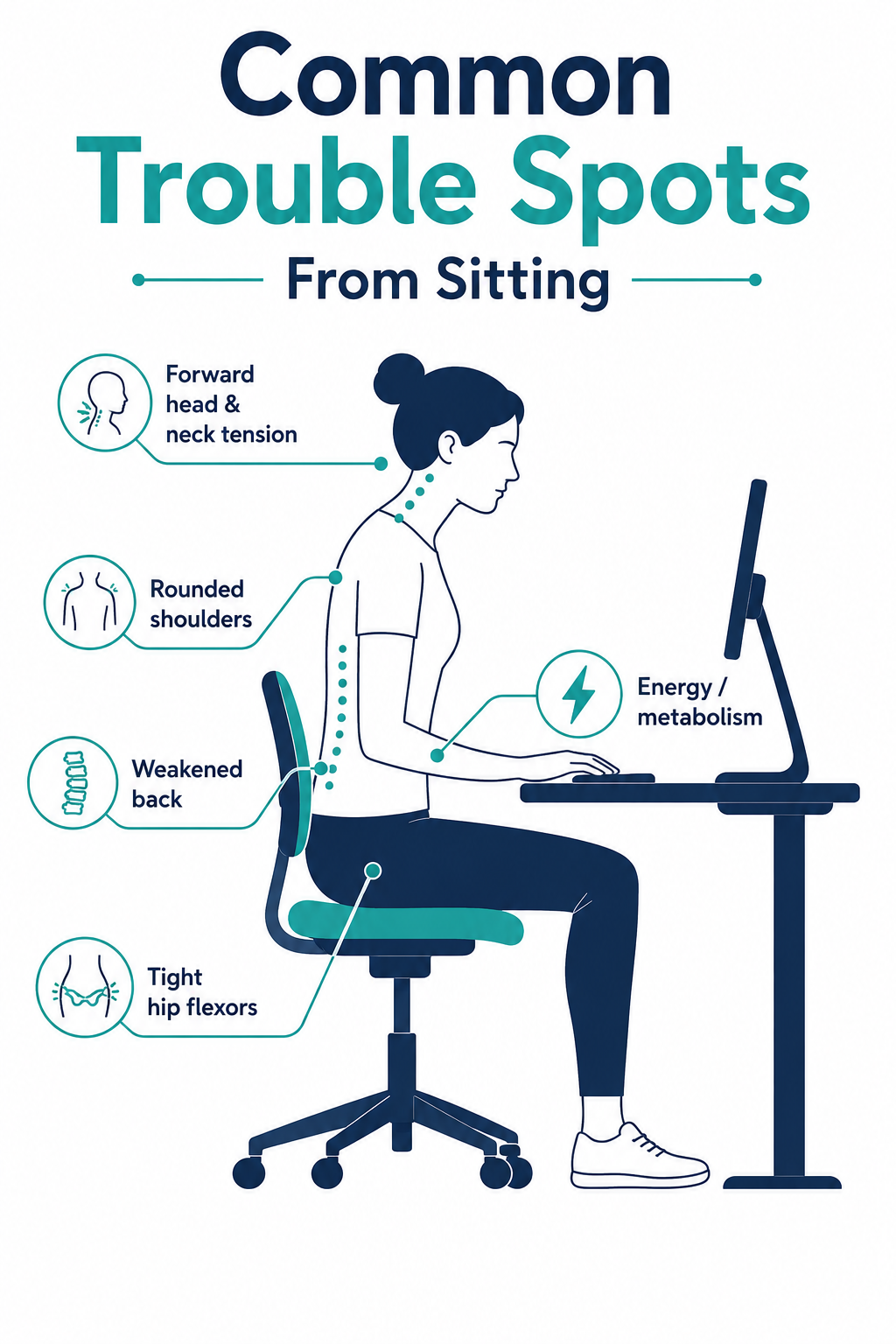
If I am being straight with you, it is almost never one thing. The headline complaint that gets someone in the door is usually low back or neck pain. But once we start talking, the real picture shows up. The tight hips. The shoulders riding up around the ears. The headaches that arrive every afternoon like clockwork. The fatigue. The brain fog. And that slow creep of weight gain they swear they did nothing to cause.
These things travel together, and there is a reason for that. The body does not break in isolated pieces. A desk job slowly hardens the front of the hips, weakens the back chain, jams the neck forward over a screen, and quiets the metabolism because the body is barely moving for ten hours a day. The pain is just the loudest symptom. The metabolic and energy changes are the quieter and frankly more dangerous part, and the research backs that up. High amounts of sedentary behavior and low levels of physical activity have been linked to heart disease, obesity, blood sugar problems, and even depression, according to Cleveland Clinic. This is why I never treat a desk job as just a back problem. Cleveland Clinic
It Was Never the Chair. It Is the Stillness.
Here is the big misunderstanding I correct every week. People think the problem is the chair, or the posture, or the desk setup. It is not the sitting. It is the stillness.
Your body is built to move, and when it does not, everything downstream suffers: circulation, metabolism, joint health, even your mood and focus. You could buy the most expensive ergonomic chair on the planet and sit in it perfectly for nine hours, and you would still be in trouble, because the issue was never the angle of your spine. The issue is that you stopped moving. The best posture is always your next posture.
And this is where it gets serious for me personally. I lost family members to heart disease and metabolic conditions, so I do not treat this casually. The science does not either. A large NIH review found that once daily sitting climbs past about seven hours, each additional hour of sitting is associated with roughly a 5 percent rise in all-cause mortality. The World Health Organization's own guidelines note that adults who sit for more than eight hours a day carry a higher risk of cardiovascular death, an effect that is blunted mainly in the most physically active people. Sitting still for a living is one of the quietest health risks of our generation, and most people have no idea it is even happening to them. PubMed CentralNCBI
My Honest Take on Standing Desks
Useful, but oversold. A standing desk is a tool, not a cure.
I have watched plenty of patients buy one, feel great about the purchase, and then just stand still for eight hours instead of sitting still for eight hours. Now they have foot pain and low back fatigue and they cannot figure out why they do not feel better. Standing in one spot is still a static position. In fact, when researchers compared standing breaks to walking breaks, the short walking breaks produced real improvements in blood sugar, insulin, and blood pressure, while the standing breaks did not improve those markers at all. nih
So here is my honest take. Get a standing desk if it nudges you to move more. If you treat it as a movement trigger, it earns its keep. If you treat it as the solution itself, you wasted your money. The win was never standing. The win is movement.
Three Small Habits I Recommend Every Single Week
These are simple on purpose. The fancy stuff does not get done.
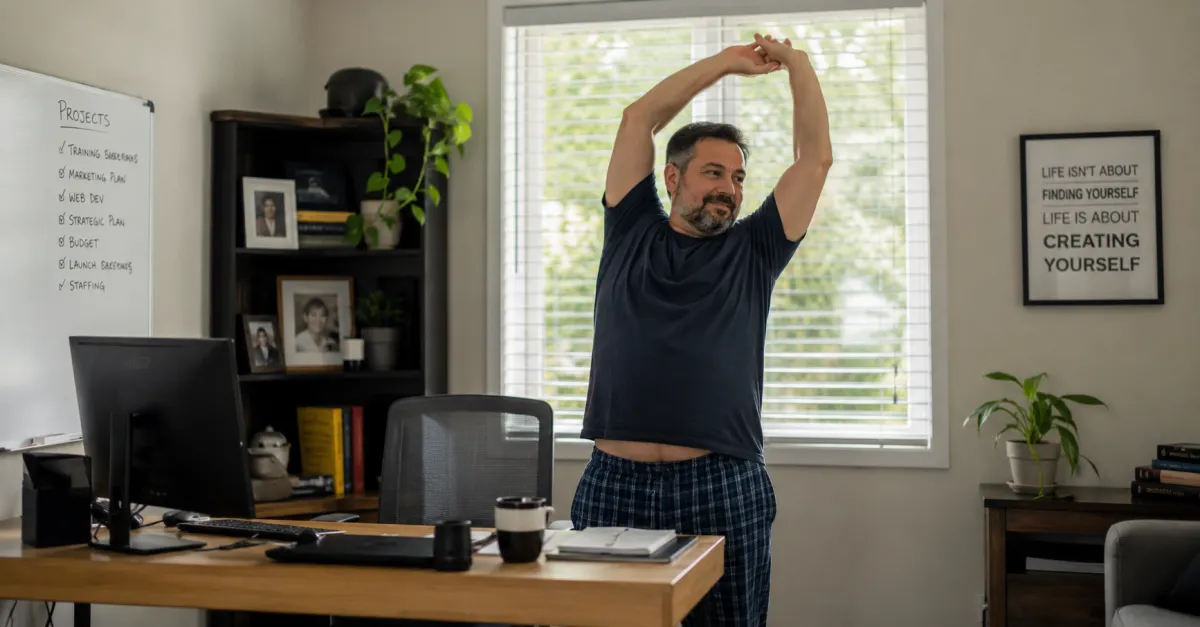
Move every hour, even if it is just two minutes. Stand up, walk to get water, roll your shoulders, do ten of anything. I would rather you move for two minutes twelve times a day than crush one workout and sit like a statue the rest of the time. Frequency beats intensity here, and the metabolism research is remarkably specific about it. In one controlled trial, interrupting sitting with brief two-minute bouts of light or moderate walking measurably lowered post-meal glucose and insulin in overweight adults. Two minutes. That is the whole intervention. PubMed
Start the day with protein, not just coffee and a carb. When you anchor your morning with real protein, you stabilize your energy and you blunt that afternoon crash. A randomized study found that a protein-rich breakfast raised satiety through the morning and even improved concentration compared with a carbohydrate breakfast or skipping it. This one is metabolic, and it matters more than people realize. PubMed
Hydrate on purpose. Most of my patients walk in mildly dehydrated and have no idea. Research on even mild dehydration shows it can trigger fatigue, headaches, and difficulty concentrating, which is the exact cluster of symptoms people come to me for. A water bottle on your desk that you actually refill is one of the cheapest health upgrades there is. Journal of Nutrition
He Came In for His Back and Left With His Life Back
I had a patient, a man in his late forties, who came in for low back pain that had been dragging on for months. Classic desk worker. Long hours, no breaks, living on coffee. He assumed he needed his back "fixed," like it was a part that had broken.
The hands-on care helped him get out of the acute pain, no question. But the real change came from the small stuff. We set a simple timer on his phone so he moved every hour. We swapped his muffin for actual protein at breakfast. We got him hydrating. Within a few weeks, the back pain was not the headline anymore. What surprised him was everything else. His afternoon energy came back. The fog lifted. He told me he had dropped some weight without trying, which made complete sense, because we had quietly fixed the inputs that were working against him.
He came in for his back and left with his life back a little. That is the part of this work I love. The back pain was just the door.

The Too Busy Excuse, Said With Love
I hear "I am too busy to exercise during the workday" every single week, and I will gently call the bluff. You are not too busy to exercise. You are too busy for the version of exercise you are picturing. The gym. The forty-five minutes. The change of clothes. The shower after. Forget all of that. I am not asking you to train. I am asking you to move.
You have time to stand up while you are on a phone call. You have time to take the stairs. You have time to do twenty squats while your coffee brews, or to walk one lap around the building before you sit back down. Two minutes an hour adds up to about sixteen minutes across a workday, and it will change how you feel. The "too busy" excuse assumes movement has to be big. It does not. It has to be frequent.
And here is the hard truth I say with love: you will find the time for your body now, or you will find it later sitting in a doctor's office. One of those is a lot cheaper.
Where Chiropractic Care Fits In
If I had to lead with one word for what chiropractic care offers a desk worker, it is prevention. Most people come to me reactively, after the pain has already set in, and I am always glad to help them out of that hole. But the real value is keeping the body moving well before it breaks down. We restore mobility, we keep the spine and joints functioning the way they are supposed to, we support healthy nervous system function, and we catch the small dysfunctions before they grow into the big, expensive ones.
I see chiropractic as one piece of a bigger lifestyle, not the whole answer. I am never going to tell you that an adjustment alone fixes a problem you are creating eight hours a day at a desk. My job is to help you move better and feel better, and then partner with you on the habits that keep you there. That combination of care plus lifestyle is where people actually get well and stay well, and it is the whole philosophy behind how we work at Optimal Health Members here in Henderson.
The Bad Advice I Want You to Stop Believing
A few of these really get under my skin.
"Just sit up straight." Sitting up straight and frozen is still frozen. Good posture held rigidly for hours is still a static position your body hates. The answer is not a better posture. It is more movement.
"Pain is normal with age." This might be the most damaging one, because it gets people to give up. Stiffness and pain are common as we age, sure, but common is not the same as normal or inevitable. I have watched people in their sixties and seventies move beautifully because they kept moving. Do not let anyone, including a doctor, tell you to simply accept it.
"Buy an expensive chair." No chair moves your body for you.
"Stretch once and you are fine." Your body responds to consistency, not to a single big effort. One stretch is like brushing your teeth once and expecting it to last the month.
If You Remember Nothing Else, Remember This
Motion is the medicine.
Your body is designed to move, and the single most powerful thing you can do at a desk job is refuse to stay still. Move a little, often. Do not wait for the workout, do not wait for the weekend, and do not wait until something hurts. Everything good downstream, the energy, the focus, the lower pain, the steadier metabolism, flows from that one decision. And the best part is that it is free, and you can start with your very next hour.
If your desk job has left you stiff, tired, foggy, or quietly gaining weight, that is not something you have to just live with. If you are local to Henderson or Las Vegas, I would be glad to help you move and feel better in the office at Optimal Health Members. And if the weight gain that comes with sedentary work is the part that worries you most, our doctor-supervised metabolic program through GLP THREE is available both here in the Valley and online for patients anywhere in the country. Either way, the first move is the same. Stand up. The rest follows.